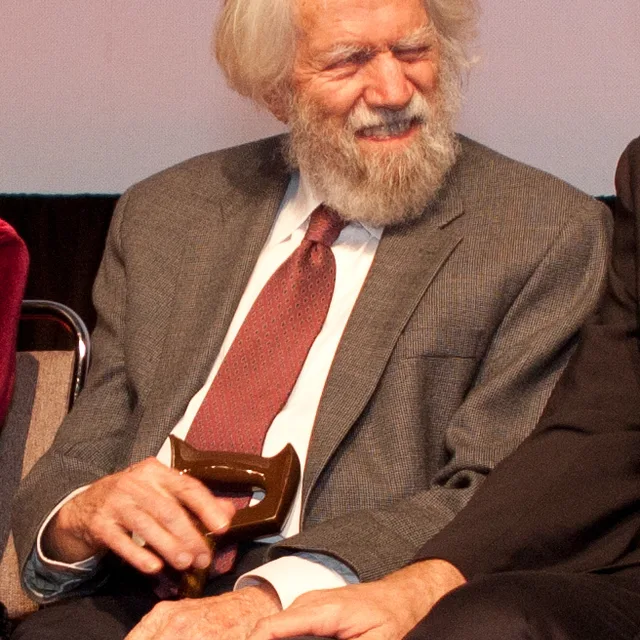

Alexander "Sasha" Shulgin
Alexander 'Sasha' Shulgin (1925-2014) was an American medicinal chemist who synthesized and self-tested hundreds of psychoactive phenethylamines and tryptamines, publishing the results with his wife Ann in PiHKAL (1991) and TiHKAL (1997). At Dow Chemical he created DOM and DOET; independently he originated most of the 2C series, including 2C-B. He did not invent MDMA — Merck's Anton Köllisch first synthesized it in 1912 — but Shulgin re-synthesized it, and in 1976 introduced it to the psychologist Leo Zeff, through whom it spread into psychotherapeutic use. His books and structure-activity work remain standard references for this chemical space.
Compounds
41 credited across 3 classes · 39 with a page here
- Methylenedioxyphenethylamines
- MMDA C11H15NO3 discovered its activity, 1962 source
NOT his first synthesis: Gordon Alles made and studied it at Edgewood Arsenal in the mid-1950s. Shulgin synthesized it independently in 1962, discovered the psychoactivity the same year, and published in 1964. PiHKAL #132.
- MDMA C11H15NO2 popularised it, 1976 source
NOT his synthesis: first made by Anton Köllisch at Merck in 1912 (patented 1913). Shulgin re-synthesized it, developed a new synthesis route, and in 1976 introduced it to the Oakland psychologist Leo Zeff, through whom it spread to therapists; he co-published the first human pharmacology with David Nichols in 1978.
- MDEA C12H17NO2 popularised it, 1991 source
Original synthesizer undocumented; Shulgin's 1967 notebook records a colleague's (negative) trial and his PiHKAL entry (#106, 'Eve') characterized it publicly. His exact originating role could not be confirmed, hence 'popularised' at low confidence.
- MDOH C10H13NO3 discovered its activity, 1991 source
Human activity is documented by Shulgin in PiHKAL (#114), but the original synthesizer is not clearly documented and the first-human-report claim could not be confirmed from fetched sources; it may trace to Braun, Shulgin and Braun's 1980 study of N-substituted MDA analogs.
- Psychedelic Phenethylamines
- TMA (3,4,5-Trimethoxyamphetamine) C12H19NO3 popularised it, 1961 source
NOT his synthesis or discovery: Gordon Alles synthesized TMA around 1937 and its psychedelic effects were first described in 1955 (Peretz, Smythies, Gibson). Shulgin published early psychotomimetic research on it in 1961 and covered it in PiHKAL (#157); it launched his mescaline-analog programme.
- TMA-2 C12H19NO3 discovered its activity, 1962 source
First synthesized by Viktor Bruckner in 1933; Shulgin discovered the hallucinogenic activity in 1962 and published in 1964. PiHKAL #158.
- DOM C12H19NO2 first synthesis, 1963 source
Synthesized at Dow Chemical in 1963. Appeared on the street as 'STP' in 1967. PiHKAL #68.
- TMA-6 C12H19NO3 discovered its activity, 1964 source
First synthesized by Benington, Morin and Clark in 1954; Shulgin found the psychedelic activity in 1964, published 1969, and coined the name TMA-6 in 1970. PiHKAL #162.
- DOET C13H21NO2 first synthesis, 1966 source
Developed at Dow after DOM; Shulgin and Dow filed the patent in 1966 (published 1970). PiHKAL #66.
- DOB C11H16BrNO2 first synthesis, 1967 source
First described in the literature by Shulgin, Claudio Naranjo and a colleague in 1971. PiHKAL #62.
- Ariadne (4C-D) first synthesis, 1968 source
Also known as BL-3912. Synthesized 1968, psychoactivity found 1969; Bristol Laboratories ran clinical trials from 1974 (alertness in the elderly, Parkinson's, psychosis) but never marketed it. PiHKAL #8.
- MEM (2,5-Dimethoxy-4-ethoxyamphetamine) C13H21NO3 first synthesis, 1968 source
First synthesized by Shulgin and described by him in the literature by 1968. PiHKAL #122.
- DOPR C14H23NO2 first synthesis, 1970 source
First described in the literature by Shulgin in 1970; the original synthesizer is not explicitly named in sources, but no earlier claimant exists. PiHKAL #71.
- 2C-B C10H14BrNO2 first synthesis, 1974 source
Synthesized 1974; psychedelic effects found in self-experiments 1974-75. PiHKAL #20.
- 2C-D C11H17NO2 discovered its activity, 1975 source
NOT his first synthesis: Beng T. Ho and colleagues published it in 1970. Shulgin independently made it in 1974, found the human activity in 1974-75 and published in 1975. PiHKAL #23.
- Aleph first synthesis, 1975 source
4-methylthio DOx compound ('DOT'). First tested by Shulgin in 1975 and first described by Shulgin and Nichols from 1976, with human effects published 1978; the sources describe him as the primary researcher without an explicit first-synthesis sentence. PiHKAL #3.
- 2C-T C11H17NO2S first synthesis, 1976 source
First described by Shulgin and David E. Nichols in 1976. PiHKAL #39.
- 2C-E C12H19NO2 first synthesis, 1977 source
One of his 'magical half-dozen'. PiHKAL #24.
- 2C-I C10H14INO2 first synthesis, 1977 source
First described by Shulgin and colleagues in 1977; human effects described by him in 1978. PiHKAL #33.
- 2C-T-2 C12H19NO2S first synthesis, 1981 source
Synthesized and tested by Shulgin in 1981; first literature description by Myron Stolaroff in 1990. PiHKAL #40.
- Methallylescaline C14H21NO3 first synthesis, 1981 source
First described in the literature by Shulgin in PiHKAL (entry 'MAL', #99); he first tried it in 1981 and noted its hallucinogenic effects in 1982. No earlier synthesizer is documented.
- 2C-T-7 C13H21NO2S first synthesis, 1986 source
Developed by Shulgin with Peyton Jacob III; PiHKAL (#43) commentary dates his first trials to 1986. First literature description by Myron Stolaroff, 1990.
- 2C-C C10H14ClNO2 discovered its activity, 1991 source
NOT his synthesis: first described by Alice Cheng and Neal Castagnoli in 1984. Human activity documented by Shulgin in PiHKAL (#22); year given is the PiHKAL publication.
- 2C-G C12H19NO2 first synthesis, 1991 source
Shulgin's compound, first published in PiHKAL (#27); year given is the publication year, the synthesis is earlier. Sometimes misattributed to Daniel Trachsel — it is Shulgin's.
- 2C-N C10H14N2O4 first synthesis, 1991 source
Wikipedia credits Shulgin with first synthesis; first published in PiHKAL (#34), so the year given is the publication year.
- 2C-P C13H21NO2 first synthesis, 1991 source
First described in the literature by Shulgin in PiHKAL (#36); no earlier synthesizer is documented. Year given is the publication year.
- 2C-T-21 C12H18FNO2S first synthesis, 1991 source
First described by Shulgin and colleagues in a 1991 journal article, then in PiHKAL (#49). Year given is the publication year.
- 2C-T-4 C13H21NO2S first synthesis, 1991 source
First described by Shulgin and colleagues in a 1991 journal article, then in PiHKAL (#41). Part of the sulfur-substituted 2C-T series he developed with Peyton Jacob III; year given is the publication year.
- Allylescaline C13H19NO3 popularised it, 1991 source
NOT his synthesis: first synthesized and studied by Otakar Leminger in 1972. Shulgin later synthesized it and documented it in PiHKAL (entry 'AL', #2).
- DOC C11H16ClNO2 discovered its activity, 1991 source
NOT his synthesis: first described by Coutts and Malicky in 1973. Human activity documented by Shulgin in PiHKAL (#64); year given is the PiHKAL publication.
- DOI C11H16INO2 discovered its activity, 1991 source
NOT his synthesis: first described by Ronald Coutts and Jerry Malicky in 1973. Shulgin's PiHKAL entry (#67) is the source of the human dosage and activity data; year given is the PiHKAL publication.
- Escaline C12H19NO3 popularised it, 1991 source
NOT his synthesis: first described by George S. Grace in 1934, later made by Benington (1954), Leminger (1972) and Nichols (1977). Shulgin's PiHKAL entry (#72) supplies the human dosage data the field relies on.
- Mescaline C11H17NO3 popularised it, 1991 source
NOT his in any originating sense: isolated from peyote in the 1890s (Heffter) and first synthesized by Ernst Späth in 1919. It was Shulgin's reference compound and one of his 'magical half-dozen'; PiHKAL (#96) is a standard modern source on its human pharmacology.
- Proscaline C13H21NO3 popularised it, 1991 source
NOT his synthesis: first synthesized and studied by Otakar Leminger in 1972. Shulgin later made it independently and documented it in PiHKAL (#140).
- Tryptamines
- DiPT C16H24N2 discovered its activity, 1974 source
NOT his first synthesis: described by R. B. Barlow and colleagues by 1959. Shulgin's human findings (the unusual auditory distortions) date to 1974, disclosed 1976. TiHKAL #4.
- 5-MeO-DiPT C17H26N2O first synthesis, 1975 source
'Foxy'. Shulgin tested it from 1975 and first described it with Michael Carter in 1980; no earlier synthesizer is documented. TiHKAL #37.
- 5-MeO-MiPT C15H22N2O first synthesis, 1985 source
'Moxy'. First described by Shulgin, David Repke and colleagues in 1985; the specific synthesizer within that collaboration is not singled out. TiHKAL #40.
- 4-HO-DiPT C16H24N2O discovered its activity, 1997 source
NOT his synthesis: first described by David Repke and colleagues in 1977. The human effects were first described by Shulgin in TiHKAL (#17); year given is the publication year.
- 4-HO-DPT C16H24N2O popularised it, 1997 source
NOT his synthesis: first described by David Repke and colleagues in 1977. Shulgin's TiHKAL entry (#20) is the main public documentation.
- MiPT C14H20N2 popularised it, 1997 source
NOT his synthesis: first synthesized and described by David Repke and colleagues in 1981. Shulgin's TiHKAL entry (#47) is why it is generally known.
- 4-HO-MET C13H18N2O first synthesis source
First synthesized and its activity discovered by Shulgin in the 1970s (exact year not documented); first literature description by David Repke and colleagues by 1981. TiHKAL #21.
Books
- PiHKAL: A Chemical Love Story 1991 · by them
With Ann Shulgin. Part biography, part catalogue of 179 phenethylamines; the chemistry half is hosted free on Erowid.
- TiHKAL: The Continuation 1997 · by them
With Ann Shulgin. Companion volume covering 55 tryptamines; chemistry half hosted free on Erowid.
- The Shulgin Index, Volume One: Psychedelic Phenethylamines and Related Compounds 2011 · by them
With Tania Manning and Paul F. Daley. Reference monograph, not a trip-report book.