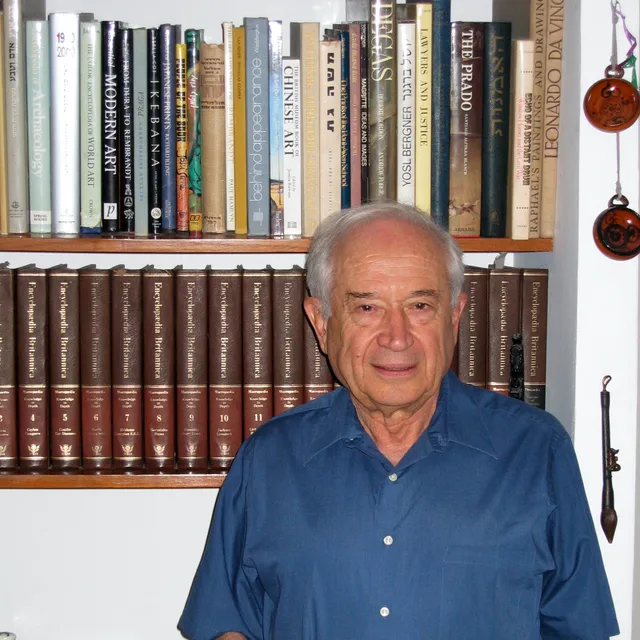

Raphael Mechoulam
Raphael Mechoulam was an Israeli organic chemist who spent his career on the chemistry of cannabis. With Yechiel Gaoni he isolated Δ9-tetrahydrocannabinol and determined its structure in 1964, and the two completed a total synthesis in 1965; the structure of cannabidiol had been settled a year earlier in work with Yuval Shvo. From the late 1980s his laboratory produced the HU series of synthetic cannabinoids, named for the Hebrew University, and it was in his laboratory that the first endogenous cannabinoid receptor ligands were isolated - anandamide in 1992 and 2-arachidonoylglycerol in 1995. He held the Lionel Jacobson Chair in Medicinal Chemistry, served as rector of the Hebrew University, and received the Israel Prize in 2000.
Compounds
20 credited across 3 classes · 11 with a page here
- Endocannabinoids
- Anandamide C22H37NO2 isolated it, 1992 source
The first endogenous cannabinoid receptor ligand, isolated from porcine brain. The hands-on work was done by William Devane and Lumír Hanuš in Mechoulam's laboratory; Mechoulam initiated and directed the project and is the senior (last) author on Devane et al., Science 258:1946-1949. The name comes from the Sanskrit ananda, 'bliss'.
- 2-Arachidonoylglycerol C23H38O4 isolated it, 1995 source
Isolated from canine gut in his laboratory; the bench work is credited to his PhD student Shimon Ben-Shabat, and Mechoulam is first author on Biochem. Pharmacol. 50:83-90. Sugiura's group in Japan reported 2-AG independently in the same year, so this is a co-discovery rather than a sole one.
- Noladin ether C23H40O3 isolated it, 2001 source
An ether-type endocannabinoid isolated from porcine brain, binding CB1 with Ki 21.2 nM. Hanuš, Abu-Lafi, Fride, Breuer, Vogel, Shalev, Kustanovich, Mechoulam, PNAS 98:3662-3665. Mechoulam is senior author.
- N-Arachidonoyl-L-serine isolated it, 2006 source
Isolated from bovine brain. Binds CB1, CB2 and TRPV1 only weakly but produces endothelium-dependent vasodilation, so it is described as endocannabinoid-like rather than a true endocannabinoid. Milman et al., PNAS 103:2428-2433, Mechoulam senior author.
- N-Oleoyl-L-serine isolated it, 2010 source
An endogenous N-acyl amide found in mouse bone that modulates bone remodelling and mass; it does not bind the cannabinoid receptors. Smoum et al., PNAS 107:17710-17715, Mechoulam senior author.
- Phytocannabinoids
- CBD C21H30O2 isolated it, 1963 source
Full structure and stereochemistry of cannabidiol, published as 'Hashish. I. The structure of cannabidiol'. The co-author was Yuval Shvo, NOT Yechiel Gaoni — Gaoni joined for the THC and CBG work that followed. CBD itself had been obtained in impure form by Roger Adams in 1940; Mechoulam and Shvo settled what it actually is.
- CBG (Cannabigerol) C21H32O2 isolated it, 1964 source
Isolated, characterised and synthesised with Yechiel Gaoni (Proc. Chem. Soc. 1964); they also showed it is not psychoactive.
- THC (Δ9-THC) C21H30O2 isolated it, 1964 source
Joint with Yechiel Gaoni: isolation from hashish, structure elucidation and partial synthesis, J. Am. Chem. Soc. 86:1646-1647. The paper carries Gaoni as first author.
- CBDA C22H30O4 isolated it, 1965 source
Cannabidiolic acid, isolated and structurally characterised with Yechiel Gaoni in 'Hashish. IV', Tetrahedron 21:1223-1229, alongside cannabinolic and cannabigerolic acids.
- CBGA (Cannabigerolic acid) isolated it, 1965 source
Isolated and characterised with Yechiel Gaoni in the same 'Hashish. IV' paper. Now understood as the biosynthetic precursor of the other phytocannabinoids.
- CBNA (Cannabinolic acid) isolated it, 1965 source
Third of the three acids in 'Hashish. IV', with Yechiel Gaoni. Note that cannabinol itself is not his — it was isolated in 1896 by Wood, Spivey and Easterfield and its structure settled by Adams and by Todd around 1940.
- THC (Δ9-THC) C21H30O2 first synthesis, 1965 source
Total synthesis of dl-Δ1-THC, joint with Yechiel Gaoni, J. Am. Chem. Soc. 87:3273-3275. Separate act from the 1964 isolation/structure paper, hence the second entry.
- CBC (Cannabichromene) C21H30O2 isolated it, 1966 source
Gaoni & Mechoulam, 'Cannabichromene, a new active principle in hashish', Chem. Commun. 1966, 20-21. Claussen, von Spulak and Korte reported it independently in the same year.
- 11-Hydroxy-Δ8-THC (7-hydroxy-Δ6-THC) discovered its activity, 1970 source
With his doctoral student Zvi Ben-Zvi and Sumner Burstein, identified-through-synthesis the first active THC metabolite, establishing that THC is converted in the body to an active hydroxylated form. The paper concerns the Δ6 (Δ8) series specifically; the equivalent Δ9 metabolite, 11-OH-Δ9-THC, was characterised around the same period by several groups.
- Δ8-THC C21H30O2 discovered its activity, 1995 source
Clinical antiemetic use. With A. Abrahamov and A. Abrahamov, gave Δ8-THC to eight children on chemotherapy across 480 treatments and reported vomiting completely prevented with negligible side effects; the trial began in 1987 and was published in Life Sciences in 1995. He did NOT first make Δ8-THC — Roger Adams's group prepared it in the early 1940s.
- Synthetic Cannabinoids
- Dexanabinol (HU-211) first synthesis, 1988 source
The (+)-enantiomer of HU-210, from the same 1988 Experientia paper. It is essentially inactive at cannabinoid receptors; his group showed in 1989 (Feigenbaum et al., PNAS 86:9584-9587) that it acts instead as a non-competitive NMDA receptor blocker, which is why it was later developed as a neuroprotectant by Pharmos.
- HU-210 C25H38O3 first synthesis, 1988 source
The (-)-enantiomer of the 1,1-dimethylheptyl analogue of 11-hydroxy-Δ8-THC, made from (1R,5S)-myrtenol in his group at the Hebrew University — 'HU' stands for Hebrew University. Reported with Feigenbaum, Lander, Segal, Järbe, Hiltunen and Consroe; 100-800x the potency of THC. The paper's point was that cannabinoid activity is stereospecific.
- HU-308 first synthesis, 1999 source
One of the first highly CB2-selective agonists (Ki 22.7 nM at CB2, >10 µM at CB1), so it is non-psychotropic. Hanuš, Breuer, Tchilibon, Shiloah, Goldenberg, Horowitz, Pertwee, Ross, Mechoulam, Fride, PNAS 96:14228-14233.
- HU-320 first synthesis, 2004 source
A non-psychoactive cannabinoid acid from his group with anti-inflammatory activity in murine collagen-induced arthritis. Sumariwalla, Gallily, Tchilibon, Fride, Mechoulam, Feldmann, Arthritis Rheum. 50:985-998.
- HU-331 first synthesis, 2004 source
A quinone made by oxidation of cannabidiol, investigated as an anticancer agent; later shown to be a topoisomerase II inhibitor. Kogan, Rabinowitz, Levi, Gibson, Sandor, Schlesinger, Mechoulam, J. Med. Chem. 47:3800-3806.
Books
- Marijuana: Chemistry, Pharmacology, Metabolism and Clinical Effects 1973 · by them
Edited volume, Academic Press, New York. Mechoulam is editor and a contributing author.
- Cannabinoids as Therapeutic Agents 1986 · by them
Edited volume, CRC Press. Mechoulam's own chapter is 'The pharmacohistory of Cannabis sativa'.
- Cannabinoids as Therapeutics 2005 · by them
Edited volume, Birkhäuser, in the Milestones in Drug Therapy series.
Reading
- Hebrew University Prof. Raphael Mechoulam, 'Father of Cannabis Research', Dies at 92 · obituary
- Raphael Mechoulam, Israel's 'father of cannabis research,' dies at 92 (JTA) · obituary
- Raphael Mechoulam, the 'father of cannabis research' who discovered THC, has died (NPR) · article
- Tribute to Professor Raphael Mechoulam, The Founder of Cannabinoid and Endocannabinoid Research (Molecules, 2022) · paper
- Devane, Hanuš, … Mechoulam, 'Isolation and structure of a brain constituent that binds to the cannabinoid receptor', Science 1992 (the anandamide paper) · paper
- Gaoni & Mechoulam, 'Isolation, Structure, and Partial Synthesis of an Active Constituent of Hashish', J. Am. Chem. Soc. 1964 · paper