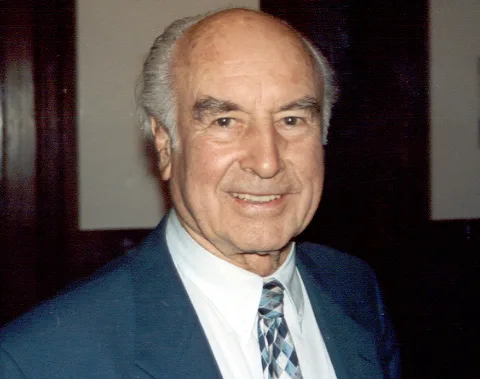

Albert Hofmann
Albert Hofmann joined Sandoz in Basel in 1929 and spent his career on the chemistry of ergot alkaloids, retiring in 1971 as director of the natural products department. From 1935 he worked out practical routes from lysergic acid to ergot-alkaloid derivatives, which produced the obstetric drug methylergometrine and the migraine drug dihydroergotamine, and in 1938 the untested 25th compound in that series, LSD-25; he found its psychoactivity by accident in April 1943. In 1958 his group isolated, named and synthesised psilocybin and psilocin from cultivated Psilocybe mexicana, and in 1960 he and Hans Tscherter showed that the active principle of the Mexican morning-glory ololiuqui was ergine (LSA), a lysergic acid derivative in a flowering plant. He wrote or co-wrote several books on this work, including LSD: My Problem Child and, with the ethnobotanist Richard Evans Schultes, Plants of the Gods; he died in 2008, aged 102.
Compounds
14 credited across 2 classes · 10 with a page here
- Lysergamides
- Ergometrine C19H23N3O2 first synthesis, 1938 source
Read this one carefully: ergometrine is a natural ergot alkaloid and was isolated in 1935 by other groups (Dudley & Moir; Stoll & Burckhardt; Kharasch & Legault; Thompson). Hofmann did NOT discover it. His contribution, begun in 1935 and published as Stoll & Hofmann, Hoppe-Seyler's Z. physiol. Chem. 251, 155-163 (1938), was the first laboratory (partial) synthesis of a natural ergot alkaloid, joining lysergic acid to propanolamine - the route that later gave methylergometrine, dihydroergotamine and LSD.
- LSD C20H25N3O first synthesis, 1938 source
Synthesised 16 November 1938 as the 25th compound in his lysergic acid amide series (hence LSD-25), intended as a circulatory/respiratory stimulant analogous to nikethamide. No psychoactivity was noticed in animal screening and it was shelved for five years. First described in print in Stoll & Hofmann, Helv. Chim. Acta 26, 944-965 (1943).
- Dihydroergotamine first synthesis, 1943 source
Made by catalytic hydrogenation of ergotamine at Sandoz in 1943 and still used for migraine (D.H.E. 45, approved 1946). Wikipedia credits 'Albert Hofmann and Werner Stoll'; the co-worker on the Sandoz ergot chemistry was Arthur Stoll, the department head, while Werner Stoll (his son) was the psychiatrist who ran the first human LSD study in 1947 - treat the given name as unresolved.
- LSD C20H25N3O discovered its activity, 1943 source
On 16 April 1943 he re-made LSD-25, absorbed a trace accidentally and recorded the effects; on 19 April 1943 he deliberately took 250 micrograms, which he expected to be a threshold dose. That deliberate dose, and the bicycle ride home, is the origin of 'Bicycle Day'.
- Methylergometrine C20H25N3O2 first synthesis, 1943 source
Semisynthetic homologue of ergometrine made from lysergic acid and (S)-2-amino-1-butanol by Stoll and Hofmann, Helv. Chim. Acta 26, 944-965 (1943) - the same paper series that first described LSD-25. Marketed by Sandoz as Methergine for postpartum haemorrhage; US approval 1946. It remains on the WHO essential medicines list.
- Dihydroergotoxine (Hydergine, ergoloid mesylates) first synthesis, 1949 source
Hydrogenated mixture of the ergotoxine-group alkaloids, from the same 1943-onwards dihydrogenation work; Sandoz launched it as Hydergine in 1949. English Wikipedia states flatly that 'it was developed by Albert Hofmann for Sandoz' but gives no year or primary citation, so the year here is the launch date rather than a sourced synthesis date.
- LSM-775 C20H23N3O2 first synthesis, 1955 source
Lysergic acid morpholide, one of the systematic amide variations made at Sandoz: Stoll & Hofmann, 'Amide der stereoisomeren Lysergsauren und Dihydro-lysergsauren', Helv. Chim. Acta 38, 421-433 (1955). It reappeared as a designer drug around 2013, which is not Hofmann's doing.
- ALD-52 C22H27N3O2 first synthesis, 1957 source
1-Acetyl-LSD, first made and described by Franz Troxler and Albert Hofmann at Sandoz, Helv. Chim. Acta 40, 1721-1732 (1957). Its later fame comes from 1960s US street supply (the 'Orange Sunshine' era), not from Sandoz.
- LSA (Ergine) C16H17N3O isolated it, 1960 source
Hofmann and Hans Tscherter identified ergine (d-lysergic acid amide) and isoergine as the main alkaloids of ololiuqui, the seeds of the Mexican morning glory Turbina (Rivea) corymbosa, in 1960 - the first lysergic acid derivatives found outside fungi, which was initially disbelieved. Ergine itself was not new: Smith and Timmis obtained it from ergot in 1932. Note the site also carries a separate 'ergine' molecule page for the same compound.
- Bromocriptine C32H40BrN5O5 first synthesis, 1968 source
2-Bromo-alpha-ergocryptine, from Hofmann's Sandoz department; he is a named inventor with Eduard Flueckiger and Franz Troxler on the patents (US 3,752,814, priority 31 May 1968; DE 1926045A1). Secondary sources date the discovery to 1965 with first publication in 1968. Credit is shared - this was a team result, not a solo synthesis, and the pharmacology (prolactin inhibition) was Flueckiger's side.
- Tryptamines
- Psilocin C12H16N2O isolated it, 1958 source
Isolated and named alongside psilocybin from Psilocybe mexicana in 1958; full account in Hofmann, Heim, Brack, Kobel, Frey, Ott, Petrzilka & Troxler, Helv. Chim. Acta 42, 1557-1572 (1959). Hofmann also took mushroom extracts himself to track the active fraction during the isolation.
- Psilocybin C12H17N2O4P isolated it, 1958 source
Isolated and named by Hofmann's Sandoz group from Psilocybe mexicana grown in culture by Roger Heim in Paris; the structure was then confirmed by total synthesis in the same year (Hofmann, Frey, Ott, Petrzilka & Troxler, Experientia 14, 397-399, 1958). He could equally be credited with the first synthesis; isolation is the primary act. Sandoz sold pure psilocybin to researchers as Indocybin.
- CZ-74 (4-HO-DET) first synthesis, 1959 source
4-Hydroxy-N,N-diethyltryptamine, one of the psilocin analogues Hofmann and Franz Troxler made at Sandoz after the mushroom work (Troxler, Seemann & Hofmann, 'Abwandlungsprodukte von Psilocybin und Psilocin', Helv. Chim. Acta 42, 2073-2103, 1959; US patent 3,075,992, 1963). Shorter-acting than psilocin, which is why psycholytic therapists were interested in it.
- Ethocybin (CEY-19) first synthesis, 1959 source
The phosphate ester prodrug of CZ-74, i.e. the diethyl homologue of psilocybin, from the same Sandoz series; Hofmann and Troxler are the named inventors on US patent 3,075,992 (1963). Human effects were reported by Leuner & Baer in 1965.
Books
- LSD: My Problem Child 1979 · by them
Memoir. Published in German as 'LSD - mein Sorgenkind' (Klett-Cotta, 1979); English translation by Jonathan Ott, 1980.
- Plants of the Gods: Origins of Hallucinogenic Use 1979 · by them
With the ethnobotanist Richard Evans Schultes. Revised second edition, 'Plants of the Gods: Their Sacred, Healing and Hallucinogenic Powers' (1992/2001), adds Christian Ratsch as co-author.
- The Road to Eleusis: Unveiling the Secret of the Mysteries 1978 · by them
With R. Gordon Wasson and Carl A. P. Ruck. Argues an ergot-derived preparation lay behind the Eleusinian Mysteries; this is a contested hypothesis, not an established finding.
- The Botany and Chemistry of Hallucinogens 1973 · by them
With Richard Evans Schultes; the technical companion to Plants of the Gods. Second edition 1980.
- Die Mutterkornalkaloide 1964 · by them
German-language monograph on the ergot alkaloids; his technical summary of the Sandoz programme.
- Mystic Chemist: The Life of Albert Hofmann and His Discovery of LSD 2013 · about them
Biography by Dieter Hagenbach and Lucius Werthmuller (Synergetic Press); English edition of the 2011 German original.
Reading
- Albert Hofmann, the Father of LSD, Dies at 102 — The New York Times · obituary
- Obituary: Albert Hofmann, LSD inventor — The Daily Telegraph · obituary
- LSD inventor Albert Hofmann dies — BBC News, 30 April 2008 · article
- Giger & Engel, 'Albert Hofmann's Pioneering Work on Ergot Alkaloids and Its Impact on the Search of Novel Drugs at Sandoz' — Chimia 60 (2006) · paper
- Hofmann, 'LSD: Completely Personal' — 1996 Heidelberg speech, MAPS Bulletin · article
- Stanislav Grof interviews Dr. Albert Hofmann — MAPS Bulletin · interview
- Der Nachlass von Albert Hofmann: Auf den Spuren von LSD — University of Bern, on his research archive · archive
- High Times — Science History Institute, Distillations (2017) · article