Encountered as the racemate. As with MDMA the enantiomers differ in character, the (S) form being more stimulant-like, but single-enantiomer MDA is not something that circulates.
MDA was first synthesised by Carl Mannich and Willy Jacobsohn in 1910. Alles took 126 mg orally and produced the first description of the drug's psychoactive effects, but did not publish it until 1959, in 'Some Relations Between Chemical Structure and Physiological Action of Mescaline and Related Compounds' in Neuropharmacology: Transactions of the Fourth Conference (Josiah Macy Jr. Foundation). Wikipedia and most secondary accounts date the self-experiment to July 1930; Passie and Benzenhofer (2018), reading Alles's own 1959 text, date it to 1934 and describe the dose as accidental. The event and the 126 mg are well attested; the year is not settled.
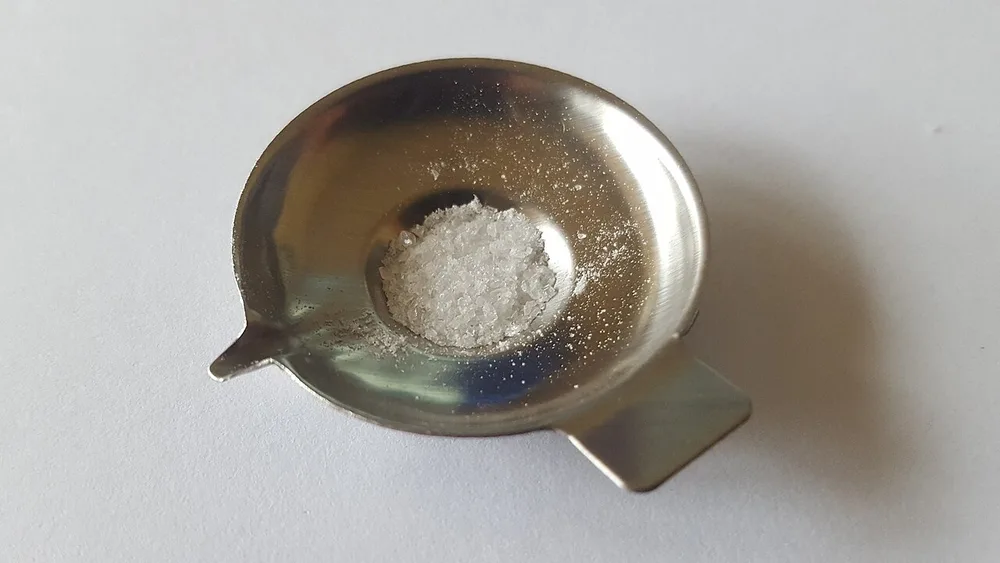
sampleMDA (3,4-methylenedioxyamphetamine) as typically encountered: white crystalline powder, here a small heap in a metal weighing dish. Illicit MDA is sold as powder, crystal or pressed pills — never in pharmaceutical packaging. DMTrott ·CC BY-SA