
Air scent, nail polish remover, leather cleaner: the poppers trademark wars
In September 2015 a Nevada company asked the United States Patent and Trademark Office to register RUSH for “chemicals, namely, isobutyl nitrite”.[1] Isobutyl nitrite is one of the chemicals Congress named in 1988 when it declared that “butyl nitrite shall be considered a banned hazardous product”.[2] The picture the company filed to show the mark in use was a small yellow bottle with SOLVENT CLEANER printed on its shoulder.[1]
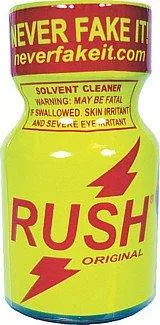
Figure 1. The specimen Pac-West filed in September 2015 to show its RUSH mark in use on chemicals, namely, isobutyl nitrite: a bottle labelled solvent cleaner. [1]
The company was Pac-West Distributing, which owned the Rush trademarks from 2015 until it sold them for $1,000,000 in January 2026. Ten months after that filing it abandoned the application, and ten more like it, on the same day it told the trademark office that its bottles were cleaners and complied with federal law.[3][4] Those cleaner registrations are the ones that changed hands in 2026.[5]
This article is about that paperwork. Poppers have been banned as consumer products for more than thirty years, and for fifty years the companies that bottle them have registered their brand names with a federal agency as air scents, room odorizers, nail polish removers, incense and leather cleaners. The trademark register is the one place in the federal government where the bottlers have to say, in writing, what the product is. Four dossiers on this site cover the companies one at a time: Pac-West Distributing, the Rush owner; AFAB Industrial Services, the Pennsylvania bottler that fought it in court for a decade; Lockerroom Marketing, the Canadian maker of Jungle Juice; and The Popper King, the Buffalo store at the address of the company that bought Rush. The chemistry and the medical history are in this site's deep dive on poppers, and the general history of the disclaimer label is in the deep dive on not for human consumption. This piece reads across all of them, and adds the trademark office's own letters.
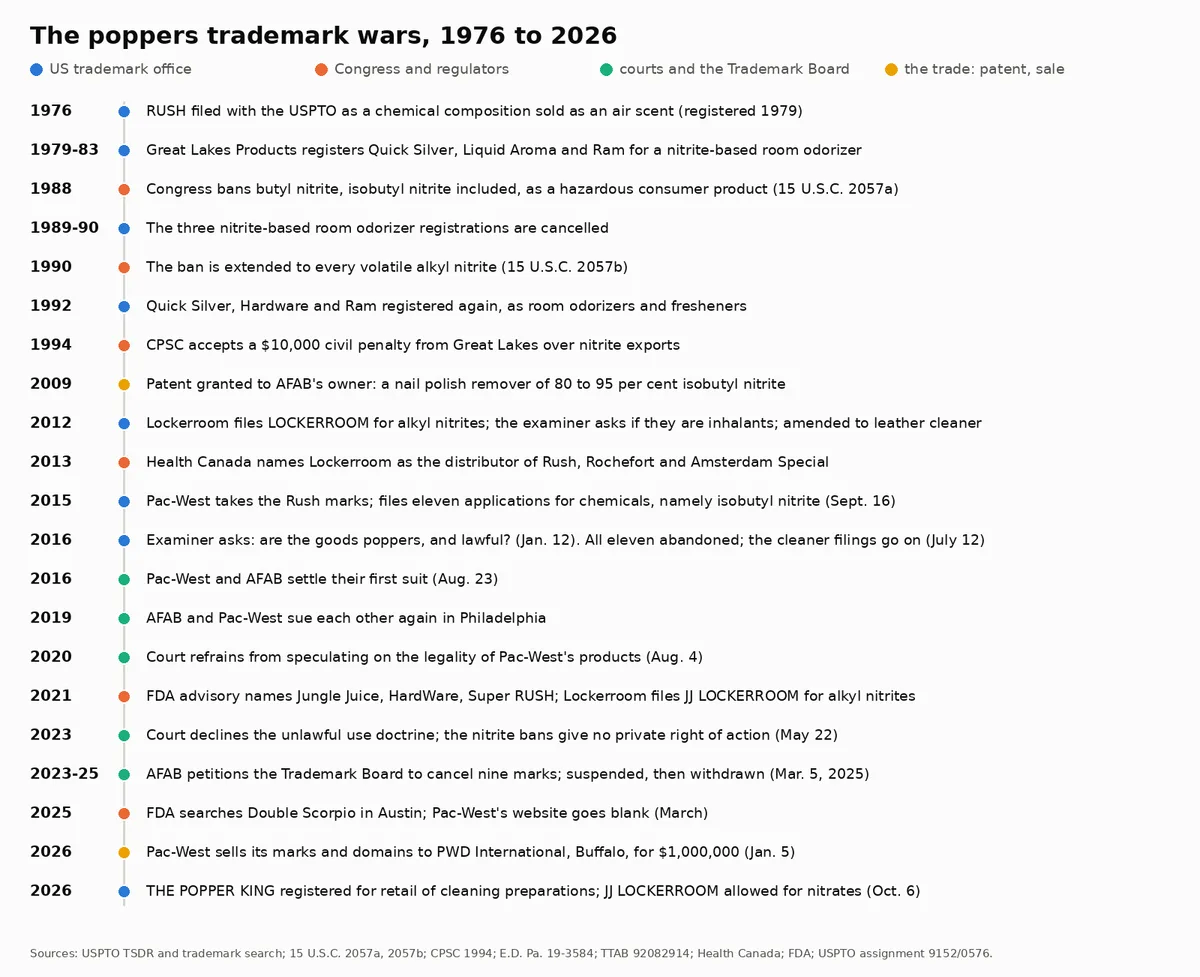
Figure 2. Fifty years of the poppers trademark file, drawn for this article from the records it cites. [6]
The law the bottles live under
Two short statutes govern the trade. Section 2057a of title 15, passed in 1988, says “butyl nitrite shall be considered a banned hazardous product”, and its definition “includes n-butyl nitrite, isobutyl nitrite, secondary butyl nitrite, tertiary butyl nitrite, and mixtures containing these chemicals”.[2] Section 2057b, passed in 1990 after bottlers moved to isopropyl nitrite, extends the rule to the whole family: “volatile alkyl nitrite shall be considered a banned hazardous product”.[7]
Both keep a door open. Under 2057b “it shall not be unlawful for any person to manufacture for sale, offer for sale, distribute in commerce, or import into the United States volatile alkyl nitrites for any commercial purpose”.[7] A commercial purpose is then defined as any purpose “other than for the production of consumer products containing volatile alkyl nitrites that may be used for inhaling or otherwise introducing volatile alkyl nitrites into the human body for euphoric or physical effects”.[7] Every label in this story, from solvent cleaner to leather cleaner, is an argument that the bottle sits on the commercial side of that line. The two words that decide it are may be used.
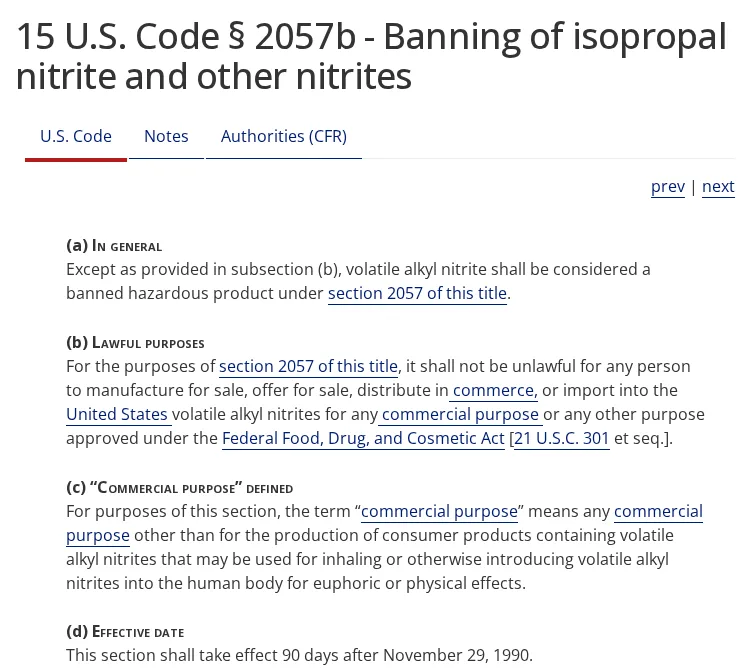
Figure 3. The 1990 statute in full. Everything in this article turns on subsection (c), and on the words may be used. [7]
The bans are consumer-product law, enforced by the Consumer Product Safety Commission and the Justice Department, not drug law. The public record of enforcement is thin. In 1994 the commission “accepted a $10,000 civil penalty settlement from Great Lakes Products Inc.”, the Indianapolis company that then owned Rush, over nitrite exports.[8] The rest of that history, and the FDA's later role, is in the poppers deep dive.
Fifty years of goods descriptions
A trademark is registered for named goods. The first Rush registration, filed in December 1976 and still live in 2026, covers a “chemical composition sold in an easily openable container as an air scent”.[9]
For a few years the register used the chemical's name. Great Lakes Products registered Quick Silver in 1982 for a nitrite-based room odorizer, and Liquid Aroma and Ram for the same goods in 1982 and 1983.[10][6] Quick Silver was cancelled in April 1989 because no declaration of continued use was filed, which is the routine way a registration lapses; Liquid Aroma lapsed the same month and Ram in 1990.[10][6] The record does not say why the filings stopped. The dates are what they are: the butyl nitrite ban took effect in 1988, and the wider ban in 1990.[2][7]
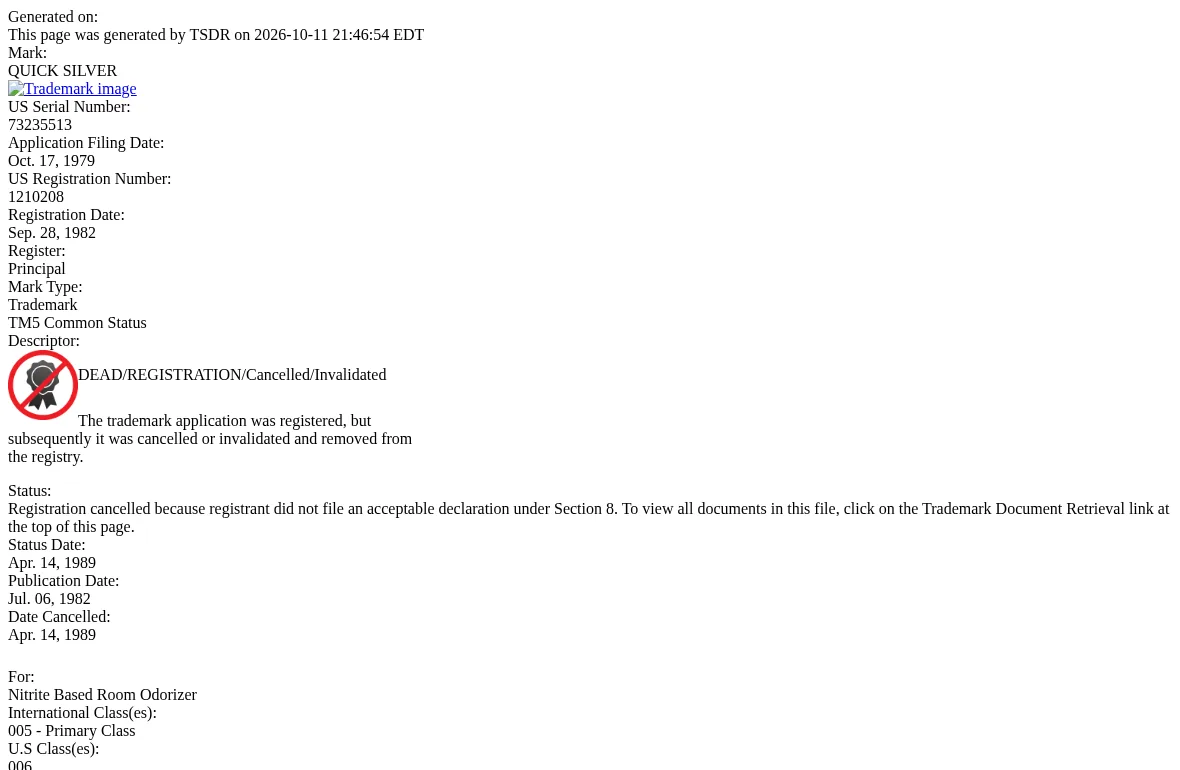
Figure 4. Before the bans the register used the word. Quick Silver was registered in 1982 for a nitrite-based room odorizer; the registration lapsed in 1989. [10]
When Great Lakes registered Quick Silver, Hardware and Ram again in 1992, the goods were room odorizers and fresheners, with no chemical named.[6] After that the register records a slow change of costume. Power-Pak Pellet was registered in 2002 for desiccants for use in the manufacture of incense. Grand Canyon Products, the Arizona company that held the marks before Pac-West, filed Bolt, Ram and Hardware in 2012 as nail polish remover and PWD as a personal lubricant. Pac-West filed its brands as all-purpose cleaners in 2015 and as incense in 2016.[6] Lockerroom Marketing registered LOCKERROOM for leather cleaning preparations.[11] The California Law Review, which surveyed this file in 2024, counted Pac-West's portfolio at “around forty trademarks”.[12]
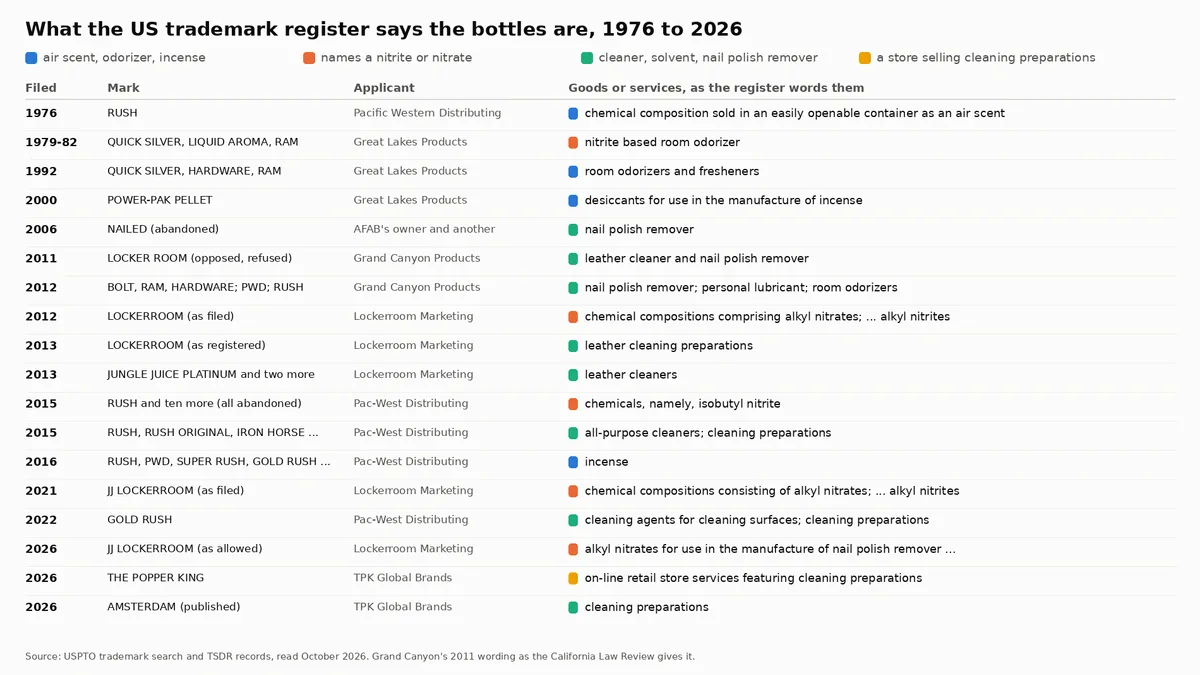
Figure 5. What the register says the bottles are. The word nitrite appears before 1988, disappears, and returns only in filings that were abandoned or amended. [6]
After 1990 the word nitrite came back in three rounds of filings, and each application that carried it was abandoned or amended before it could register. Those three applications are the centre of this story.
What the trademark office is allowed to ask
The trademark office does not enforce the nitrite bans. It can, though, refuse a mark whose use breaks federal law. The USPTO's own statement of the rule, in a 2019 examination guide written for cannabis, is that “Use of a mark in commerce must be lawful under federal law to be the basis for federal registration under the U.S. Trademark Act”, and the guide adds that the office “refuses to register marks for goods and/or services that show a clear violation of federal law, regardless of the legality of the activities under state law”.[13] It cites the examiners' manual, section 907, as the source.[13]
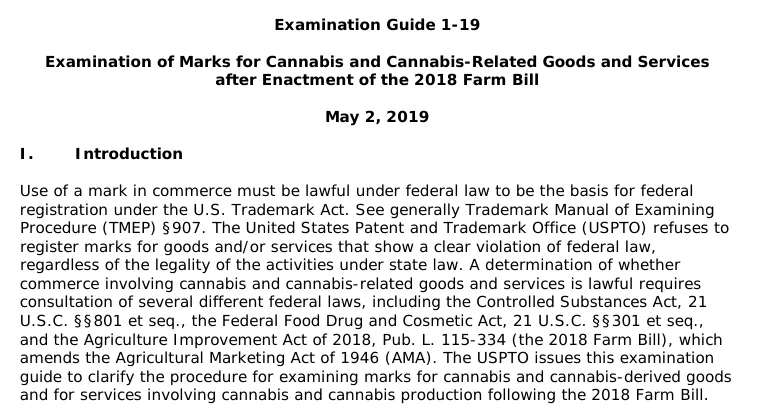
Figure 6. The trademark office's own statement of the rule, in its 2019 guide on cannabis marks. [13]
A regulation from 1989 gives examiners the power to ask. Where a product's sale is regulated under an Act of Congress, the office “may make appropriate inquiry as to compliance with such Act for the sole purpose of determining lawfulness of the commerce recited in the application”.[14] The Trademark Trial and Appeal Board has applied the same idea since the 1950s, as a federal judge in Philadelphia summarised it in 2023: use in commerce means lawful use in commerce.[15] That is the unlawful use doctrine. The office can use it to refuse an application. Whether a rival can use it in court to cancel a registration is a separate question, and the Philadelphia case answered it.
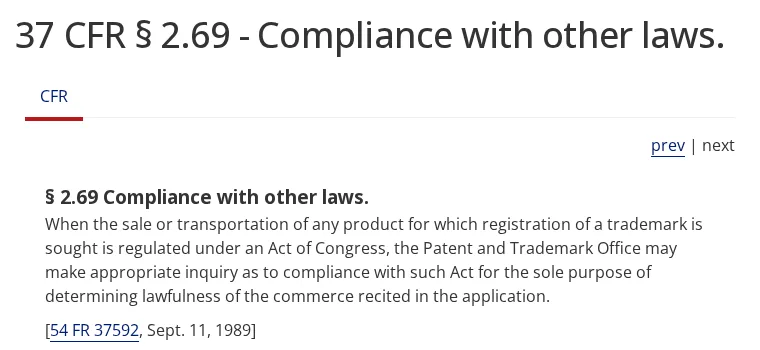
Figure 7. The rule that lets an examiner ask whether a product complies with another federal law, in force since 1989. [14]
2011 and 2012: Lockerroom names the chemistry
The first company in the modern file to say what was in the bottle was Canadian. Lockerroom Marketing, of Delta, British Columbia, had called its own product a popper on its website in 2001, “voted the best popper by those in the know”, and in 2010 listed the contents in its footer: “they contain highly pure isobutyl nitrite, alkyl nitrites, cyclohexyl nitrite or hexyl nitrites only”.[16][17]
In 2011 it opposed Grand Canyon's application to register LOCKER ROOM for leather cleaner and nail polish remover. The law review, which read the notice of opposition, quotes the line that put recreational use into the trademark record: “isobutyl nitrate is considered by some to be a euphoric sex enhancing inhalant”.[12] Grand Canyon did not answer and the opposition was sustained in 2012, as the Lockerroom dossier sets out.
In August 2012 Lockerroom filed its own LOCKERROOM application, and named the chemistry in the goods: “chemical compositions comprising alkyl nitrates; chemical compositions comprising alkyl nitrites; leather cleaners”.[18] The examining attorney asked the company to say “if, in finished form, these are substances in the form of inhalants, gels or liquids used for sexual stimulation or other stimulant use”.[19] Among the wordings the office offered was “Sexual stimulant inhalants comprising amyl nitrite”.[19] The company deleted the chemicals and registered the mark for “leather cleaning preparations”.[11] The law review's verdict: “Lockerroom Marketing avoided the sexual stimulant claim entirely”.[12] That office action asked what the goods were. It did not ask whether they were lawful.
2015: eleven applications for isobutyl nitrite
On September 16, 2015 Pac-West filed twenty applications at once. Eleven named the chemical. RUSH, RUSH ORIGINAL, SUPER RUSH, GOLD RUSH, IRON HORSE, LOCKER ROOM, HARDWARE, QUICK SILVER, BOLT, PWD and NEVER FAKE IT! were each filed in class 1 for chemicals, namely, isobutyl nitrite. Most of the same names were filed beside them, the same day or earlier that year, in class 3 for all-purpose cleaners.[6] Each brand went in twice: once as the chemical, once as the cleaner.
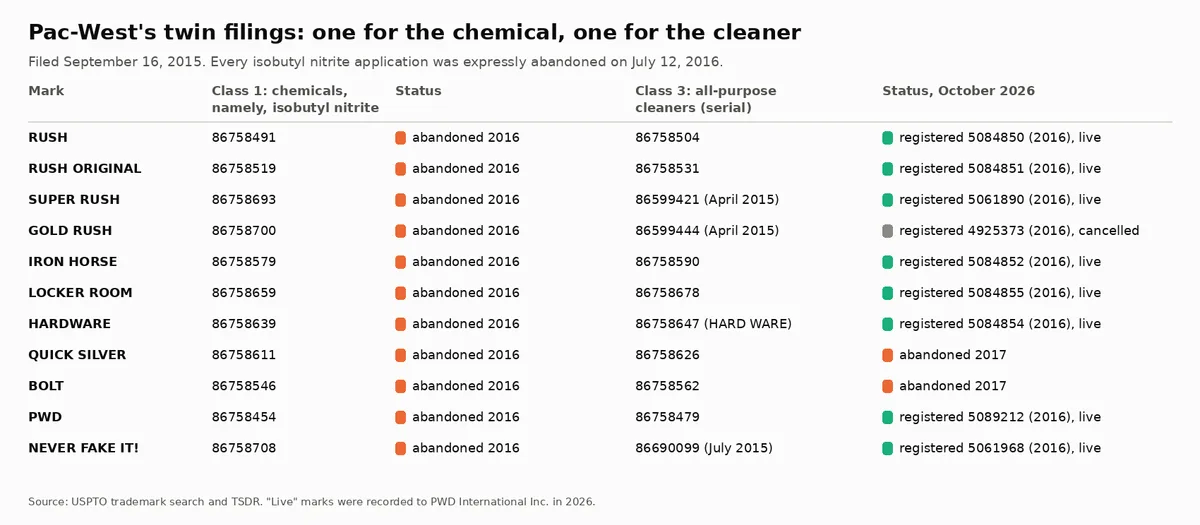
Figure 8. Pac-West's twin filings. Each brand was filed once as the chemical and once as a cleaner. The chemical applications were all abandoned on one day; the cleaners became the registrations sold in 2026. [6]
The Pac-West dossier, which read two of these files, counted two applications for isobutyl nitrite. The trademark office's search shows eleven.[6] The specimen for RUSH, the class 1 application, was the solvent-cleaner bottle at the top of this article, and the application claimed the mark had been used on isobutyl nitrite since December 15, 1976.[1]
Pac-West did not hide the chemical from its customers either. From 2020 its website said “all of our liquid products are licensed and labeled as solvent cleaner”, and in the next breath, “our contents is clearly stated as isobutyl nitrite not as alcohol acid and water”.[20]
January 2016: the examiner asks
On January 12, 2016 the examining attorney sent the same letter on each application. It is headed with a requirement the office was using for cannabis goods, and it is direct. The applicant “must submit a written statement indicating whether all the goods identified in the application comply with relevant federal law, including The Anti-Drug Abuse Act of 1988”, and the letter explains the reason: “This law prohibits the use of alkyl nitrites, including isobutyl nitrite, for recreational uses”.[21] It warns that if the answer shows the goods do not comply, “registration may be refused on the ground that the applied-for mark is not in lawful use in commerce”.[21]
Then it asks three questions. Are the goods intended for ingestion or inhalation? Are they intended for use as poppers, defined in the letter as alkyl nitrites “which are alkyl nitrites/isobutyl nitrite that is inhaled for recreational purposes, especially in preparation for sex”? And are they lawful under the Controlled Substances Act?[21] The third question is beside the point, since the nitrite bans are in the consumer-product statute and not the drug schedules. The first two are the questions every label in the trade is designed to avoid.
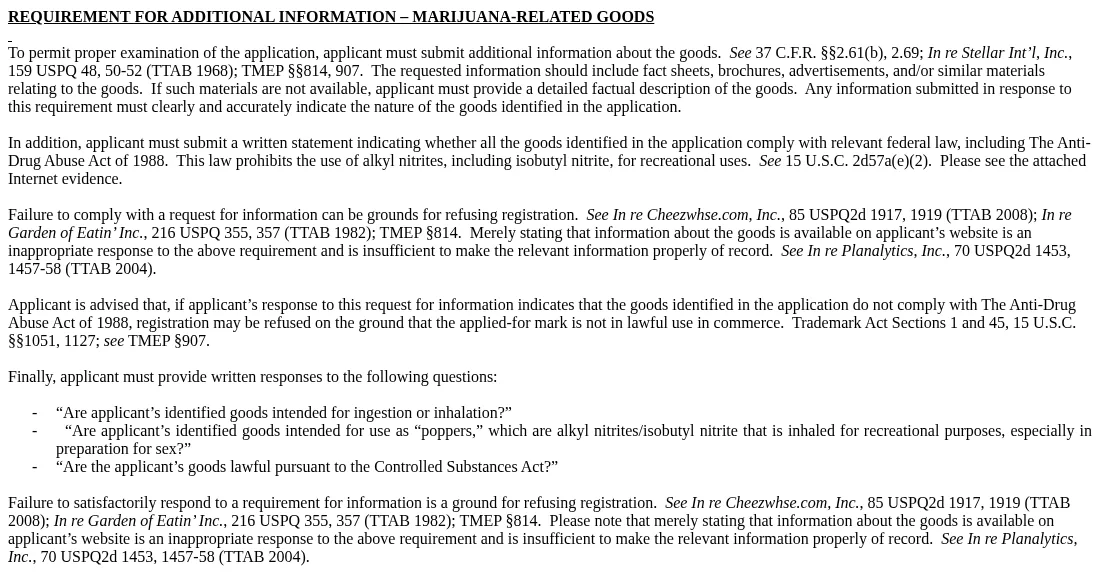
Figure 9. January 12, 2016. The examining attorney asks the question the labels avoid, in three sentences. [21]
The same letter refused the class 1 specimen, on the ground that a finished bottle is not a raw chemical, and offered wordings the company could adopt instead. One was a metal solvent. Another was “Chemicals, namely, Isobutyl nitrite for use as a sexual stimulant, in Class 5”.[21]

Figure 10. The same letter offers wordings the applicant could adopt, one of them isobutyl nitrite for use as a sexual stimulant. [21]
The examiner attached twelve pages of internet evidence. Seven are printouts of Wikipedia's articles on poppers and isobutyl nitrite. One is Pac-West's own neverfakeit.com. Two are from rush-poppers.org, a fan site that called Rush the most popular poppers brand, and two from pwdrush.net, which sold Rush, Super Rush and Bolt bottles as poppers.[21] Pac-West's site spent years warning about sites that used its names without paying for them; the office action does not say who ran these two, and nothing read here does either.
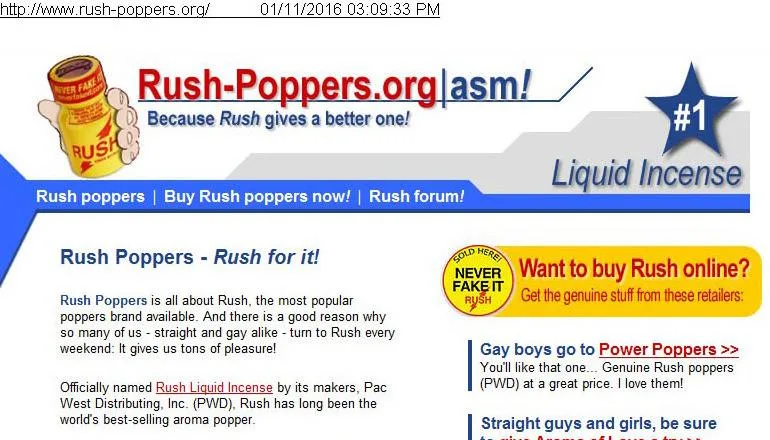
Figure 11. One of the twelve pages of internet evidence attached to the office action: a fan site calling Rush the most popular poppers brand. The office action does not say who ran it. [21]
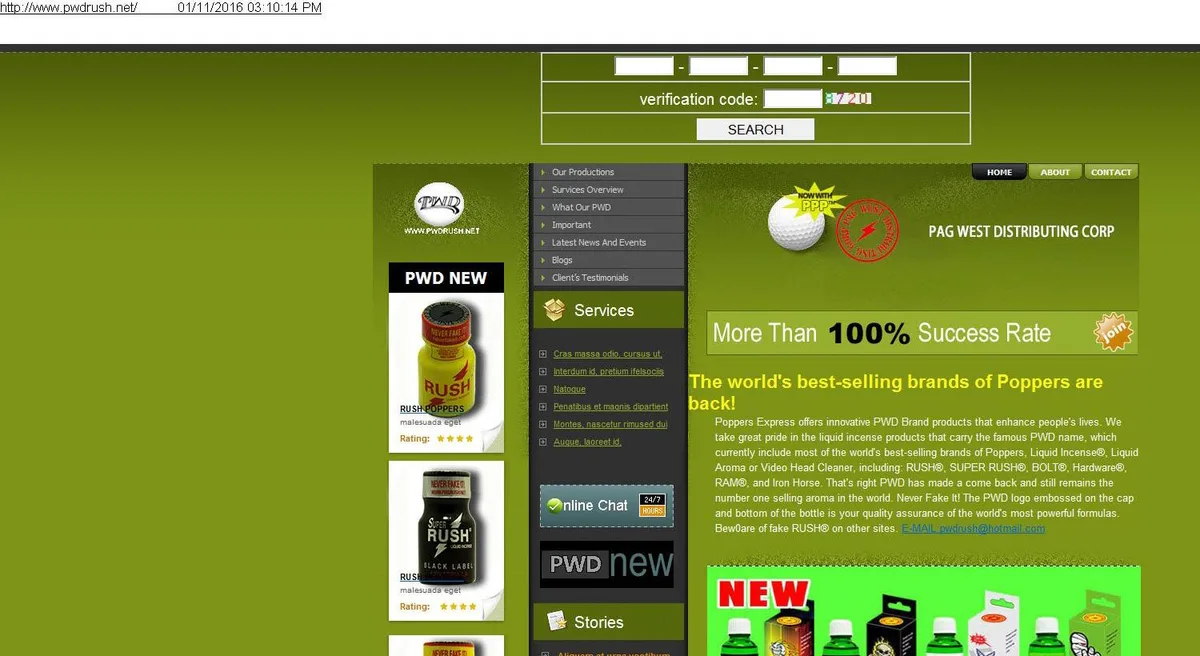
Figure 12. Another attachment: a site selling Rush, Super Rush and Bolt as poppers. Pac-West's own site warned about imitation sites; who ran this one is not in the record. [21]
July 12, 2016: abandon the chemical, keep the cleaner
Pac-West answered on July 12, 2016, in two ways at once. On RUSH for isobutyl nitrite, its lawyer filed a one-line request: “the applicant hereby expressly abandons the application for trademark registration”.[3] The other ten class 1 applications were abandoned the same day.[6]
On RUSH for all-purpose cleaners, which had received the same questions, the company filed a response. It said “the goods are multi purpose solvent cleaners” and attached a label and a signed statement.[22] The statement, signed by Trent Taylor as Pac-West's manager, says that to the best of the company's knowledge “these products are in compliance with all relevant federal law, including The Anti-Drug Abuse Act of 1988”.[4] It says the goods are not intended for ingestion, inhalation, as poppers, “or any use other than as a multi-purpose solvent cleaner”, and that “There are numerous warnings on the packaging stating specifically that the products should not be ingested or inhaled”.[4]
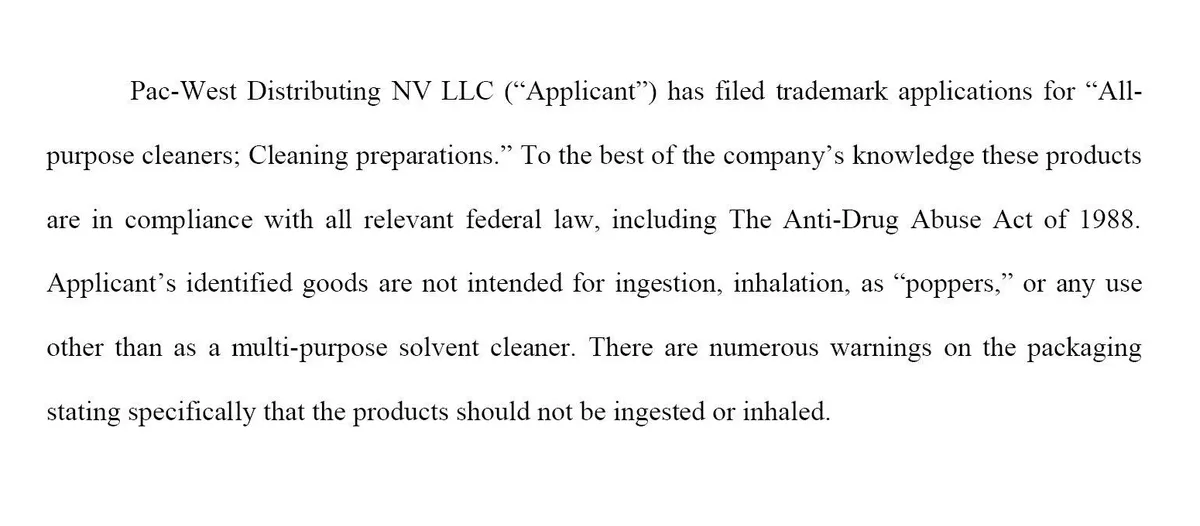
Figure 13. July 12, 2016: Pac-West's answer, filed on the cleaner application the same day it abandoned the chemical ones. Cropped above the signature. [4]
The label filed with it tells the reader to dip a cotton swab in solvent and apply it to the area to be cleaned.[22] RUSH for all-purpose cleaners was registered on November 22, 2016, as registration 5,084,850.[23]
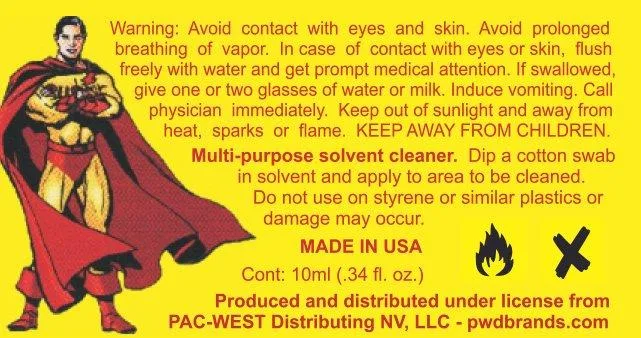
Figure 14. The product labelling Pac-West attached to the same response: directions for a cotton swab. [22]
The law review read the abandonments as a choice: “in response pac west chose to abandon these trademark applications not seeking to incriminate themselves”.[12] That is the authors' inference, not a finding. The record shows only the sequence. The applications that named the chemical were withdrawn, and the ones that described a cleaner went through, on the strength of a statement about intended use.
The rival who called the bottles unlawful
The one party that tried to turn the bans against the register was another bottler. AFAB Industrial Services of Bensalem, Pennsylvania, owned by Everett Farr III, sold Rush-branded bottles as nail polish remover under a 2016 settlement with Pac-West.[24] Its owner is a named inventor on a 2009 patent for a nail polish remover containing “about 80% to about 95% by volume isobutyl nitrite”.[25] The fight between the two companies is told in full in the Pac-West dossier and the AFAB dossier. What matters here is what the courts said about the trademarks.
When Pac-West sued AFAB in 2019, AFAB argued that the marks could not be enforced because the products were really drugs. In August 2020 the judge declined to go behind the pleadings: “the Court certainly refrains from speculating as to the legality of” Pac-West's products on that record.[24] The same opinion defined the word the labels avoid, in a footnote: poppers “are recreational drugs inhaled to achieve a high and said to facilitate anal intercourse”.[24]
AFAB pressed the point as counterclaims, asking the court to cancel Pac-West's registrations under the unlawful use doctrine. On May 22, 2023 the court refused. Its memorandum is a scanned document, so what follows is our summary of it. The court set out both readings of may be used. On AFAB's, any product that could physically be inhaled falls outside the commercial-purpose exception, and since every alkyl nitrite is volatile, the exception would mean nothing. On Pac-West's, the words refer to the purpose behind a product. The court chose neither, because it would not interpret the two statutes in a civil case to which the United States was not a party.[15]
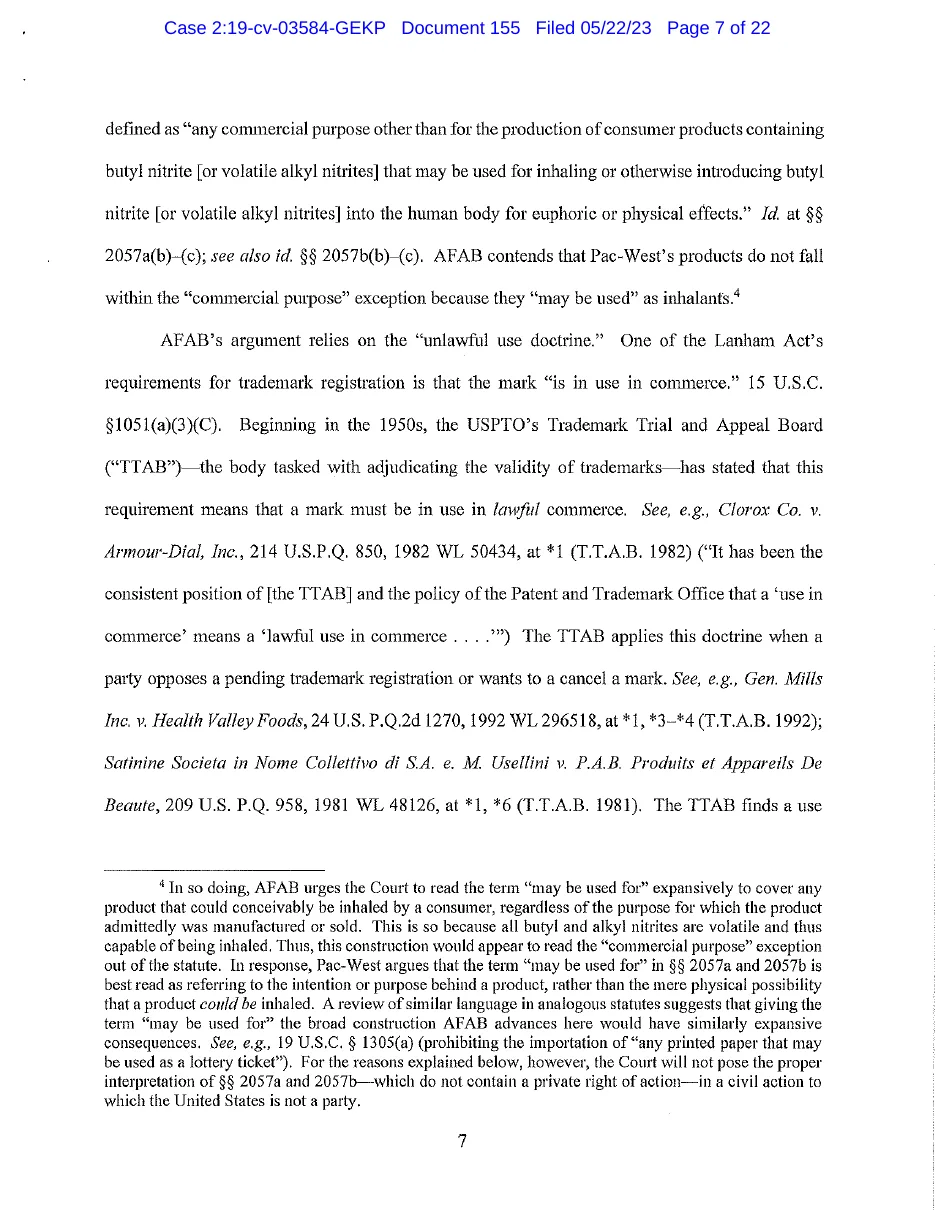
Figure 15. May 2023. The court sets out both readings of may be used for, and declines to choose between them in a suit between two companies. [15]
It then declined to adopt the unlawful use doctrine at all. It reasoned that sections 2057a and 2057b give no private right of action, so Congress left their enforcement to the federal government, and that it would be anomalous to let private parties litigate those statutes only inside a trademark suit. It noted that some appeals courts have adopted the doctrine and others have rejected it, and that the Third Circuit had not decided.[15] It added a distinction that explains the rest of this article: the question was not whether the trademark office may refuse a mark for unlawful use, which it does, but whether a court should cancel one already registered.[15]
The same ruling disposed of AFAB's claim that the registrations had been obtained by fraud. AFAB's argument was that the 2016 statement to the trademark office was false. The court found that the statement could fairly be read as describing how the products were marketed and labelled when it was made, that the office had asked only about present compliance, and that AFAB had offered no clear and convincing evidence of an intent to deceive. It granted Pac-West summary judgment on that count too.[15]
AFAB took the same argument to the Trademark Trial and Appeal Board in July 2023, in a petition to cancel nine Pac-West registrations. The board suspended it to wait for the court, “susp pend disp of civil action”, and on March 5, 2025 the record shows “w draw of pet for cancellation”.[26] No document read gives a reason for the withdrawal. Asked about the poppers trade in March 2025, after the FDA searched the Austin bottler Double Scorpio, Farr told the Los Angeles Times: “I manufacture a completely legal product.”[27] No court has decided whether any bottle in this story falls inside the commercial-purpose exception or outside it.
2021 to 2026: the questions stop
Lockerroom tried again in July 2021. Its JJ LOCKERROOM application, for the logo now printed on every Jungle Juice box, listed as its first goods “Chemical compositions consisting of alkyl nitrates; chemical compositions consisting of alkyl nitrites”.[28]
The office action of April 2022 raised two problems, neither of them about inhalation. “Registration of the applied-for mark is partially refused because of a likelihood of confusion with the mark in U.S. Registration No. 5084855”, which was Pac-West's LOCKER ROOM, one of the cleaner twins of 2015. And the chemical goods were too vague, because “the use of the chemical compositions is not specified”.[29] The letter asked for no statement about the 1988 or 1990 laws.[29]
The application waited almost four years for its Canadian basis. In May 2026, after Pac-West's marks had been sold, the examiner wrote that “the following refusal(s) is withdrawn; Likelihood of confusion refusal”, without a reason.[30] In July the goods were agreed as “Chemical compositions consisting of alkyl nitrates for use in the manufacture of nail polish remover”, with deodorisers and leather preparations.[31] The nitrites line was gone. Nitrates are different compounds, and poppers are nitrites. The mark was allowed on October 6, 2026.[32]
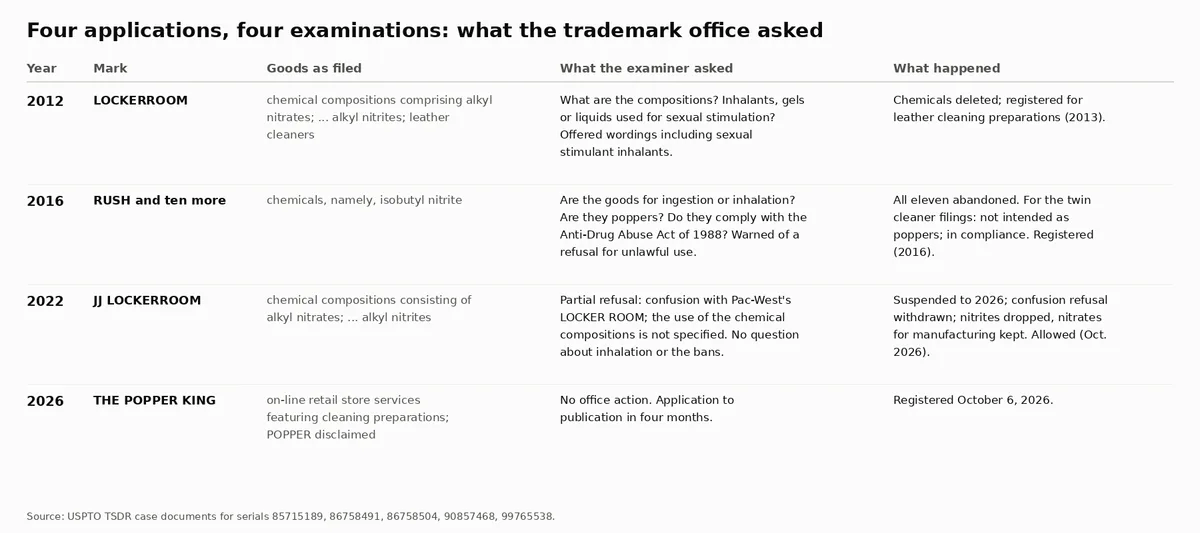
Figure 16. Four applications that named nitrites or poppers, and what the examiner asked each time. [21]
The sale
On January 5, 2026 Pac-West signed an Asset Purchase Agreement selling its trademarks, domains and goodwill to PWD International Inc. of 912 Elmwood Avenue, Buffalo, New York, for $1,000,000, mostly on a three-year note.[5] The USPTO's history of the 1979 Rush registration records it: “assignor name pac west distributing nv llc execution date jan 05 2026”.[33] The thirteen registrations sold were the survivors of the file described above: the 1979 air scent registration and, for the rest, cleaners and a desiccant.[5] None of the isobutyl nitrite applications existed to be sold.
Three months later, on April 15, 2026, a company at the same Buffalo address, TPK Global Brands LLC, applied to register the name of a poppers store, THE POPPER KING, for on-line retail store services featuring cleaning preparations. The same person signs for both companies, as the Popper King dossier documents. The specimen was the store's Rush product page, filed as a “website showing the mark the popper king used in connection with online retail store services featuring cleaning preparations”.[34]
The application contained its own disclaimer: “No claim is made to the exclusive right to use” the word POPPER apart from the mark as shown.[34] The Lanham Act provides both kinds. “The Director may require the applicant to disclaim an unregistrable component of a mark otherwise registrable”, and “An applicant may voluntarily disclaim a component of a mark sought to be registered”.[35] This one was volunteered. The file shows no office action of any kind: the application went to publication in August and was registered on October 6, 2026, as number 8,484,985.[36]
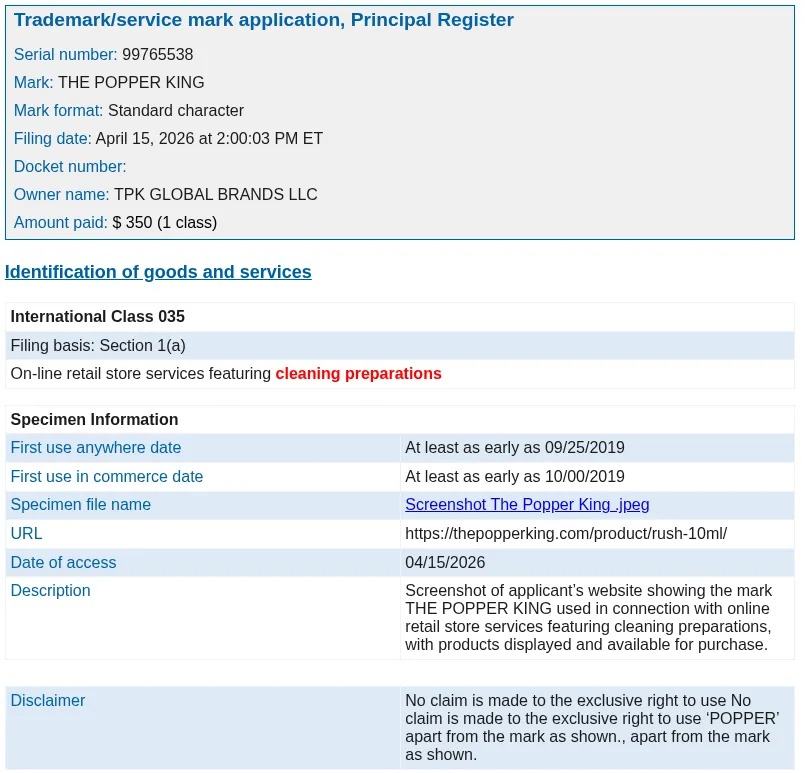
Figure 17. April 2026. A store named for poppers, registered for selling cleaning preparations, with the word popper disclaimed by the applicant itself. Its specimen is a Rush product page. [34]
The store's own pages explain why the disclaimer matters. In 2020 its footer said “all of our products contain highly pure isobutyl nitrite and are not controlled by the fda”.[37] In October 2026 it says “the popper king is a brand name used for identification purposes only and does not describe the intended use of the products offered on this website”.[38] Ten years earlier the trademark office had asked Pac-West whether its cleaners were poppers. In 2026 it registered a store named for poppers, selling the same brand, without asking.
Canada: the same bottles, a different question
Canada asks what is in the bottle. On May 16, 2013 Health Canada issued an advisory on three products labelled as leather cleaner or liquid incense, Rush among them. Its finding on the labels: “Health Canada is not aware of credible evidence confirming that alkyl nitrites are legitimately used in consumer products such as leather cleaners, room odourisers or liquid incense”.[39] It named the distributor: “Lockerroom Marketing Ltd. (694 Derwent Way, Delta, B.C.) has been distributing” them.[39]
Its follow-up notice, updated until 2017, states the law. Despite the consumer-product labels, “these products are ingested or inhaled by consumers for recreational purposes”, and “products containing alkyl nitrites are considered drugs under the Food and Drugs Act and must be authorized by Health Canada to be legally sold”.[40] Under that rule the label does not matter. A Canadian inspector does not have to decide what may be used means, because a nitrite sold without authorization is an unauthorized drug whatever it says it is for.
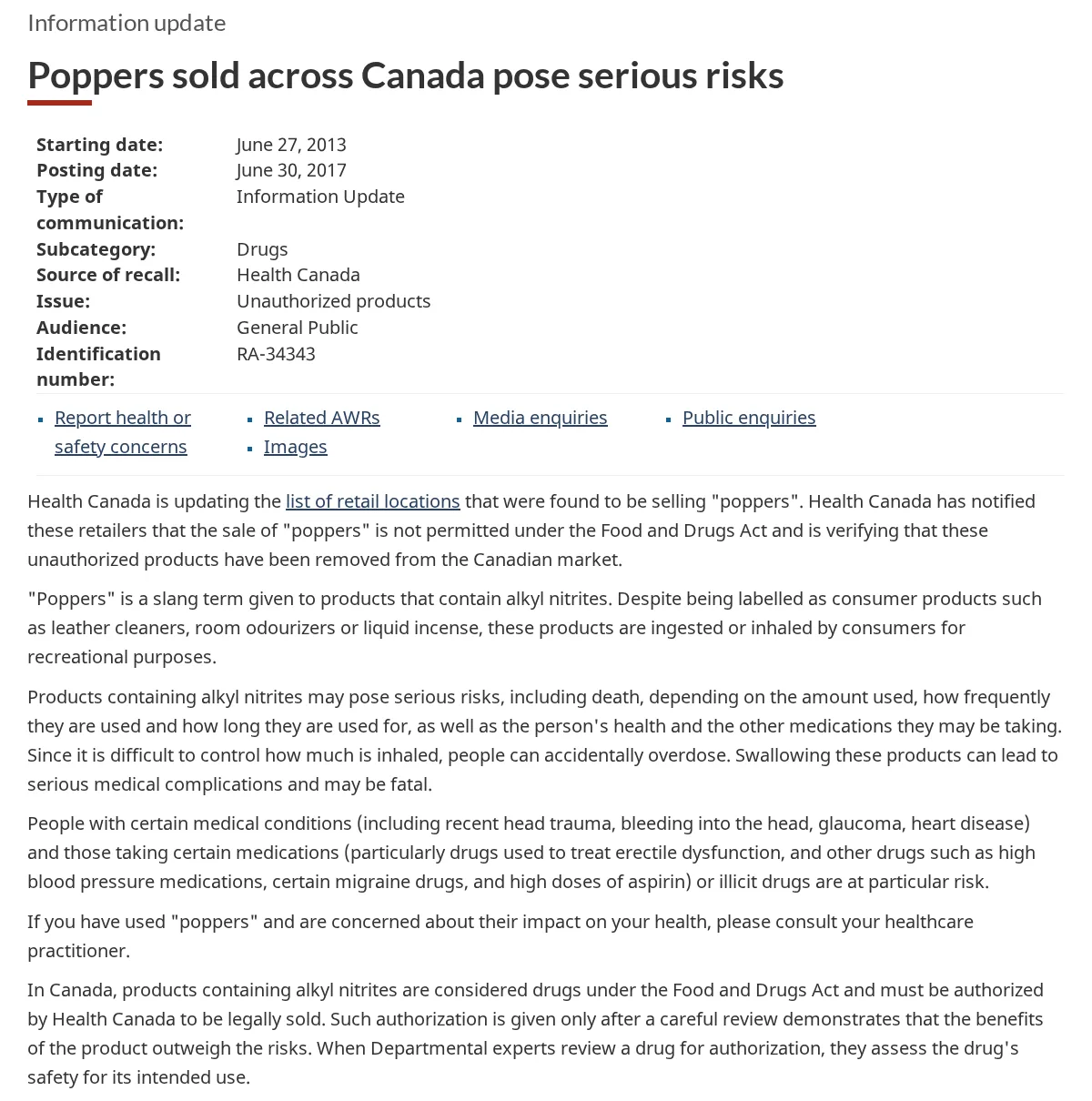
Figure 18. Canada, 2013 to 2017. The regulator reads past the label and treats the bottle as an unauthorized drug. [40]
The seizures have continued. In 2024 Health Canada listed Jungle Juice Platinum taken from an Etobicoke shop with the note “Product with similar packaging (previously seized) was tested and found to contain isobutyl nitrite”.[41] That is the only laboratory result on any of these brands found by the four dossiers, and it comes from a regulator, not from a company or a court.
Yet Canada's trademark office registers the brands. The US file for JJ LOCKERROOM rests on Canadian registration 1390653, issued on March 4, 2026.[32] Lockerroom's own caution panel, in the same year, ends with a sentence about its home country: “lockerroom products are not authorized for sale in canada”.[42] In both countries the trademark register and the product regulator look at the same bottle and record different things.
In the United States the FDA has spoken by brand name. Its June 2021 advisory said “Brand names include Jungle Juice, Extreme Formula, HardWare, Quick Silver, Super RUSH, Super RUSH Nail Polish Remover and Premium Ironhorse, among others”.[43] Jungle Juice, HardWare, Quick Silver and Super RUSH are all names in the trademark file above. What followed in March 2025, the search at Double Scorpio and the websites that went dark, is told in the poppers deep dive. No warning letter, indictment or court order naming any of the trademark owners in this article was found in the records read.
Still open
- Whether the bottles fall inside the exception. No court has ruled on the commercial-purpose exception for any product in this article, and the 2023 ruling declined to.
- Why the questions stopped. No USPTO guidance on alkyl nitrites was found. The 2016 letters borrowed a heading written for cannabis, the 2022 letter on Lockerroom's nitrites did not ask, and the 2026 Popper King file has no office action at all.
- How the Philadelphia cases ended. The last ruling found in the public dockets is from October 2023.
- Who owns PWD International and TPK Global Brands. New York's register names no owners; the trademark papers show one signatory for both.
- AMSTERDAM. TPK Global Brands' application for the Amsterdam poppers brand, also filed for cleaning preparations, was published for opposition on September 29, 2026, as the Popper King dossier records.
Changes
- 2026-10-12: first written.
References
- RUSH, application serial 86758491 for chemicals, namely, isobutyl nitrite (filed 2015-09-16), with specimen — US Patent and Trademark Office, TSDR case documents
- 15 U.S. Code § 2057a. Banning of butyl nitrite — Legal Information Institute, Cornell Law School
- RUSH, serial 86758491, request for express abandonment (2016-07-12) — US Patent and Trademark Office, TSDR case documents
- Pac-West Distributing NV LLC, written statement filed with the response on serial 86758504 (2016-07-12) — US Patent and Trademark Office, TSDR case documents
- Trademark assignment, reel 9152 frame 0576 (recorded 2026-02-01): cover sheet, Asset Purchase Agreement of 2026-01-05 and exhibits, scanned — US Patent and Trademark Office, Assignment Center
- USPTO trademark search: filings by owner Pac-West Distributing NV LLC, and filings whose goods name a nitrite, read 2026-10-12 — US Patent and Trademark Office
- 15 U.S. Code § 2057b. Banning of isopropal nitrite and other nitrites — Legal Information Institute, Cornell Law School
- Great Lakes Products Inc. Pays To Settle Civil Penalty Case (release 94-136) — US Consumer Product Safety Commission, 1994-09-22
- USPTO TSDR status: RUSH, registration 1112095 (filed 1976, registered 1979), read 2026-10-11 — US Patent and Trademark Office
- USPTO TSDR status: QUICK SILVER, registration 1210208 (Great Lakes Products, 1982, cancelled 1989), read 2026-10-12 — US Patent and Trademark Office
- LOCKERROOM, serial 85715189, response to office action, June 2013 — US Patent and Trademark Office, TSDR case documents
- Sex, Drugs, Innovation, Law: Regulating the Legality of 'Poppers' — Lawrence Myung and William P. Kasper, California Law Review vol. 112, August 2024
- Examination Guide 1-19: Examination of Marks for Cannabis and Cannabis-Related Goods and Services after Enactment of the 2018 Farm Bill (2019-05-02) — US Patent and Trademark Office
- 37 CFR § 2.69. Compliance with other laws — Legal Information Institute, Cornell Law School
- Pac-West v. AFAB, E.D. Pa. No. 19-3584, memorandum on Pac-West's motion for summary judgment on AFAB's counterclaims (Doc. 155, 2023-05-22), scanned — US District Court, Eastern District of Pennsylvania
- JungleJuicePlus.com home page, May 2001, archived — Wayback Machine
- Jungle Juice Plus shop home page, December 2010, archived — Wayback Machine
- LOCKERROOM, serial 85715189, application as filed, August 2012 — US Patent and Trademark Office, TSDR case documents
- LOCKERROOM, serial 85715189, office action, 2012-12-27 — US Patent and Trademark Office, TSDR case documents
- neverfakeit.com (Pac-West) home page, archived 2020-11-01 — Wayback Machine
- RUSH, serial 86758491, office action of 2016-01-12, with twelve attachments of internet evidence — US Patent and Trademark Office, TSDR case documents
- RUSH, serial 86758504 (all-purpose cleaners), response to office action (2016-07-12), with product labelling — US Patent and Trademark Office, TSDR case documents
- USPTO TSDR status: RUSH, registration 5084850 (all-purpose cleaners, 2016), read 2026-10-12 — US Patent and Trademark Office
- Pac-West Distributing NV LLC v. AFAB Industrial Services, Inc., E.D. Pa. No. 19-3584, memorandum (Doc. 40, 2020-08-04) — US District Court, Eastern District of Pennsylvania
- US Patent 7,625,852 B2, Nail polish remover (filed 2007-06-06, granted 2009-12-01) — Google Patents
- TTABVUE, Cancellation No. 92082914, AFAB Industrial Services, Inc. v. Pac-West Distributing NV LLC (2023-2025) — USPTO Trademark Trial and Appeal Board
- FDA crackdown on poppers prompts rush on popular gay party drug — Sonja Sharp, Los Angeles Times, syndicated by Yahoo News, 2025-03-21
- JJ LOCKERROOM, serial 90857468, application as filed, 2021-07-30 — US Patent and Trademark Office, TSDR case documents
- JJ LOCKERROOM, serial 90857468, nonfinal office action, 2022-04-28 — US Patent and Trademark Office, TSDR case documents
- JJ LOCKERROOM, serial 90857468, nonfinal office action, 2026-05-06 — US Patent and Trademark Office, TSDR case documents
- JJ LOCKERROOM, serial 90857468, examiner's amendment, 2026-07-08 — US Patent and Trademark Office, TSDR case documents
- USPTO TSDR status: JJ LOCKERROOM, serial 90857468, read 2026-10-12 — US Patent and Trademark Office
- USPTO TSDR assignment history: RUSH, registration 1112095, read 2026-10-12 — US Patent and Trademark Office
- THE POPPER KING, application serial 99765538 (filed 2026-04-15), with specimen — US Patent and Trademark Office, TSDR case documents
- 15 U.S. Code § 1056. Disclaimer of unregistrable matter — Legal Information Institute, Cornell Law School
- USPTO TSDR documents: THE POPPER KING, serial 99765538, registration 8484985 (2026-10-06), read 2026-10-12 — US Patent and Trademark Office
- thepopperking.com home page, archived 2020-05-06 — Wayback Machine
- thepopperking.com home page, archived 2026-10-05 — Wayback Machine
- Marketed leather cleaners and liquid incense are being used to get high, poses serious dangers to Canadians (RA-29269) — Health Canada, 2013-05-16 (archived advisory)
- Poppers sold across Canada pose serious risks (RA-34343) — Health Canada, 2013-06-27, information update posted 2017-06-30
- Poppers are unauthorized and may pose serious health risks — Health Canada, last updated 2024-08-07
- Jungle Juice Plus home page, April 2026, archived — Wayback Machine
- FDA Advises Consumers Not to Purchase or Use Nitrite "Poppers" — US Food and Drug Administration, 2021-06-24
Comments
Sign in to join the conversation.
No comments yet.