
Rush, Locker Room, Jungle Juice, Amsterdam: poppers from the angina ampoule to the FDA's 2025 search and seizure
Every few years someone discovers poppers again. In 2025 it was the federal government. On March 13 a small Austin company that sold bottles under the name Double Scorpio posted a notice on its home page: “Double Scorpio has stopped all operations following a search and seizure at our offices by the FDA”.[1] Within a week the Los Angeles Times reported that “rival brands such as Pig Sweat, Brown Bottle and Dumb Bitch Juice have also become scarce”, and that “major players including Pac West Distributing and Nitro Solv had taken down their websites or replaced them with banners saying they no longer operate”.[2] The FDA's spokesperson told NBC News that the agency “does not comment on possible criminal investigations”.[3]
The bottles those companies sold are the latest step in a chain that starts with a heart medicine in 1867. This article follows it link by link: the medicine, the prescription rule that pushed it out of pharmacies, the butyl and isobutyl nitrites that replaced it on adult-store counters, the AIDS hypothesis, the federal bans of 1988 and 1990, the isopropyl and cyclohexyl nitrites that came after, and the regulators in four countries who have tried to say what the bottles are. Its companion piece on this site, the deep dive on not for human consumption labels, covers the label trick across a dozen drugs and quotes the two federal statutes directly. This one covers the chemicals and the companies.
There are no dose figures here. The medical facts are quoted from the papers and agencies that reported them.
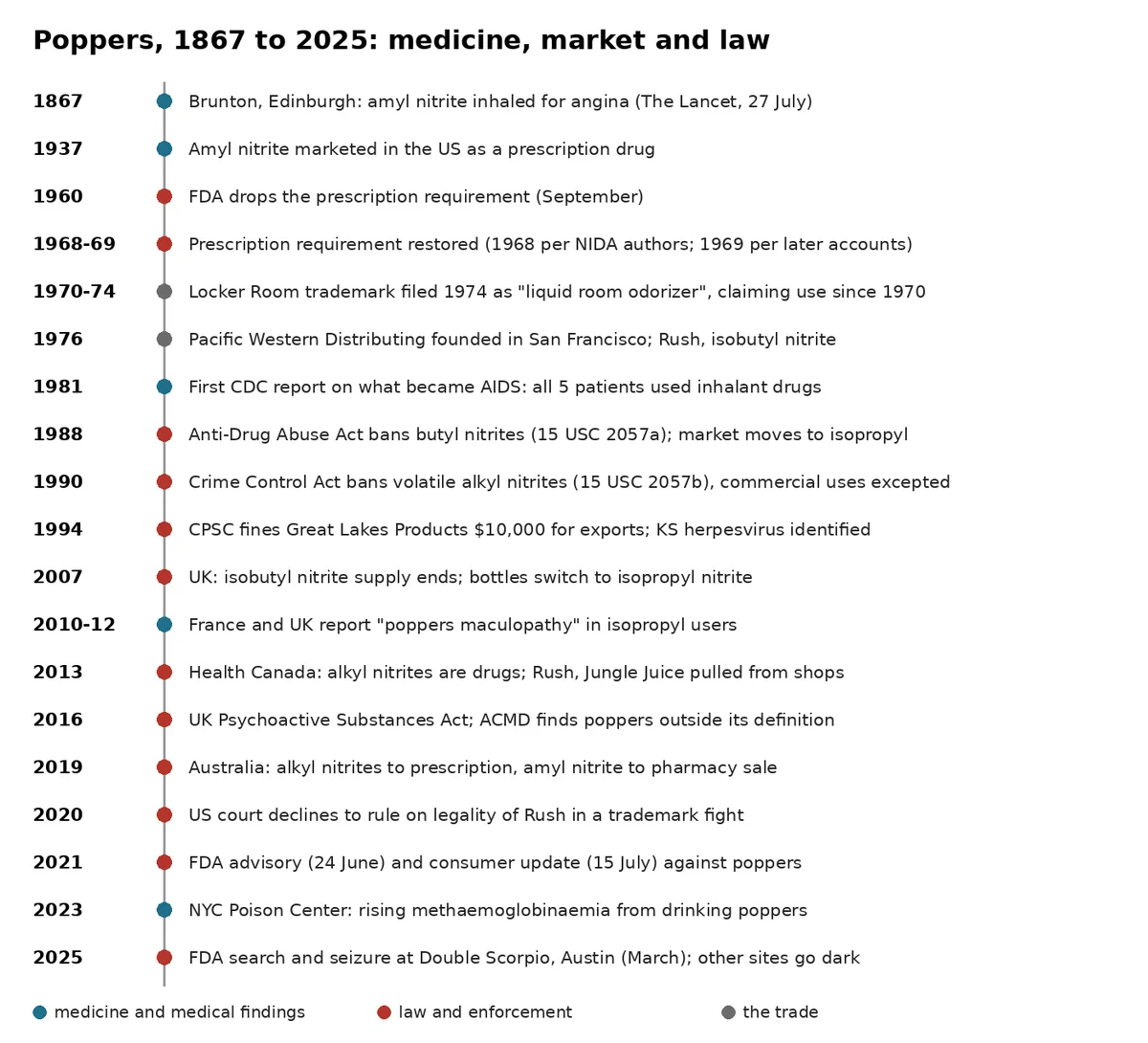
Figure 1. One hundred and fifty-eight years in one column, drawn for this article from the documents it cites. Where two sources give different years for the same event, both are shown. [4]
A medicine that went pop
Thomas Lauder Brunton was resident physician to the clinical wards of the Royal Infirmary in Edinburgh when he tried amyl nitrite on patients with angina. His report, printed in The Lancet on July 27, 1867, describes the effect: “the physiological action took place in from thirty to sixty seconds and simultaneously with the flushing of the face”, and the pain went with it.[5]
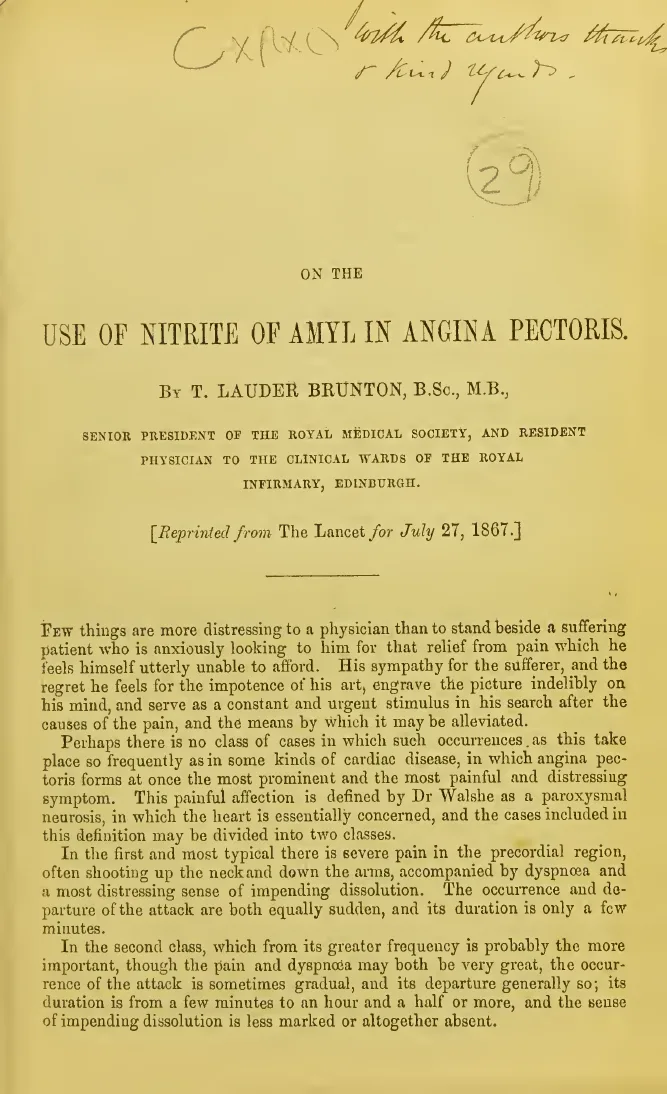
Figure 2. Brunton's paper of July 1867, in the Wellcome Collection's copy of the reprint. It is the first clinical report of the drug that became poppers. [5]
The medicine came to be sold as a liquid sealed in a covered thin glass capsule, crushed between the fingers.[6] A 1994 review by researchers at the National Institute on Drug Abuse and the CDC explains that the alkyl nitrites “have been nicknamed poppers because of the sound made when glass capsules” of amyl nitrite are crushed.[4] The product is still made that way. A New Jersey company, James Alexander Corporation, packages 0.3 ml ampules in boxes of twelve, marked Rx only and Poison.[6]
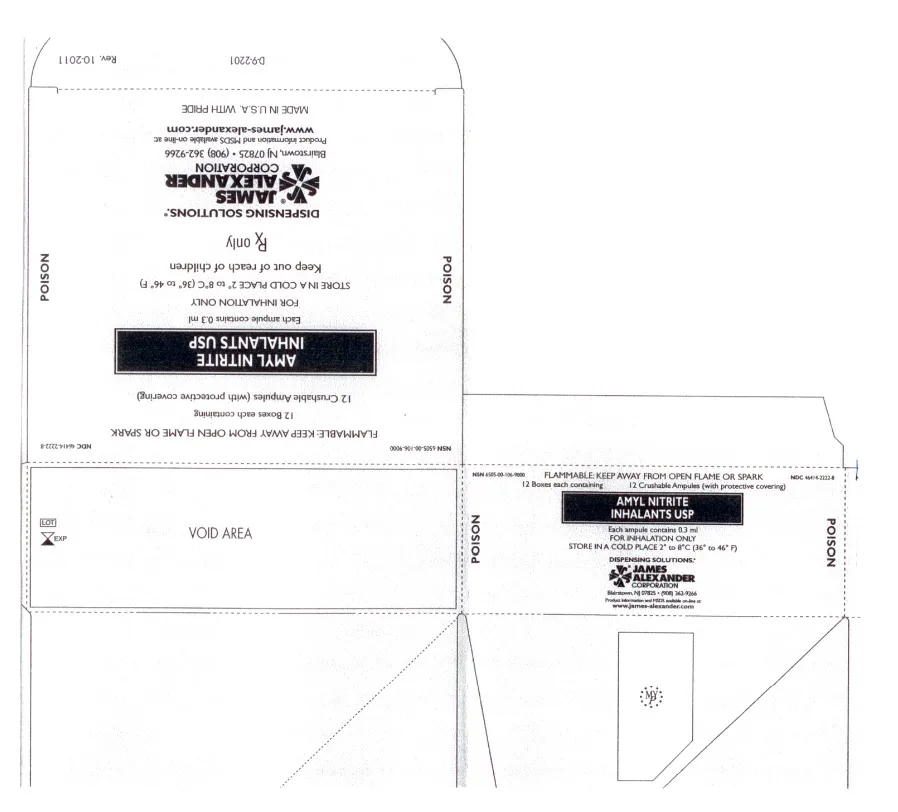
Figure 3. The medicine as it is still packaged: a carton of crushable glass ampules, labelled Rx only and Poison. The ampule that snaps is where the name comes from. [6]
That carton has an unusual regulatory history of its own. Its record in the National Library of Medicine's DailyMed reads “Marketing Status: unapproved drug other”, and carries the standard disclaimer for such products: “This drug has not been found by FDA to be safe and effective, and this labeling has not been approved by FDA”.[6] The insert inside the box is frank about the other market. Under the heading Drug Abuse and Dependence it says: “Volatile nitrites are abused for sexual stimulation, with headache as a common side effect”.[6]
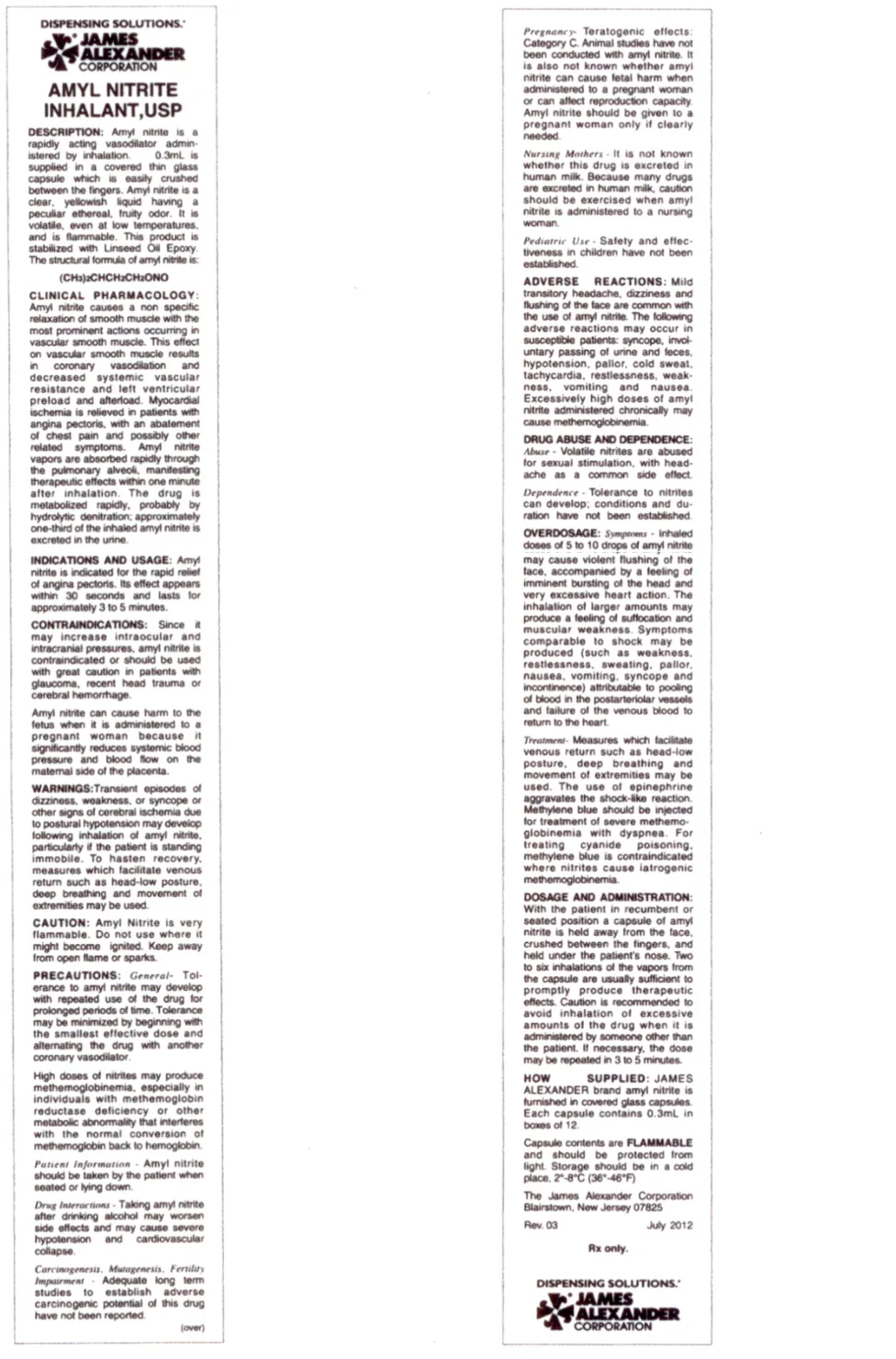
Figure 4. The package insert. Under Drug Abuse and Dependence it says what everyone already knew: volatile nitrites are abused for sexual stimulation. [6]
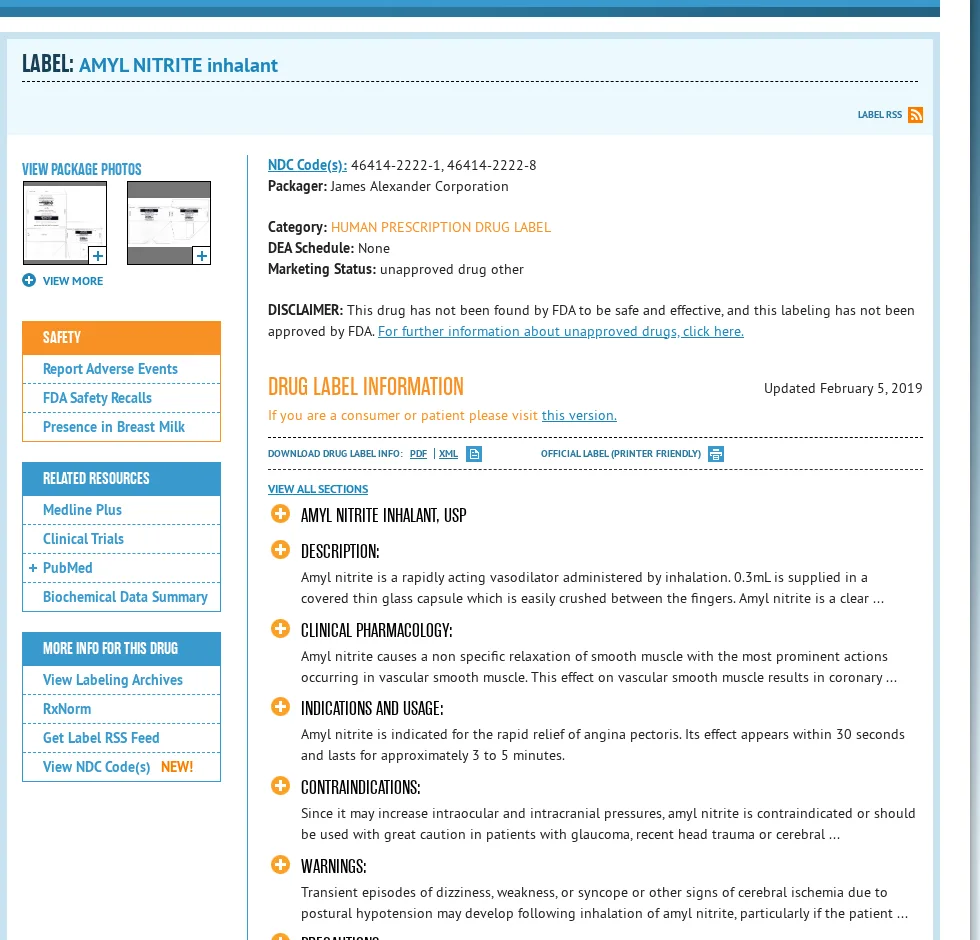
Figure 5. The prescription product's own DailyMed record. Marketing status: unapproved drug other. The medicine poppers are named after has never been through an FDA approval either. [6]
On this site the amyl nitrite page covers the molecule itself. Chemically, all the compounds in this article are esters of nitrous acid: an alcohol whose hydroxyl hydrogen has been replaced by a nitroso group. A different alcohol gives a different nitrite. Amyl nitrite comes from isoamyl alcohol. The straight-chain C5 compound, n-pentyl nitrite, is sold under the same name in some bottles, but the California Law Review's 2024 survey of the trade notes that it “does not share in amyl nitrite's long history of medicinal use”.[7]
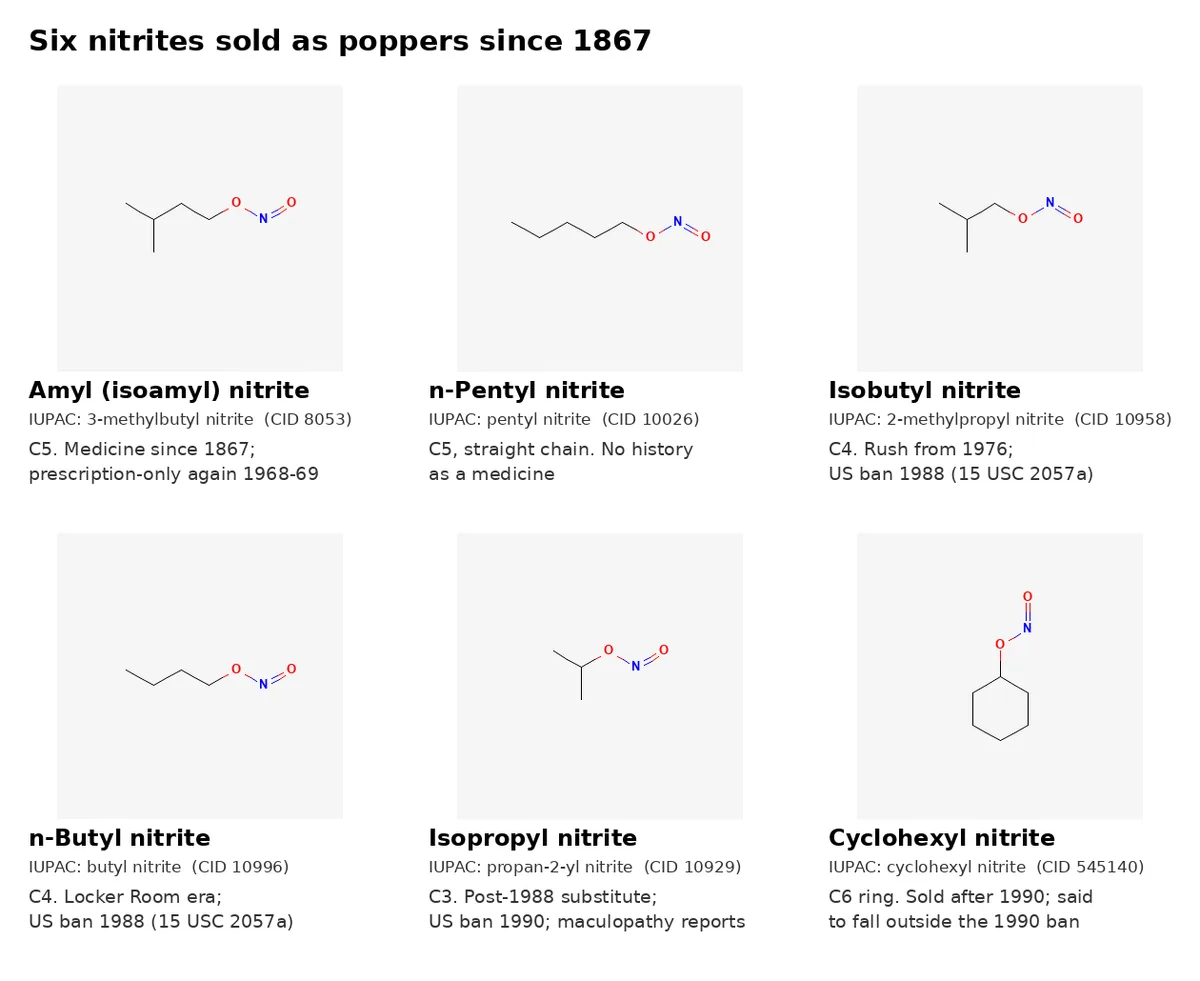
Figure 6. The six nitrites in this story, drawn from PubChem's records. Each is an alcohol joined to nitrous acid through an O-N=O group. The notes under each name are dated in the text below. [8]
Over the counter, and back again
Amyl nitrite became a prescription drug in the United States in 1937. The NIDA review gives the date it stopped being one: “amyl nitrite was initially marketed as a prescription drug in the United States in 1937 and remained a prescription drug until September 1960 when the Food and Drug Administration (FDA) eliminated the prescription requirement”.[4] By then nitroglycerin was replacing it for angina, and pharmacists and manufacturers soon “noticed widespread purchases of amyl nitrite by apparently healthy young men”.[4]
The prescription requirement came back. The two sources disagree about the year. The 1994 review, written by NIDA and CDC staff, says the FDA reinstated it in 1968.[4] The California Law Review note gives 1969 and adds a reason: “Burroughs Wellcome's conservative leaders asked the FDA that amyl nitrite poppers be taken off store shelves”, which it says led in part to the change.[7] We found no FDA document from either year that settles it, so the timeline above shows both.
The room odorizer
Taking amyl nitrite back behind the pharmacy counter did not end demand for it. It created a market for a substitute that no pharmacist controlled. The NIDA review describes what filled it: “butyl nitrites were marketed as liquid incense or room odorizers because the labels on bottles containing butyl nitrites stated that they were not to be inhaled and no health claim was made”.[4]
The first famous brand was Locker Room. The California Law Review note says that “in 1971 Clifford Hassing synthesized butyl nitrite in Los Angeles, naming his concoction Locker Room after its distinctive smell”.[7] The same note, working from the trademark file, says that “In 1974, Clifford Hassing submitted the first trademark application for his poppers brand Locker Room”, describing the goods as a liquid room odorizer, and that the Patent and Trademark Office registered it “since the mark was in commercial use since February of 1970”.[7] The two dates in the same article do not agree. The 1970 date is the applicant's own claim in a filing, so the record supports only that the brand was on sale by the early 1970s.
The second brand was bigger. “In 1976, W. Jay Freezer founded Pacific Western Distributing Corporation”, the note says, and began selling Rush, made from isobutyl nitrite.[7] The company's trademark application described the goods as a “chemical composition sold in an easily openable container as an air scent”.[7] BuzzFeed News, which reconstructed the company's history in 2021, put the workaround plainly: “freezer got around this by tweaking the formula to create an isobutyl nitrite and selling his product as” liquid incense.[9] It reported that “within a year he was bombastically claiming that he had cornered 60% of the market”, a figure a rival disputed at the time.[9] Freezer died in 1985, of AIDS.[9][7]
Where the bottles were sold mattered. “People no longer needed to get amyl nitrite from a pharmacist or a drug dealer but could buy it at sex and adult stores behind the counter”, the law review note says, and “anyone without a prescription could buy poppers in half-ounce or smaller bottles for around $4 to $10 per bottle”.[7] The isobutyl nitrite in Rush has its own page on this site, isobutyl nitrite.
Use was not confined to adults. The NIDA review reports that “Eleven percent of high school seniors interviewed in 1979 reported ever using nitrites”, falling to 1.5% for the class of 1992.[4]
The AIDS hypothesis
On June 5, 1981, the CDC's weekly bulletin reported five young men in Los Angeles with Pneumocystis pneumonia, an infection seen almost only in people whose immune systems had failed. Two had died. One line in the report described their habits: “All 5 reported using inhalant drugs, and 1 reported parenteral drug abuse”.[10] Nitrite use was common among gay men at the time. In a 1981 CDC survey of clinic patients in three cities, 86% of gay and bisexual men reported it, against 15% of heterosexual men, and almost all of the gay men in the CDC's own case-control study did.[4] Poppers became the first suspect.
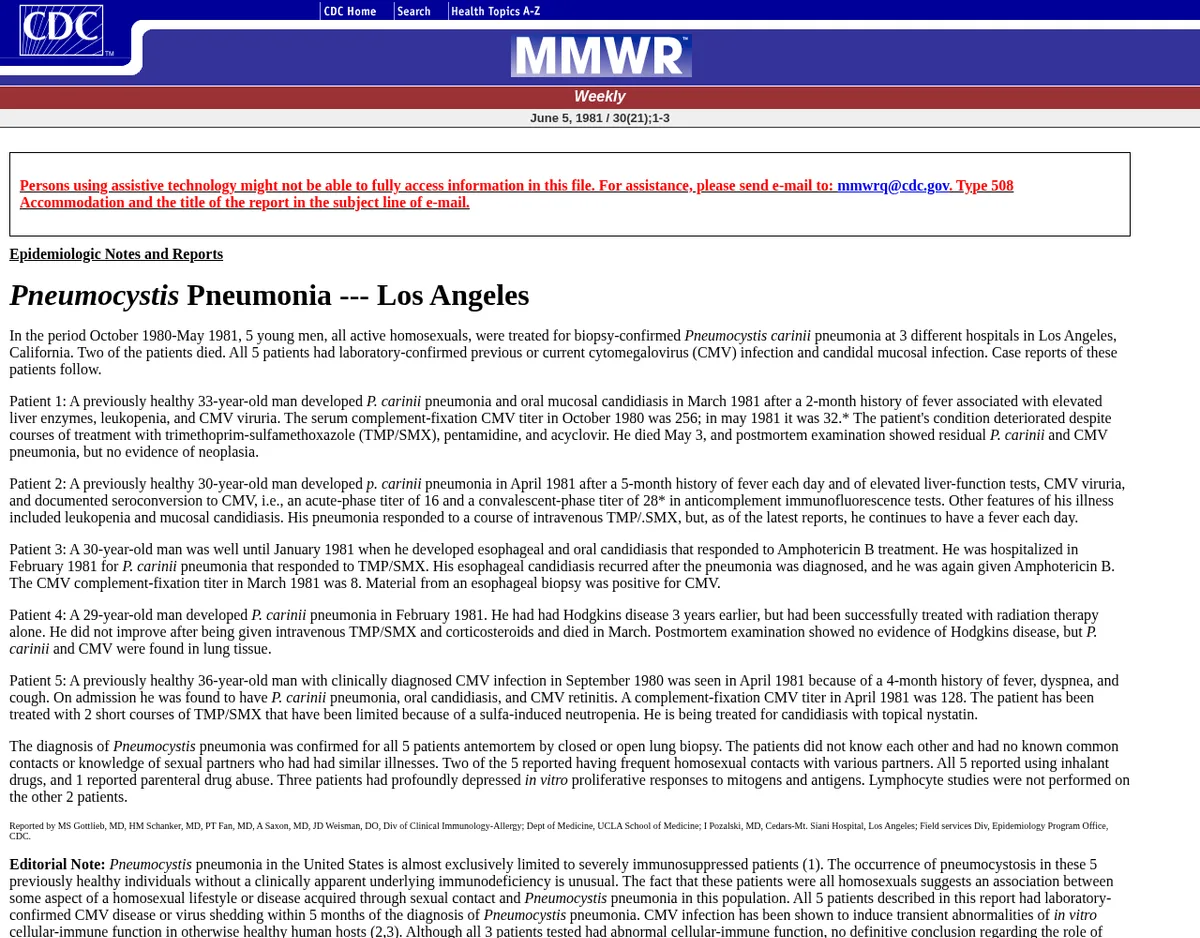
Figure 7. MMWR, June 5, 1981, the first report of what became AIDS. One sentence in it put poppers under suspicion for the next decade. [10]
The evidence moved away from them quickly, though the hypothesis lingered. A year later the CDC described a cluster of cases in Los Angeles and Orange counties linked by sexual contact, which pointed to an infectious agent. The editorial note kept the alternative alive: “Marmor et al. recently reported that exposure to amyl nitrite was associated with an increased risk of KS in New York City”.[11] The CDC's national case-control study, published in August 1983, found that “The variable most strongly associated with illness was a larger number of male sex partners per year”.[12]
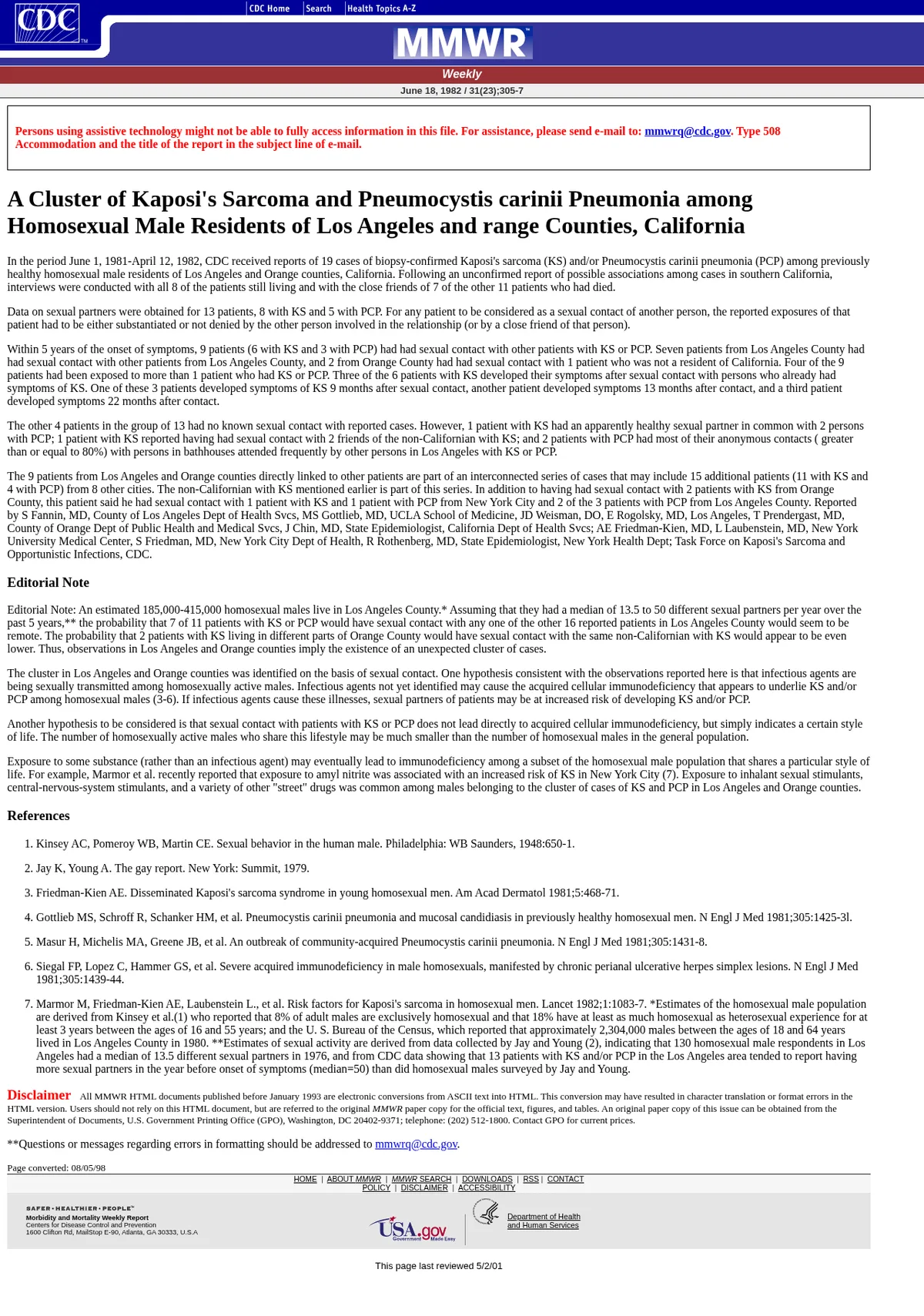
Figure 8. MMWR, June 18, 1982. The cluster of sexual contacts in this report pointed to an infectious agent, and the editorial note still kept the amyl nitrite hypothesis open. [11]
Kaposi's sarcoma was the part that took longest to explain, because it was far more common in gay men with AIDS than in other people with HIV. That pattern is why the 1994 NIDA review still concluded that nitrite use “remains a candidate cofactor in the pathogenesis of AIDS-related Kaposi's sarcoma”.[4] One of that review's four authors, Hank Wilson, was listed with the San Francisco Committee to Monitor Poppers.[4] He and the writer John Lauritsen had argued in a 1986 booklet that the drug was a cause or cofactor of AIDS, complaining that “normally every drug in the US must undergo extensive testing before it can be sold legally. Not poppers”.[9]
The answer came in December 1994, the same month the review was printed. Researchers at Columbia University reported in Science that DNA sequences found in more than 90% of AIDS-related Kaposi's sarcoma tissues “appear to define a new human herpesvirus”.[13] It is now called KSHV, or human herpesvirus 8. The sexual transmission of a second virus explained the pattern the poppers hypothesis had been invented to explain.
The idea did not die with the evidence. In 2025 The Advocate reported a video in which Robert F. Kennedy Jr., who became Secretary of Health and Human Services that year, said that “a hundred percent of the people who died in the first thousand with AIDS were people who were addicted to poppers”.[14] The 1981 report said only that five patients used inhalants, and the 1983 study found sexual contact, not inhalant use, to be the strongest association.[10][12] NBC News reported that it was unclear whether Kennedy knew about the 2025 search before it happened.[3]
The bans of 1988 and 1990
Congress acted twice. The Anti-Drug Abuse Act of 1988 declared butyl nitrite a banned hazardous product under the Consumer Product Safety Act, and the Crime Control Act of 1990 extended the ban to volatile alkyl nitrites generally. Both statutes keep an exception for commercial uses that are not about inhaling the product. The wording of both, and how courts have treated that exception, is set out in this site's deep dive on not for human consumption labels, so it is not repeated here.
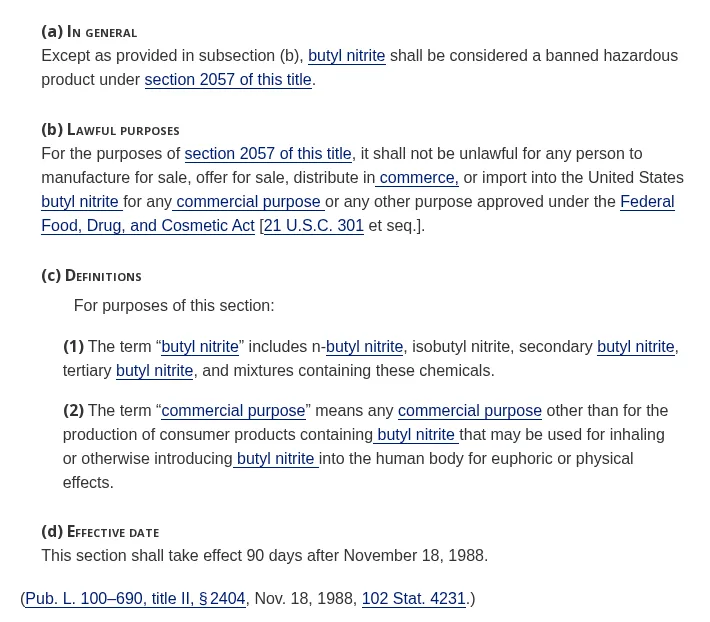
Figure 9. The 1988 butyl nitrite ban as codified. Subsection (b) is the commercial-purpose exception the bottlers have relied on ever since. [15]
What the 1988 law did to the market is the part that belongs to this story. The NIDA review says that “to circumvent the clear intent of the law, nitrite manufacturers began to sell other nitrite alkyl congeners such as isopropyl nitrite” as new and improved room odorizers.[4] That is why the 1990 law was written for the whole family. The CPSC's own explainer of 2002 lists what it covers: “The bans cover products containing n-butyl nitrite, isobutyl nitrite, secondary butyl nitrite, tertiary butyl nitrite, mixtures containing those chemicals, and volatile alkyl nitrite, including isopropyl nitrite”.[16] It adds a detail that explains why the bans are hard to find: “They are not in the Code of Federal Regulations”.[16] No agency ever wrote a rule. The bans exist only in the statute book. The isopropyl nitrite and alkyl nitrites pages cover the chemistry.
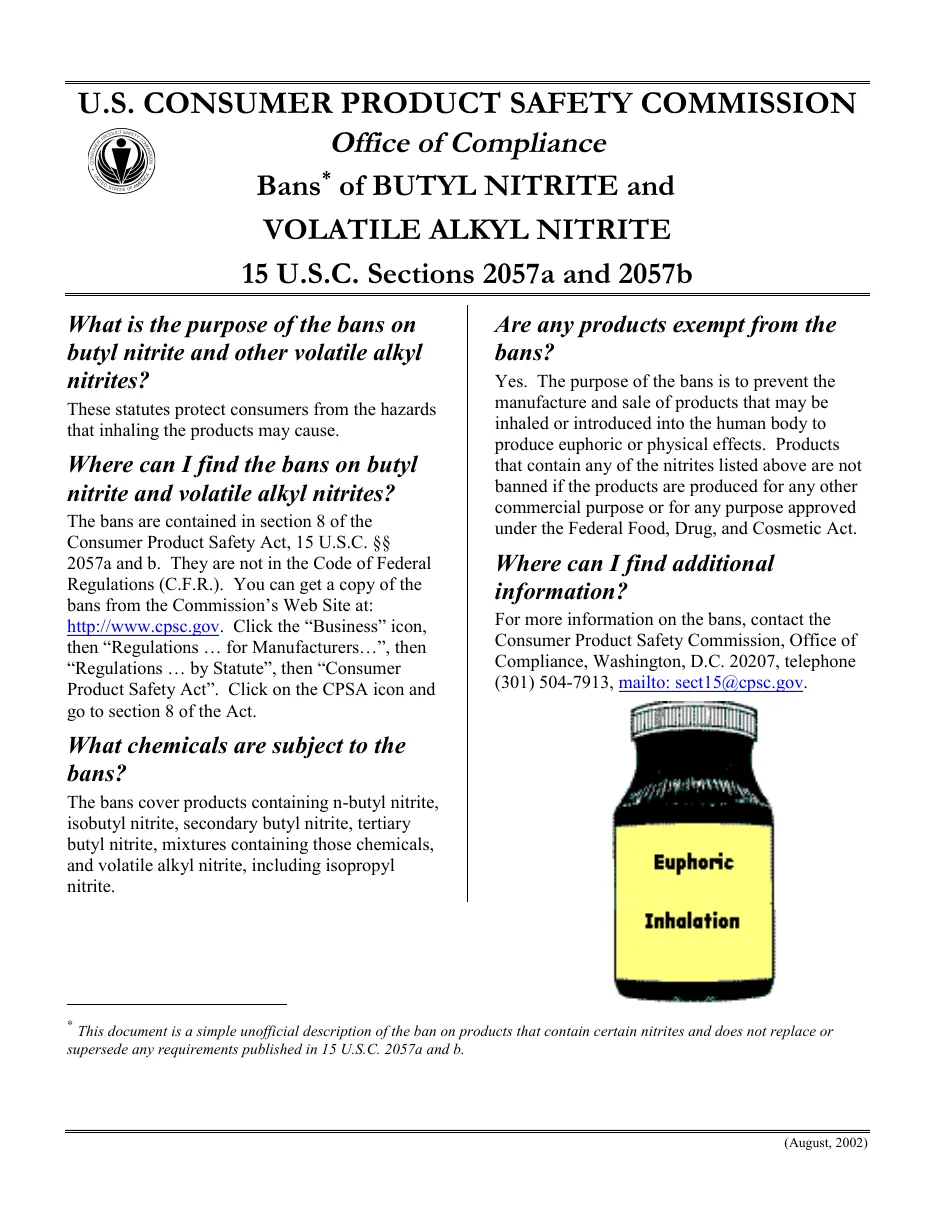
Figure 10. The regulator's own explainer, August 2002. It lists the chemicals the bans cover and illustrates them with a bottle labelled Euphoric Inhalation. [16]
Enforcement fell to the Consumer Product Safety Commission rather than the FDA, and the public record of it is thin. On September 22, 1994, the CPSC announced that it had “accepted a $10,000 civil penalty settlement from Great Lakes Products Inc.” of Indianapolis, which it said had exported volatile alkyl nitrite without notifying the agency.[17] The release named the products as Rush, Hardware, Quicksilver, Bolt and Ram, and noted that the liquid “is legal in many countries, its sale in the United States was banned in 1990”.[17] Great Lakes, the release says, raised the matter with the agency itself and “further denies CPSC's claim that the company knowingly violated the export provisions”.[17]
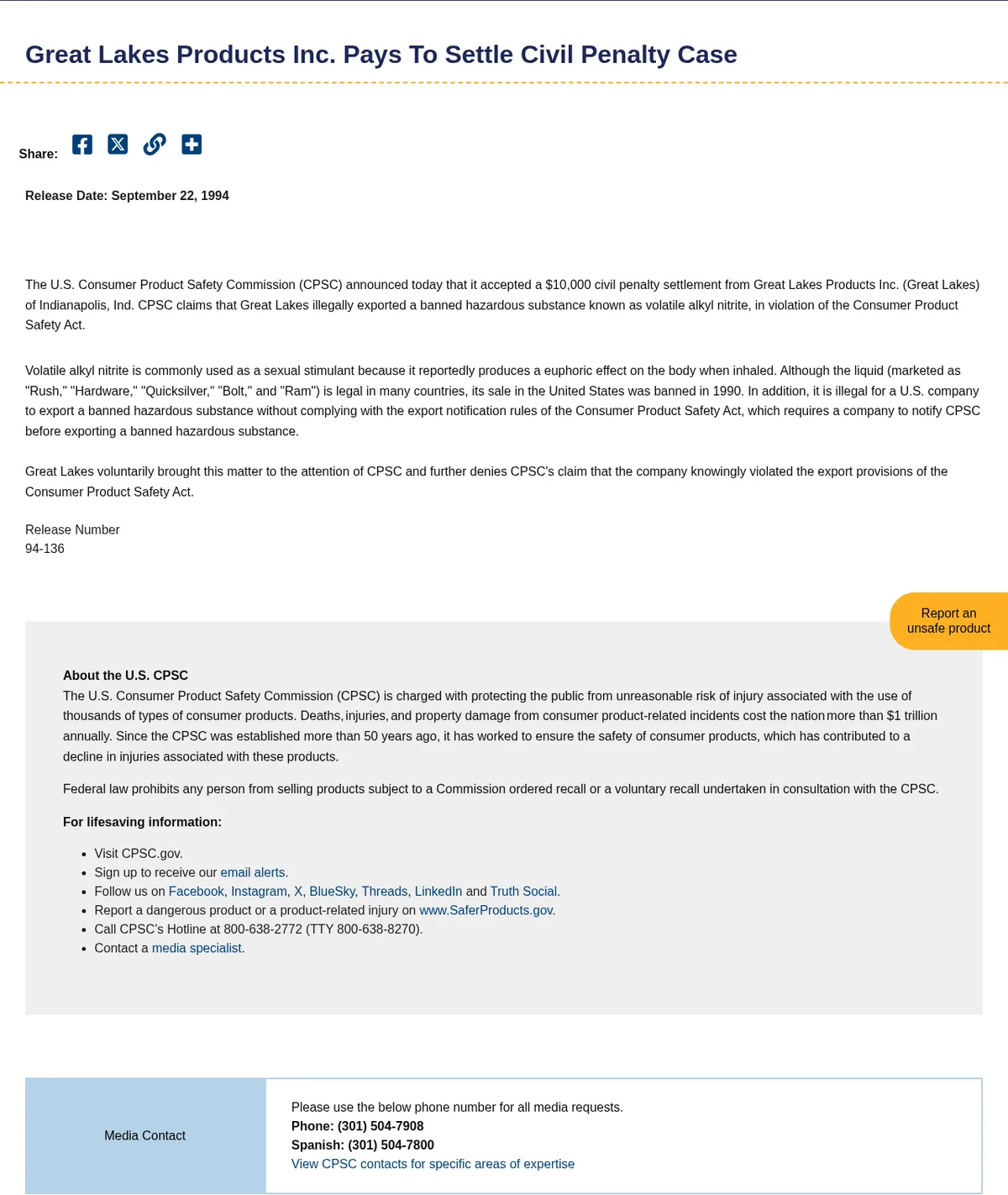
Figure 11. The CPSC's 1994 settlement with Great Lakes Products of Indianapolis, which then owned the Rush brand. The release names five brands and records the company's denial. [17]
Great Lakes was the company that owned Rush by then. According to the law review note, “after Miller bought and absorbed PWD, his company Great Lakes Products Inc. would wait until 1992 to register three poppers brands”.[7] A former CPSC director of regulatory enforcement, Mary Toro, told BuzzFeed News that “poppers manufacturers would try to flout the ban, disappear when regulators took notice, then resurface under different names”.[9] She said her office had limited success: “in 1997, officials successfully criminally prosecuted two men who sold alkyl nitrites, but the pair only received sentences of probation”.[9] The article does not name the case.
Cyclohexyl, and the bottle that says isobutyl anyway
The 1990 ban covered alkyl nitrites. A cyclohexyl group is a ring, not a chain, and the bottlers noticed. The NIDA review observed in 1994 that “according to chemical nomenclature, cyclohexyl nitrites are not in the same class as alkyl nitrites and therefore may not be banned under current federal law”.[4] BuzzFeed News reported that some manufacturers “changed their recipes to make cyclohexyl nitrites, a slightly different chemical compound that wasn't subject to the federal ban”, though the product was less popular than the originals.[9]
The same review said the reformulation was not universal: “underground manufacturers and importers continue to market butyl and isopropyl nitrites illegally”.[4] Twenty-four years later the bottles were still being advertised by their contents. A 2018 seller's post on Reddit's r/poppers offered “PWD Rush 10ml Isobutyl Nitrite Solvent Cleaner”, naming the banned chemical and the cleaning disguise in five words.[18] The FDA's 2021 advisory, discussed below, photographs a Rush bottle with a Power-Pak Pellet cap whose label reads Warning Contents: Isobutyl Nitrite above directions for artificial nails.[19]
The labels themselves rarely fooled the people who bought them. In 2017 a poster in the same subreddit asked of Jungle Juice Black Label, sold as leather cleaner: “do you think it will actually work as a cleaner”.[20] This site's owner wrote in a July 2026 Reddit thread that amyl nitrite “is sold as a cleaning product to circumvent the law”, and added: “I haven't seen legit amyl nitrite since I was a kid.”[21]
The trademark file
A brand needs a registered mark to sue a counterfeiter, and a mark needs goods. Poppers companies have spent fifty years telling the Patent and Trademark Office that their goods are something else. The California Law Review note, by two Berkeley law students, read the file. It found room odorizers in the 1970s and 1980s, then cleaners, nail polish removers and incense. In 2011 the Canadian company Lockerroom Marketing opposed a rival's attempt to register Locker Room for leather cleaner and nail polish remover. Its opposition said that “isobutyl nitrate is considered by some to be a euphoric sex enhancing inhalant”, which the note calls “seemingly the first time that poppers' recreational usage had been mentioned” to the Office.[7]
The Rush marks changed hands several times. The note traces them from PWD to Great Lakes, then to an Arizona company, Grand Canyon Products, and finally: “In 2015, Pac-West was born through a transfer of Grand Canyon's trademarks, and it remains the current owner of Rush and other poppers brands today”.[7]
Pac-West's fight with a former licensee reached a federal court in Philadelphia. AFAB Industrial Services, a Pennsylvania bottler owned by Everett Farr III, argued that Pac-West's trademarks were unenforceable because the products were really drugs. Pac-West's amended complaint said its marks were used for “all purpose cleaners, cleaning preparations, incense, desiccants, nail polish remover, and other related products”.[22] On August 4, 2020, Judge Pratter declined to look behind the pleading: “the Court certainly refrains from speculating as to the legality of Pac-West's products based on AFAB's presented submissions and inferences”.[22] Footnote 15 of the same ruling defines the word the body avoids. Poppers, it says, “are recreational drugs inhaled to achieve a high and said to facilitate anal intercourse”.[22]
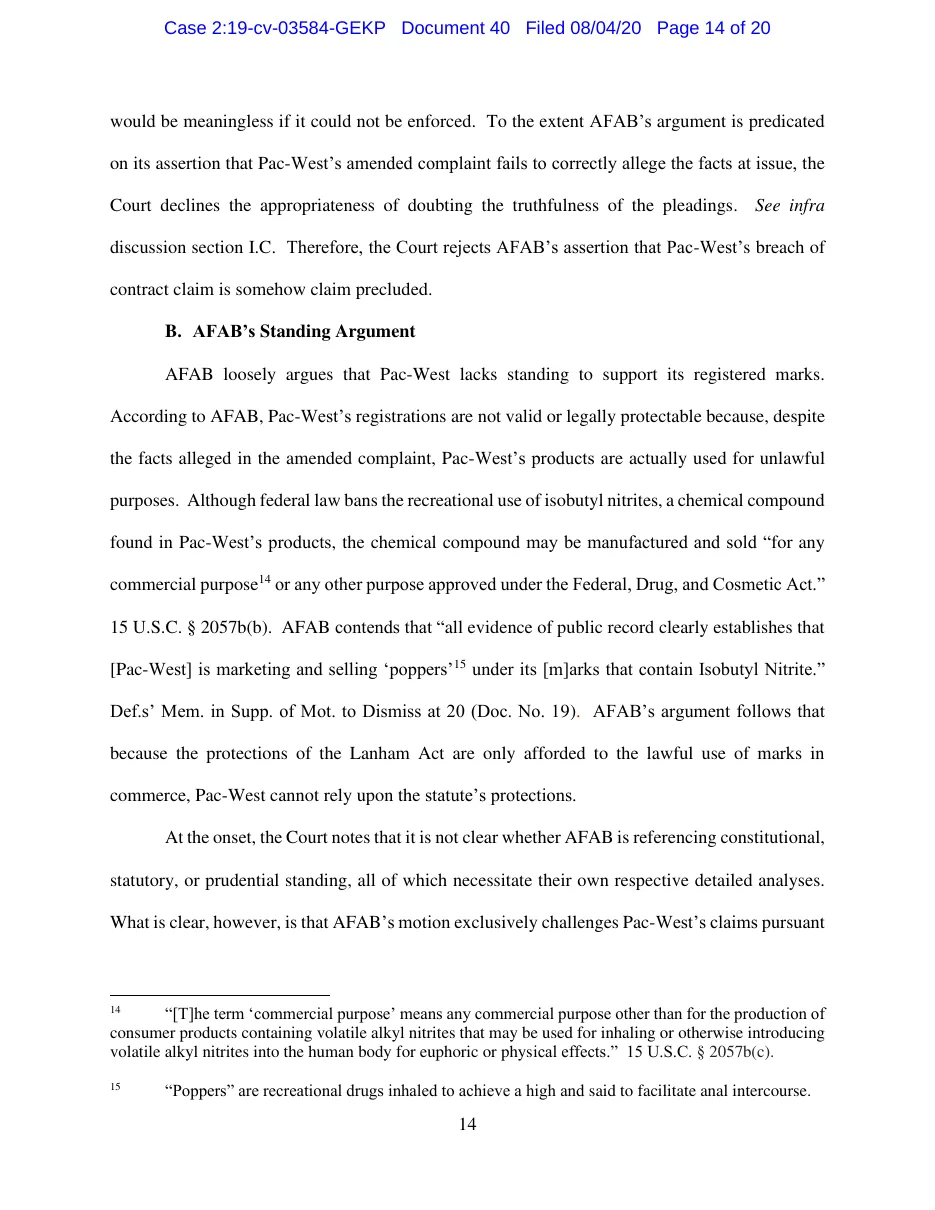
Figure 12. Page 14 of the 2020 ruling in the Rush trademark fight. The body speaks of cleaning products; footnote 15 says what poppers are. [22]
Farr spoke to BuzzFeed News in 2021. He let the reporter into his factory on the condition that his labels were described exactly. “As far as I'm concerned, I sell nail polish remover”, he said.[9] The article reports that “in 2009, Farr registered an official patent for a nail polish remover composed of an alkyl nitrite solvent”, and that his lawyers rely on the commercial-purpose exception in the 1990 law.[9] The law review note, citing the court record, says Farr “alleged that he controlled 75 percent of the U.S. poppers market and produced 23,000 bottles a day”.[7] That is his estimate. There are no trade figures to check it against.
Europe moves to isopropyl
Britain never banned poppers outright, but it did change which nitrite went into them. A 2012 case series in the journal Eye explains that “Isobutyl nitrite was thus illegal to supply in the UK from August 2007”, after European rules reclassified it as a carcinogen.[23] The bottles were refilled: “in 2007, following legislative changes, there was a change in the most commonly used compound from isobutyl nitrite to isopropyl nitrite”.[23] Poppers stayed “legal to purchase but illegal to sell for human consumption”.[23]
Then the eye reports began. French ophthalmologists had described damage to the fovea, the centre of the retina, in poppers users from 2010. The 2012 series added seven patients from four UK hospitals with central blind spots and visual distortion, and noted that there were no reports of what it called poppers maculopathy before the switch to isopropyl nitrite.[23] The brands in its case table include Liquid Gold, Jungle Juice and Ram.[23]
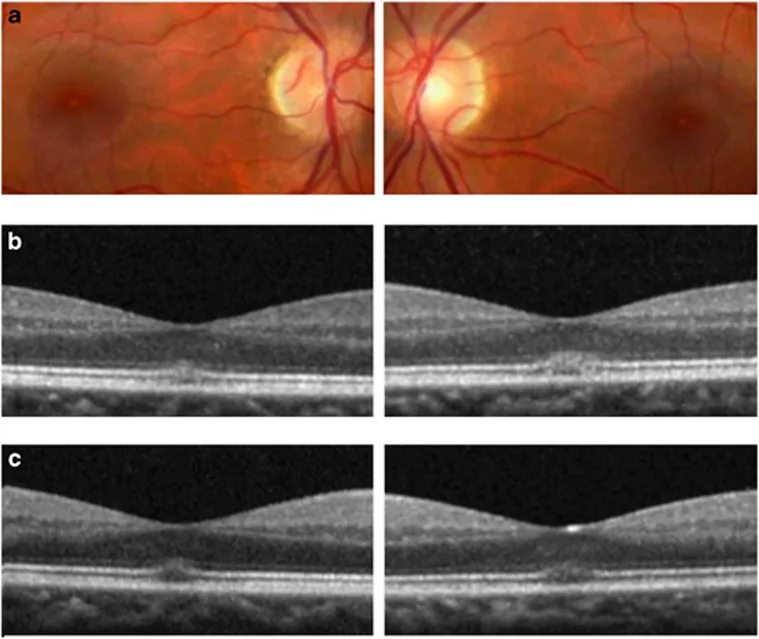
Figure 13. Case 2 in the 2012 UK case series: yellow foveal lesions in January 2010, then OCT scans in October 2010 and December 2011 showing the damage spreading after fourteen more months of use. [23]
In October 2026 a poster on r/askgaybros described waking after a long night of use with a blind spot, writing that an “OCT scan at the doctors show a tiny spot in my eye has been damaged which is what the blind spot is”.[24] The most informed reply pointed to isopropyl nitrite and admitted: “I have no idea which poppers contain that”.[24]
Britain decides poppers are not psychoactive
In January 2016 the UK's Psychoactive Substances Bill proposed a blanket ban on anything that produced a psychoactive effect, with listed exemptions. Poppers were not on the list. During the Commons debate on January 20, Crispin Blunt, Conservative MP for Reigate, said that “the Government are about to do something fantastically stupid”, and went on: “I use poppers. I out myself as a popper user and would be directly affected by the Bill”.[25]

Figure 14. Crispin Blunt, then Conservative MP for Reigate, in his official parliamentary portrait. On 20 January 2016 he told the Commons he used poppers. [25]
The government asked its drug advisers. The Advisory Council on the Misuse of Drugs replied on 16 March 2016. It described the market in one sentence: “The legally available form is isopropyl nitrite sold in small sealed bottles, often with colourful labels, as air freshener, video head cleaner or finger nail polish remover”.[26] Its pharmacology was the deciding point. The council held that “substances having peripheral effects, such as those caused by alkyl nitrites, do not directly stimulate or depress the central nervous system”, so poppers “do not fall within the scope of the current definition of a” psychoactive substance under the Act.[26] No exemption was needed, because the law did not reach them.
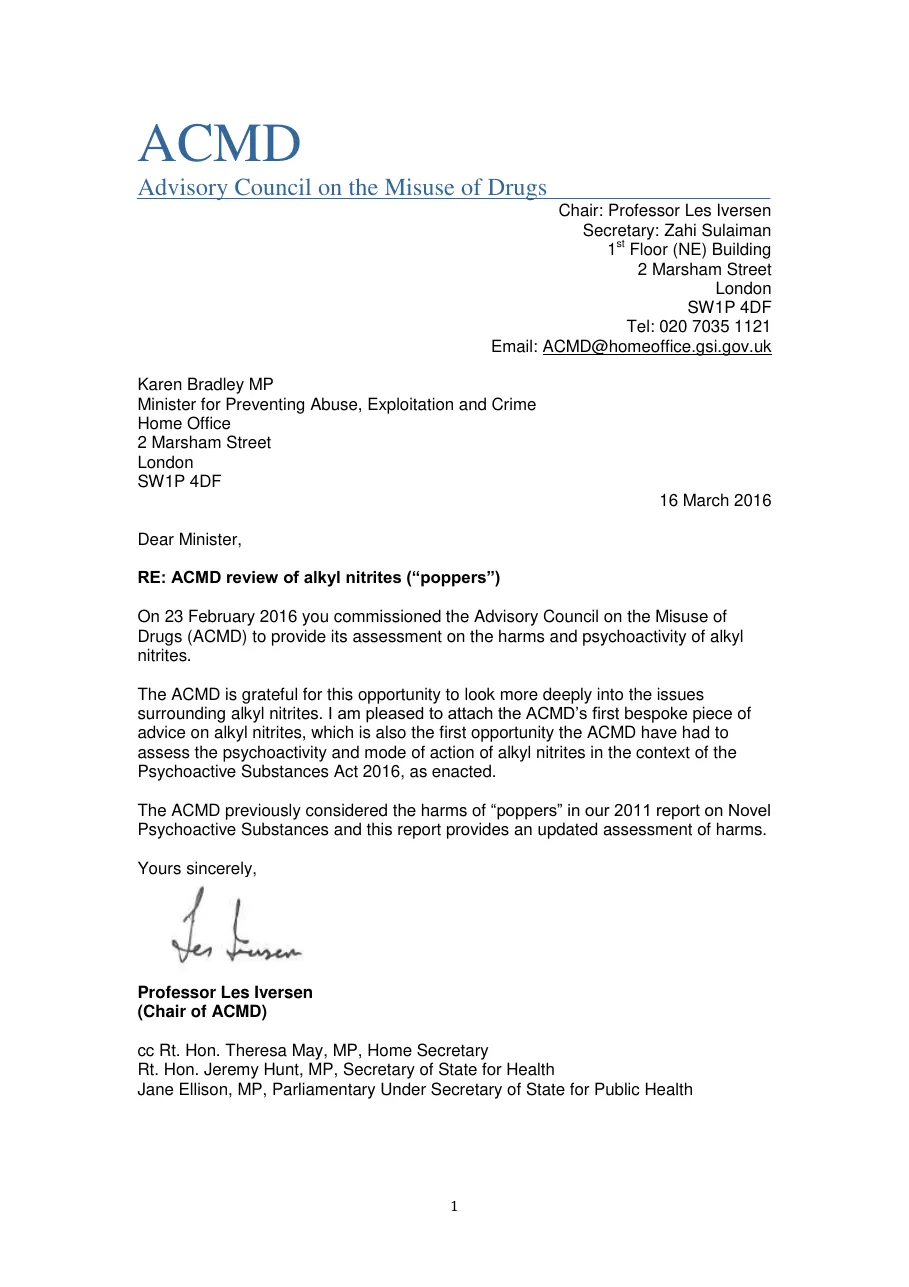
Figure 15. The ACMD's cover letter of 16 March 2016. The advice it attached concluded that poppers were outside the new Act altogether. [26]
Australia went the other way, then partway back. The law review note records that a 2018 proposal from the Therapeutic Goods Administration would have put alkyl nitrites in Schedule 9, beside heroin. After public submissions, “the updated regulation put the alkyl nitrite family as Schedule 4 substances, which also required a doctor's prescription”, with amyl nitrite in child-resistant packaging allowed as a pharmacy medicine.[7]
Canada calls them drugs
Health Canada took the opposite view from the UK, and took it first. On May 16, 2013, it issued an advisory about three products, Rochefort, Rush and Amsterdam Special, labelled as leather cleaners or liquid incense. Its finding on the label was blunt: “Health Canada is not aware of credible evidence confirming that alkyl nitrites are legitimately used in consumer products such as leather cleaners, room odourisers or liquid incense”.[27] It went on to say that “even though these products are labelled as consumer products, they are manufactured and sold so that users can” get high.[27] The advisory named the distributor as Lockerroom Marketing Ltd. of Delta, British Columbia.[27]
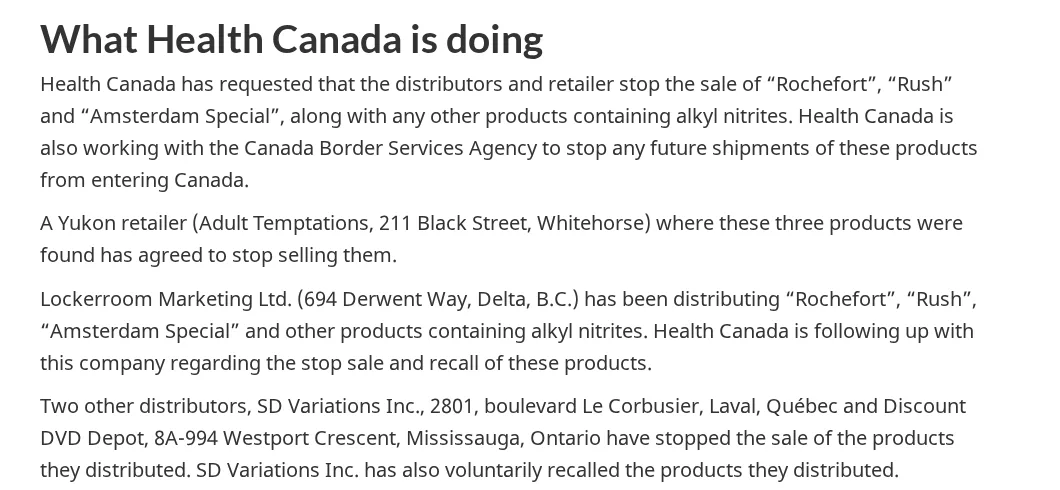
Figure 16. Health Canada, May 16, 2013. Three bottles labelled as leather cleaner or liquid incense, and the British Columbia company the advisory names as their distributor. [27]
The follow-up notice, first posted on June 27, 2013 and updated until 2017, stated the legal position: “products containing alkyl nitrites are considered drugs under the Food and Drugs Act and must be authorized by Health Canada to be legally sold”.[28] It then listed shops across the country where products had been found, among them Rush, Super Rush, Gold Rush, Jungle Juice Plus, Jungle Juice Platinum and Amsterdam, several of them flagged as labelled nail polish remover.[28]
The FDA speaks, then acts
The Advocate wrote in 2025 that the FDA had until then mostly stayed away from poppers.[14] On June 24, 2021, it issued an advisory. It named the products: “Brand names include Jungle Juice, Extreme Formula, HardWare, Quick Silver, Super RUSH, Super RUSH Nail Polish Remover and Premium Ironhorse, among others”.[19] It gave the reason: “The FDA has observed an increase in reports of deaths and hospitalizations”.[19] An FDA spokesperson later told BuzzFeed News the advisory followed about twenty serious adverse event reports, “only six of which had occurred in 2020 and 2021”.[9]
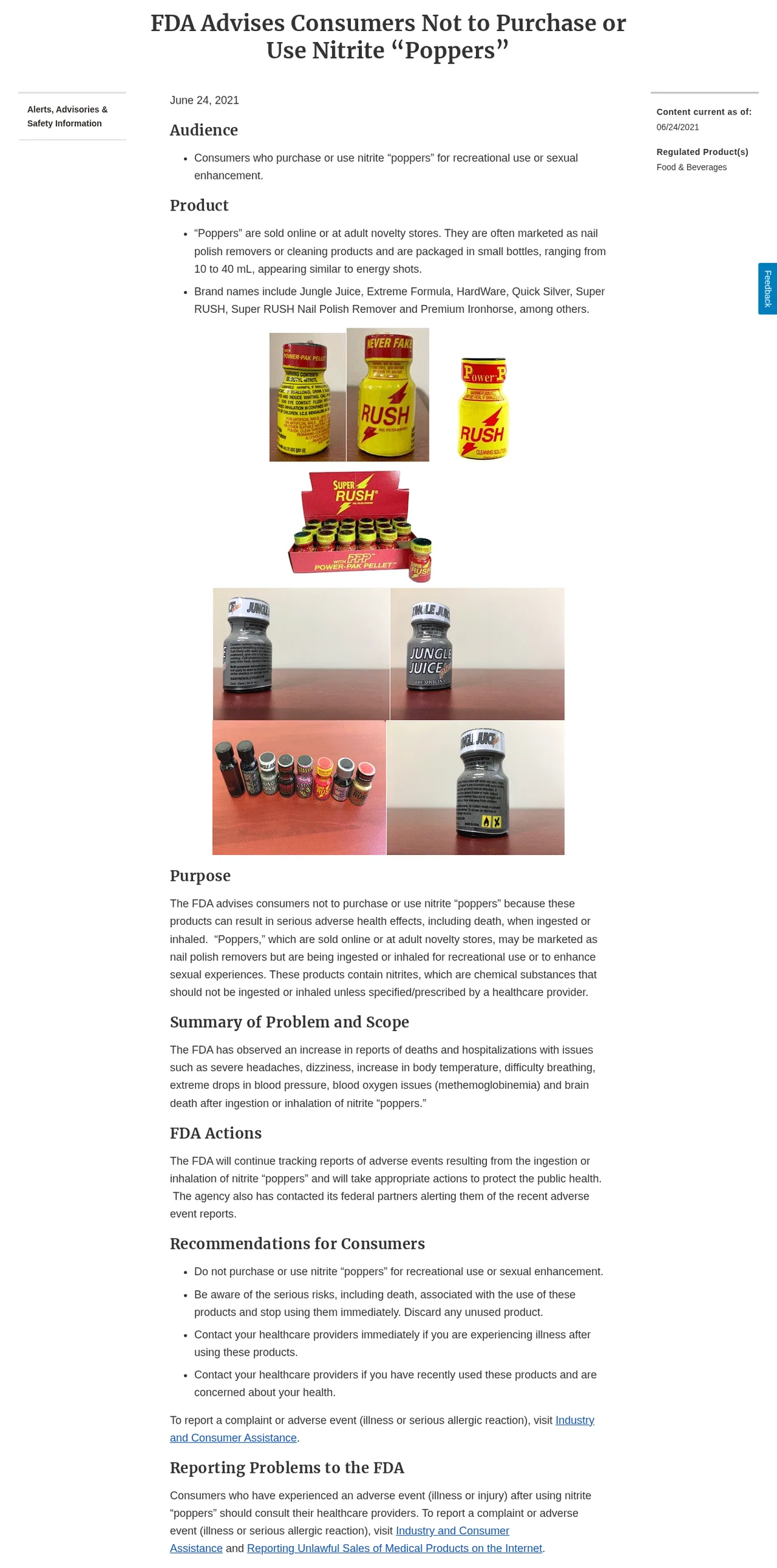
Figure 17. The FDA advisory of June 24, 2021. The first bottle's label reads Warning Contents: Isobutyl Nitrite, gives directions for artificial nails, and cites the Food, Drug, and Cosmetic Act by its US Code section. The Rush bottles beside it say nail polish remover and cleaning solution. [19]
A consumer update three weeks later said that “poppers have not been evaluated by the FDA for safe use”, and that “manufacturers are packaging and labeling these products in a way that may mislead consumers into thinking the poppers are safe or intended to be inhaled or ingested by drinking”.[29] Its list of brand names includes Locker Room, the mark first filed in 1974.[29] What the FDA wrote about the labels is covered in the companion deep dive. What it wrote about drinking them is the newer problem.
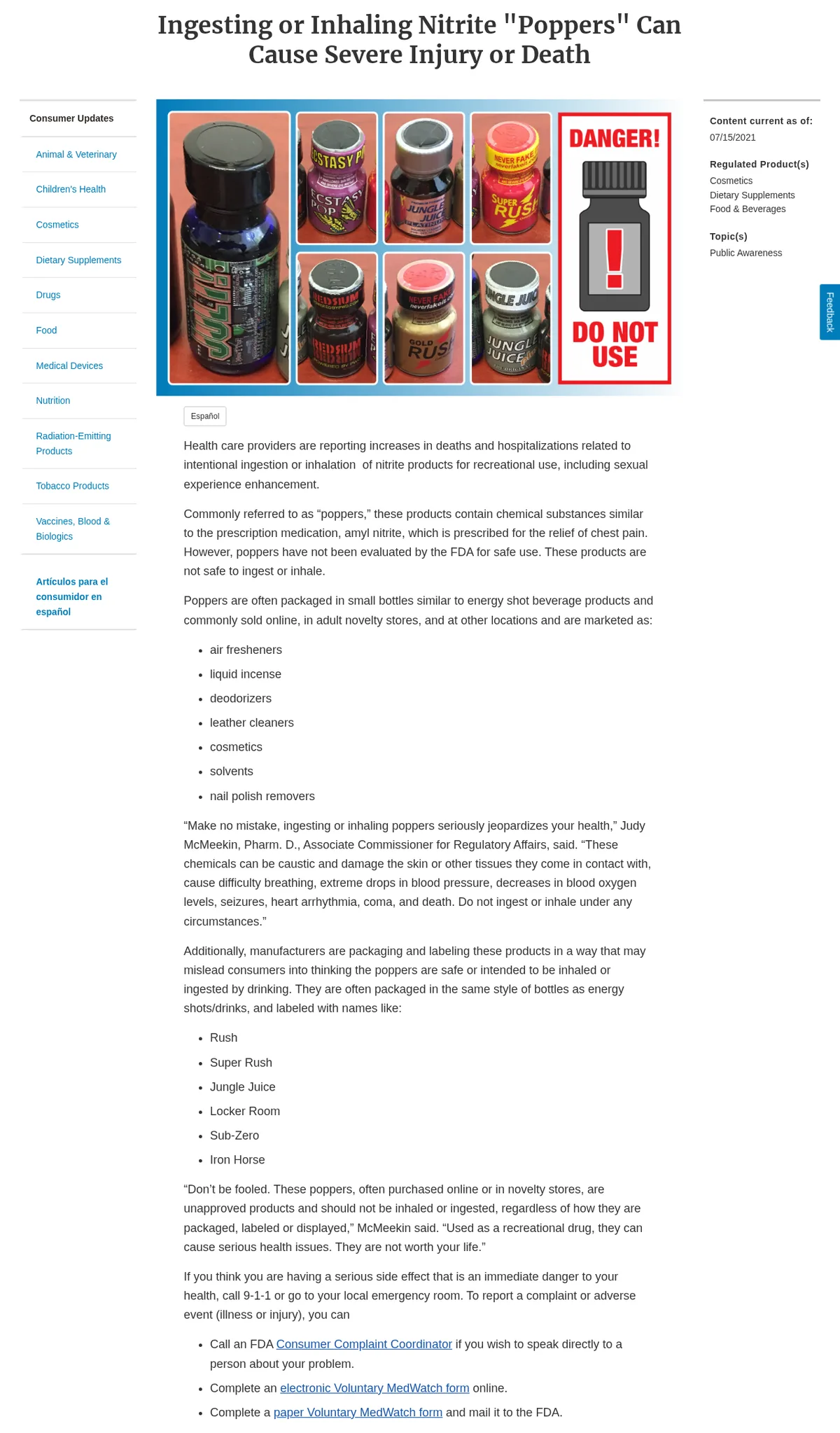
Figure 18. The consumer update of July 15, 2021. It lists seven disguises and six brand names, Locker Room among them, fifty years after that name was registered. [29]
People are drinking them
The bottles look like energy shots, and some people have treated them as one. New York City's health department warned clinicians on June 22, 2023, that “users have ingested poppers thinking it was an energy drink”, and that nitrite “ingestion delivers a much higher amount than a single inhalation and can significantly increase risk”.[30] The danger is methemoglobinemia, in which the blood's hemoglobin is oxidized and stops carrying oxygen. Its signs include blue lips and skin. In September 2026 a poster on r/askgaybros asked: “Anyone else get purple after a couple of sniffs from a bottle of poppers”.[31] The replies told them to stop.
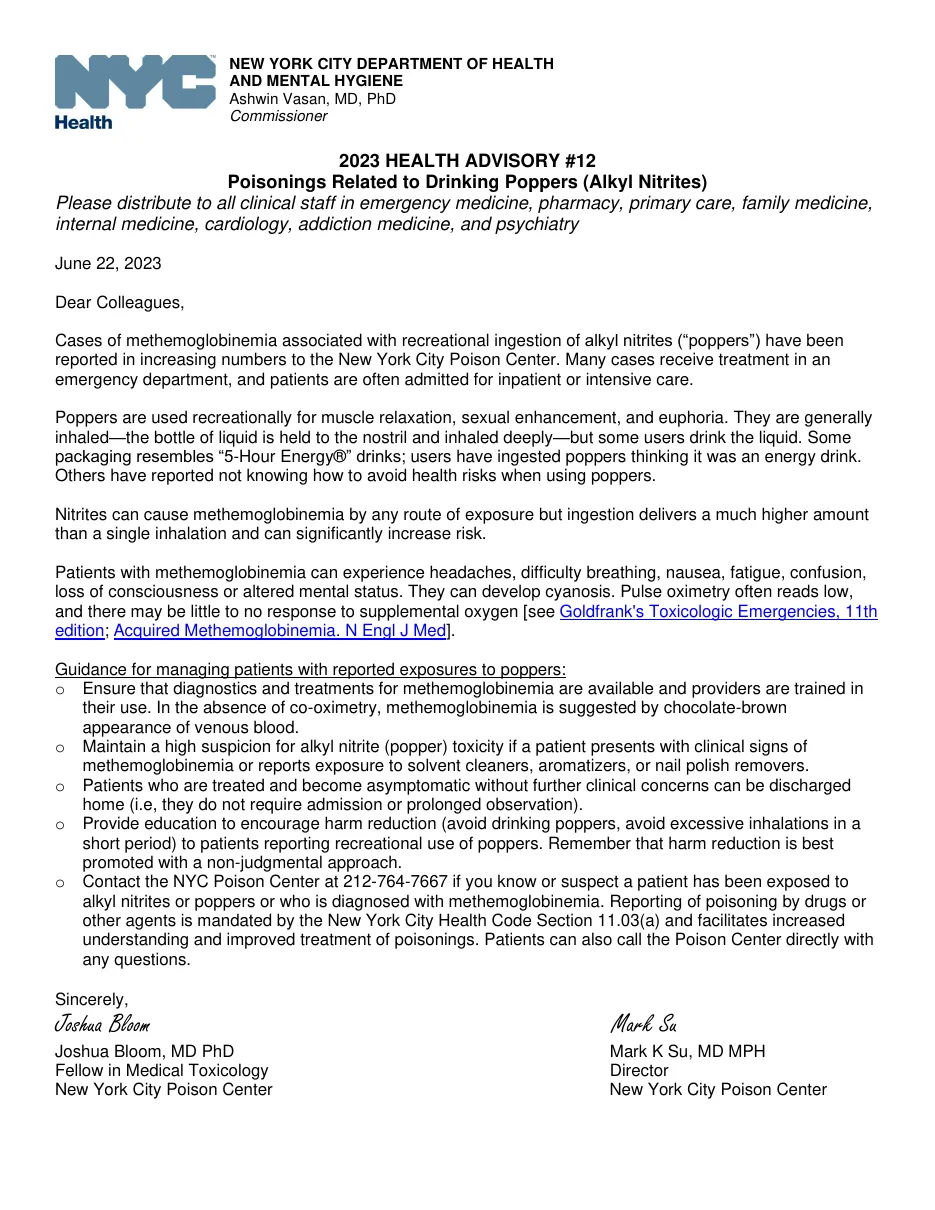
Figure 19. New York City's health advisory of June 22, 2023. The problem it describes is people drinking the bottles, some because they looked like energy shots. [30]
Physicians at NYU and the New York City Poison Center, one of them a signer of that advisory, then counted the cases nationally. In a July 2025 paper in JAMA Network Open, they reported that across US poison centers “exposures involving inhalation increased from 52 in 2013 to 228 in 2023” and “exposures involving ingestion increased from 78 in 2013 to 277 in 2023”.[32] The severe ones grew faster among the drinkers: “ingestion exposures increased from 2 cases (2.6%) to 38 cases (13.7%)” with a major or fatal outcome.[32] The authors suggest the rise in drinking is “possibly because of packaging that closely resembles energy shot beverage products”.[32]
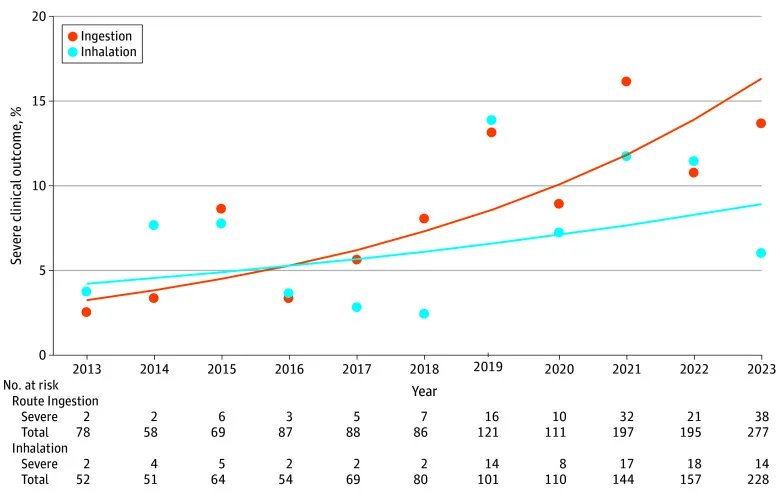
Figure 20. US poison-center exposures to poppers, 2013 to 2023, from JAMA Network Open. The share with a severe outcome rose steeply for ingestion and slowly for inhalation. [32]
Viagra and the nitrite warning
The other interaction that kills is printed on every box of sildenafil. Pfizer's prescribing information for Viagra says that its use with “organic nitrates or organic nitrites in any form” is contraindicated, because the two together can drop blood pressure severely.[33] The patient leaflet names the street form directly, telling patients not to take Viagra if they “use street drugs called poppers such as amyl nitrate or amyl nitrite and butyl nitrate”.[33] See sildenafil and tadalafil.
The warning has not reached everyone. In September 2026 a poster on r/askgaybros wrote that “a guy I was hooking up with recently told me a daily cialis regimen and poppers is fine”.[34] A commenter who said they were a sexual health nurse answered: “Any PDE5 inhibitors are contraindicated with nitrates”.[34]
March 2025
Double Scorpio had sold its bottles as cleaners. The archived storefront of February 23, 2025 filed them under a menu heading of that name, beside candles, lube and apparel.[35] One of its founders had told BuzzFeed News in 2021: “We sell cleaners, not poppers”.[9] On the February capture, three weeks before the search, every bottle on the home page is already marked unavailable while the candles are still for sale.[35] The record does not say why.
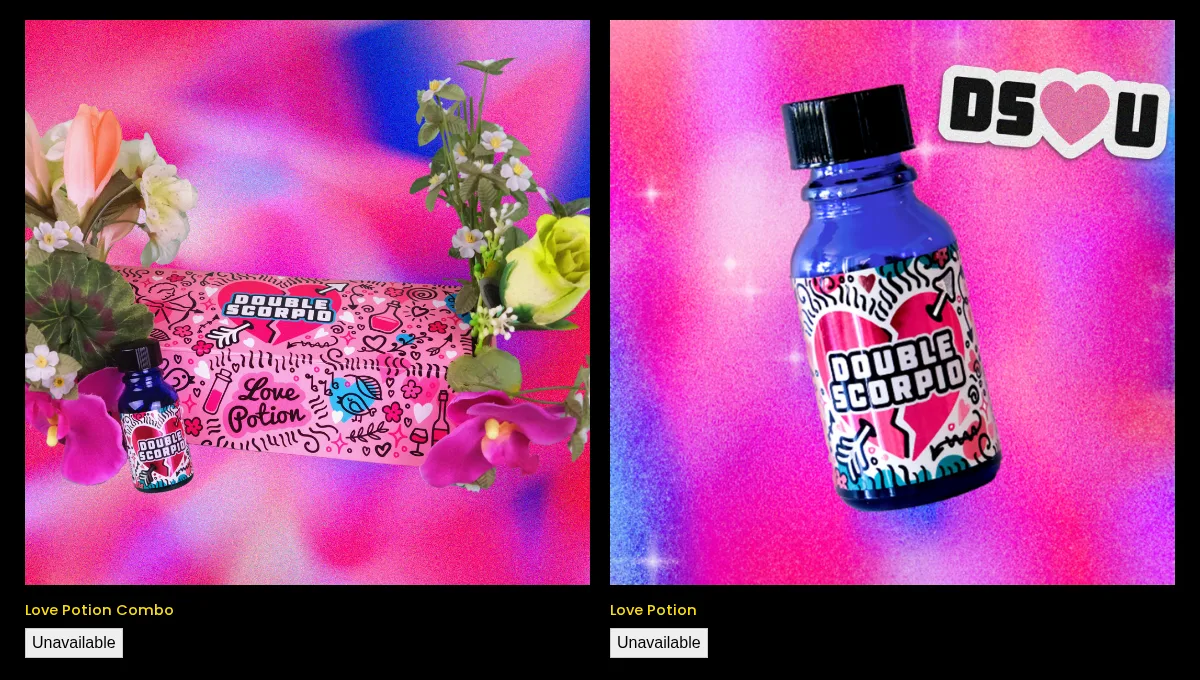
Figure 21. Double Scorpio's storefront as archived on February 23, 2025. Its menu filed the bottles under Cleaners. Every bottle on the page was already marked unavailable. [35]
On March 13 the notice went up, and by the next day it was all the site said.[1] It added that “we believe that the FDA has performed similar actions towards other companies recently”.[1] The FDA has not said which companies, under what authority, or whether anyone has been charged. As of this writing we have found no indictment, consent decree or warning letter from the 2025 actions in the public record.
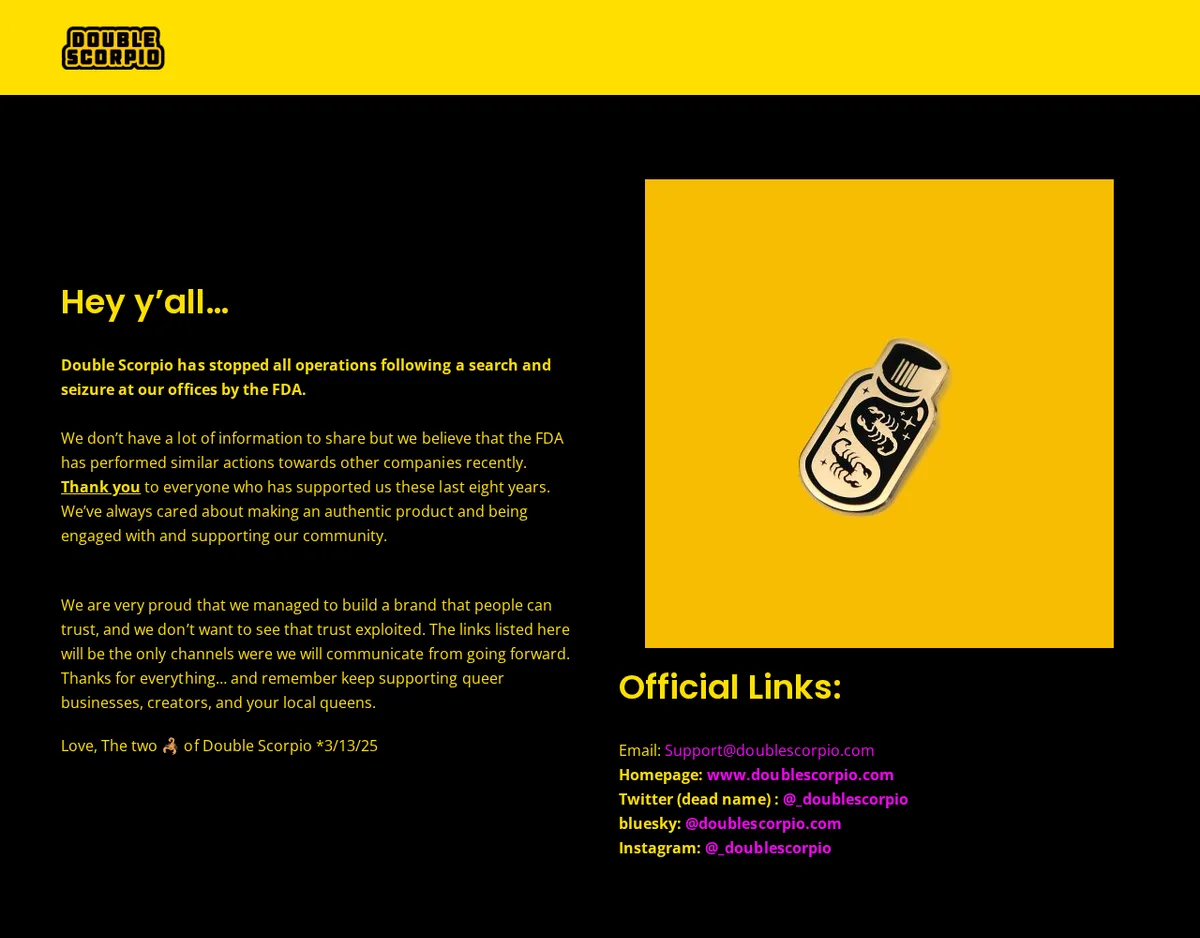
Figure 22. The same address on March 14, 2025, the day after the notice was posted. [1]
Farr told the Los Angeles Times the week after: “this is not my first rodeo”.[2] Each earlier rule in this story ended with the same bottle refilled with a neighbouring nitrite. Whether this one ends differently depends on filings nobody has seen yet.
Still open
- Which nitrite is in which bottle now. No US regulator has published an analysis of what the 2025 shelf actually contains. The Australian testing the law review note cites is the nearest public analysis we found.[7]
- The 1997 prosecution described to BuzzFeed News by a former CPSC official. A search of the sources above found no case name.
- The legal basis for the 2025 search. The FDA would not comment, and no filing has surfaced.
- The 1968 or 1969 date for the return of the prescription rule. We found no FDA notice from either year.
Changes
- 2026-10-11: First version.
References
- Double Scorpio home page: notice of 3/13/25 — Wayback Machine capture, 2025-03-14
- FDA crackdown on poppers prompts rush on popular gay party drug — Sonja Sharp, Los Angeles Times, syndicated by Yahoo News, 2025-03-21
- FDA reportedly raids manufacturer of poppers, an increasingly popular party drug — Benjamin Ryan, NBC News, 2025-03-14
- Nitrite inhalants: history, epidemiology, and possible links to AIDS — Haverkos, Kopstein, Wilson and Drotman, Environmental Health Perspectives 102(10):858-861, 1994
- On the use of nitrite of amyl in angina pectoris (reprinted from The Lancet, July 27, 1867) — T. Lauder Brunton, 1867; Wellcome Collection copy at the Internet Archive
- AMYL NITRITE inhalant (James Alexander Corporation), drug label — DailyMed, US National Library of Medicine
- Sex, Drugs, Innovation, Law: Regulating the Legality of 'Poppers' — Lawrence Myung and William P. Kasper, California Law Review vol. 112, August 2024
- PubChem compound records for CIDs 8053, 10026, 10958, 10996, 10929 and 545140 (IUPAC names) — PubChem, US National Library of Medicine
- This Man Does Not Make Poppers — David Mack, BuzzFeed News, 2021-07-27
- Pneumocystis Pneumonia, Los Angeles. MMWR 30(21):1-3 — US Centers for Disease Control, 1981-06-05
- A Cluster of Kaposi's Sarcoma and Pneumocystis carinii Pneumonia among Homosexual Male Residents of Los Angeles and Orange Counties, California. MMWR 31(23):305-7 — US Centers for Disease Control, 1982-06-18
- National case-control study of Kaposi's sarcoma and Pneumocystis carinii pneumonia in homosexual men: Part 1, epidemiologic results — Jaffe et al., Annals of Internal Medicine 99(2):145-151, August 1983 (PubMed abstract)
- Identification of herpesvirus-like DNA sequences in AIDS-associated Kaposi's sarcoma — Chang et al., Science 266(5192):1865-1869, December 1994 (Europe PMC record)
- Trump is coming for your poppers: major producer closes amid FDA crackdown — Mey Rude, The Advocate, 2025-03-14
- 15 U.S. Code § 2057a. Banned hazardous products (butyl nitrite) — Legal Information Institute, Cornell Law School
- Bans of Butyl Nitrite and Volatile Alkyl Nitrite, 15 U.S.C. Sections 2057a and 2057b — US Consumer Product Safety Commission, Office of Compliance, August 2002
- Great Lakes Products Inc. Pays To Settle Civil Penalty Case (release 94-136) — US Consumer Product Safety Commission, 1994-09-22
- Rush Poppers 10ML (a seller's post), r/poppers — Reddit, 2018-04-24, read through the Arctic Shift archive — anecdotal report, not evidence
- FDA Advises Consumers Not to Purchase or Use Nitrite "Poppers" — US Food and Drug Administration, 2021-06-24
- can you actually use jungle juice black label as a leather cleaner?, r/poppers — Reddit, 2017-08-25, read through the Arctic Shift archive — anecdotal report, not evidence
- Comments by u/saintpetejackboy in a thread about leaked poppers, r/Drugs — Reddit, 2026-07-09, read through the Arctic Shift archive — anecdotal report, not evidence
- Pac-West Distributing NV LLC v. AFAB Industrial Services, Inc., No. 19-3584, memorandum (Doc. 40) — US District Court for the Eastern District of Pennsylvania (Pratter, J.), 2020-08-04, via CourtListener RECAP
- Adverse ophthalmic reaction in poppers users: case series of 'poppers maculopathy' — Davies et al., Eye 26(11), 2012 (PMC3496104)
- Blind spot in central vision (poppers maculopathy), r/askgaybros — Reddit, 2026-10-02, read through the Arctic Shift archive — anecdotal report, not evidence
- Psychoactive Substances Bill [Lords], House of Commons, 20 January 2016: contribution of Crispin Blunt — Hansard, UK Parliament (Hansard API record)
- ACMD review of alkyl nitrites ('poppers') — Advisory Council on the Misuse of Drugs (UK), letter and advice to Karen Bradley MP, 2016-03-16
- Marketed leather cleaners and liquid incense are being used to get high, poses serious dangers to Canadians (RA-29269) — Health Canada, 2013-05-16 (archived advisory)
- Poppers sold across Canada pose serious risks — Health Canada, 2013-06-27, information update posted 2017-06-30
- Ingesting or Inhaling Nitrite "Poppers" Can Cause Severe Injury or Death — US Food and Drug Administration consumer update, content current as of 2021-07-15
- 2023 Health Advisory #12: Poisonings Related to Drinking Poppers (Alkyl Nitrites) — New York City Department of Health and Mental Hygiene, 2023-06-22
- Cyanosisis after poppers, r/askgaybros — Reddit, 2026-09-21, read through the Arctic Shift archive — anecdotal report, not evidence
- Alkyl Nitrite (Poppers) Exposures in the US — Kerester, Bloom et al., JAMA Network Open 8(7):e2523408, 2025-07-28 (PMC12305381)
- VIAGRA (sildenafil citrate) tablet, film coated: prescribing information and patient information — Pfizer, via DailyMed, US National Library of Medicine
- Cialis + Poppers, r/askgaybros — Reddit, 2026-09-26, read through the Arctic Shift archive — anecdotal report, not evidence
- Double Scorpio storefront, home page — Wayback Machine capture, 2025-02-23
Comments
Sign in to join the conversation.
No comments yet.