
A regulated peptide market: what it means for the grey market
On October 14, 2026, the White House's regulatory review office received an FDA action titled "Interim Access Policy for Compounding Using Certain Peptides".[1] Six days later, on October 20, Health Secretary Robert F. Kennedy Jr. told Fox News that the administration "aims to expand access to peptides by creating a regulated marketplace", in Reuters' summary.[2] His own words: "Americans are going to be buying these anyway", and "our objective was to make sure that there is a regulated marketplace".[2]
This article is for people who buy peptides now, mostly as vials sold "for research", and for the people around them. It sets out what the policy can change, what it cannot, where each peptide stands with the FDA today, and what to watch for if "compounded" peptides start being sold. Nothing here is a dose.
What is actually on the table
The review listing is short. RIN 0910-ZD94, HHS/FDA, received October 14, stage "Notice", not economically significant, no legal deadline.[1] It does not say which peptides the policy covers or what it would let anyone do. The text is not public while the review runs.
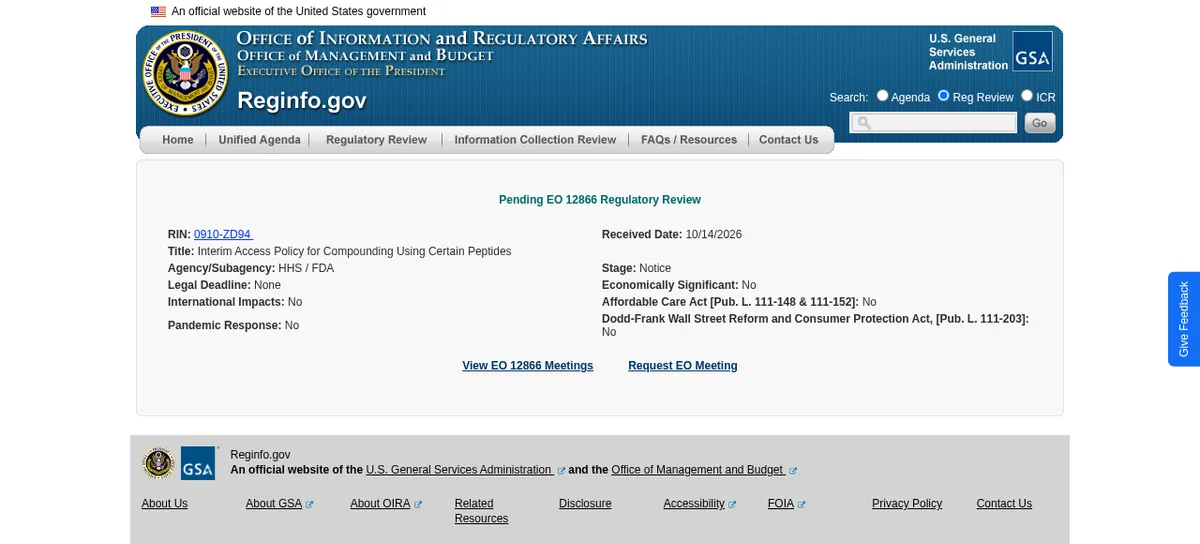
Figure 1. The White House review listing for the policy, as it read on October 21, 2026. A title, a date and a stage. The text itself is not public. [1]
What is known about the content comes from the Associated Press, citing two unnamed people familiar with the plan. They said "it is intended to allow pharmacies to temporarily compound some of the most popular peptides, including BPC-157".[3] The AP described the mechanism as a promise not to act against those pharmacies: "That approach, known as enforcement discretion, allows the FDA to selectively choose to not enforce some of its own regulations".[3] Treat that as reporting about a document nobody outside government has read, not as the policy.
Kennedy's goal, as he put it to Fox, is a product "that is safe, that the factories are inspected".[2] Whether a temporary enforcement policy delivers that is the question the rest of this article is about.
How compounding law decides which peptides a pharmacy may use
A traditional compounding pharmacy works under section 503A of the Food, Drug, and Cosmetic Act. It may compound from a bulk ingredient only if the ingredient has a USP or NF monograph, or is part of an FDA-approved drug, or failing both, if it appears on FDA's list of bulk drug substances that can be used in compounding.[4] BPC-157 and the other popular injectable peptides have no monograph and are in no approved drug, so the list is the only door.[5] Getting onto the list takes a regulation.[6]
While that list was being built, the FDA ran an interim policy with three categories. For Category 1, the FDA does not intend to act against a compounder using the substance while it is evaluated. Category 2 is for substances where the "FDA has identified significant safety risks relating to the use of these substances in compounding pending further evaluation". Category 3 is for nominations made without enough supporting information.[4] The FDA has also said "the agency does not intend to place bulk drug substances nominated on or after January 7, 2025, into these categories".[4]
That last line is our reading of why a new, separate "interim access policy" would be needed at all: a newly nominated peptide cannot simply be dropped into Category 1. This is an inference from the FDA's page. The FDA has not said it.
The 503A rules also say where the ingredient must come from. Bulk drug substances "must be accompanied by a valid certificate of analysis and must have been manufactured by an establishment registered with FDA".[4] That is the clearest difference between a lawfully compounded peptide and a research vial, and it applies whatever the interim policy says.
The July votes
The FDA's Pharmacy Compounding Advisory Committee met on July 23 and 24, 2026. The meeting notice listed seven peptides, each with the specific uses the FDA had reviewed: BPC-157 for ulcerative colitis, KPV for wound healing and inflammatory conditions, TB-500 for wound healing, MOTs-C for obesity and osteoporosis, then emideltide (also called DSIP), Semax and Epitalon.[6]
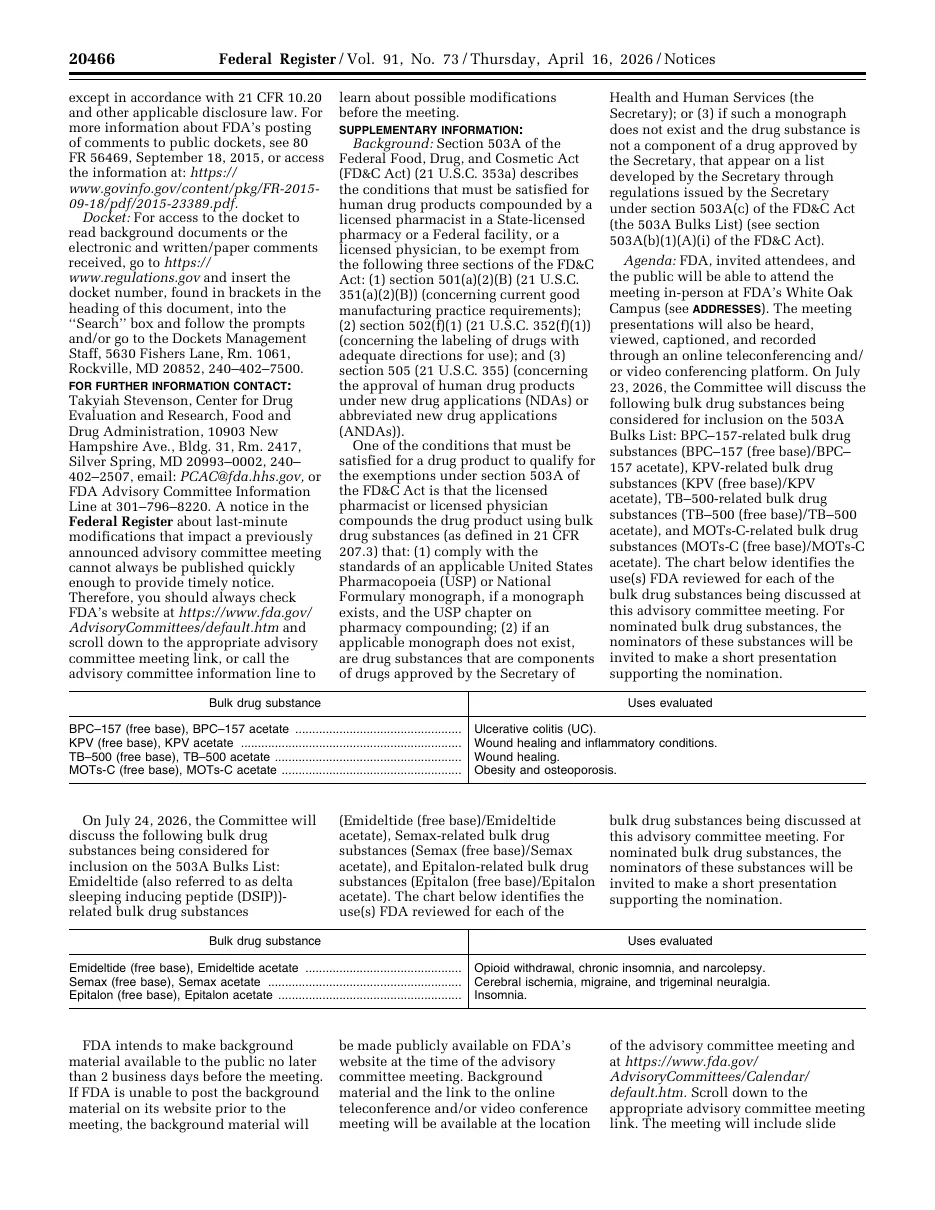
Figure 2. The meeting notice for the July advisory committee. Each peptide was reviewed for one or two named uses, not for everything it is sold for. [6]
STAT reported the tallies. On the first day the panel voted 8-6 to add each of BPC-157, KPV and TB-500 for their reviewed uses, and 7-5 for MOTs-C.[7] On the second day it backed Semax 8-5 and rejected emideltide 6-7.[7] For Epitalon, STAT gives 7-4.[7] RAPS reports that the committee "recommended epitalon for inclusion on the list to treat insomnia with a vote of 7-5 in favor with one abstention".[5] The two reports disagree, and the vote record in the FDA's meeting materials is what would settle it. Either way, six of seven peptides got a yes.
FDA staff had recommended against every one.[7] STAT described the panelists who voted yes as people "most of whom had ties to the peptide industry and were appointed by the health and human services department".[7] FDA staff also pointed out a limit that matters to buyers: "the agency has no authority to require compounders to submit safety or efficacy data once a substance is added to the list", as STAT paraphrased them.[7]
The votes are advice. In July, STAT reported that "the administration will publish its decision as a proposed rule and give the public the opportunity to comment".[7] Three months later the AP reported that formal listing "would require federal rulemaking, a process that could take years and involves multiple rounds of public comment", and that "It was not immediately clear if the administration still plans to pursue that process".[3] An interim enforcement policy would come before any of that.
Where the peptides stand with the FDA today
Out of Category 2, not in Category 1. In April the FDA moved BPC-157, TB-500, KPV, MOTs-C, Semax, Epitalon, DSIP and others to a section of its Category 2 page headed "Bulk drug substances nominated but withdrawn". The page explains: "This list of bulk drug substances previously in category 2 of the interim policies were withdrawn by the nominators".[8] The safety text for each stayed. For BPC-157 it still reads, in part, "FDA has identified no, or only limited, safety-related information for the proposed routes of administration".[8]
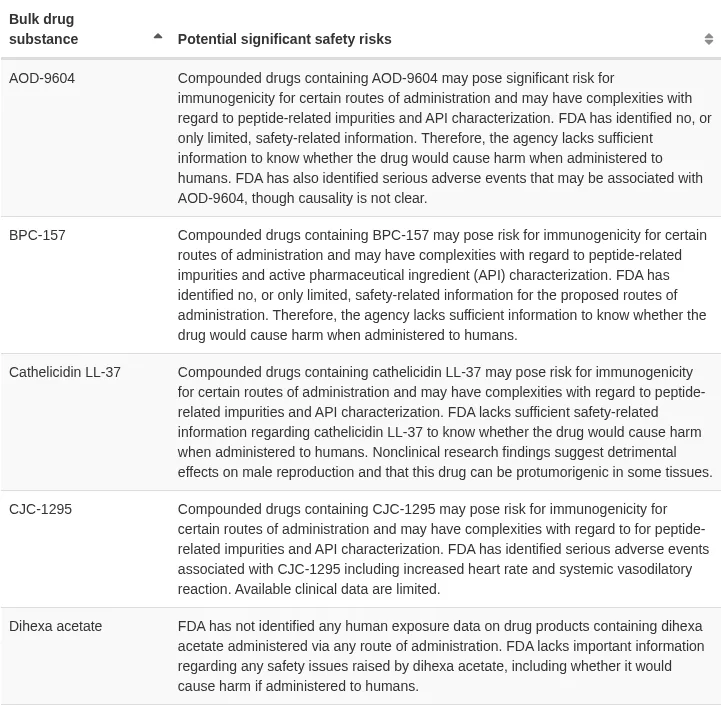
Figure 3. FDA's list of peptides that were in Category 2 until their nominations were withdrawn. The safety text stayed on the page. [8]
Leaving Category 2 is not the same as entering Category 1. The FDA's Category 1 list, updated May 14, 2026, does not name BPC-157 or any of the seven July peptides.[9] So, as of that list, none of them can be compounded under the old interim policy either. That gap is what the new policy would fill.
GHK-Cu is the exception. It is on the Category 1 list "except for injectable routes of administration", and the FDA says it "intends to consult the Pharmacy Compounding Advisory Committee (PCAC) before the end of February 2027 regarding the potential inclusion of GHK-Cu on the 503A bulks list".[9]
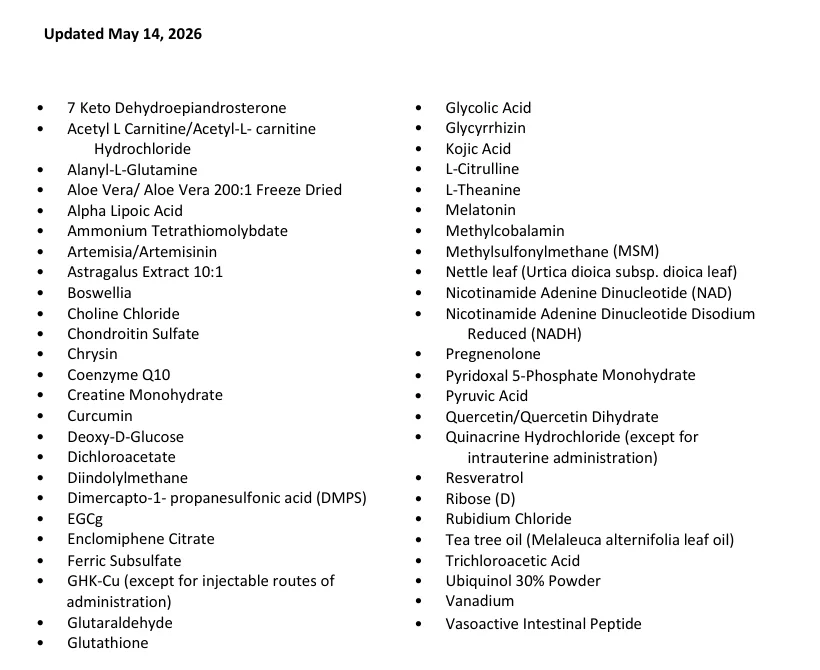
Figure 4. FDA's Category 1 list as of May 14, 2026. GHK-Cu is on it for non-injectable use only. BPC-157 and the other July peptides are not. [9]
Still in Category 2. Ibutamoren and kisspeptin-10 remain there.[9] Of ibutamoren the FDA says "Ibutamoren mesylate poses significant safety risks due to the potential for congestive heart failure in certain patients".[8] GHRP-2 and GHRP-6 sit in Category 3, nominated without adequate support.[9]
What a regulated market cannot change
Retatrutide. It is not an approved drug anywhere, and the FDA's position is plain: "Retatrutide and cagrilintide cannot be used in compounding under federal law".[10] Nothing reported about this policy touches that. A vial of retatrutide sold today is what the retatrutide article describes, and Eli Lilly's suits against sellers are in the lawsuit tracker.
The big GLP-1s at outsourcing facilities. Larger compounders registered as outsourcing facilities work under section 503B, which has its own list. Unlike a 503A pharmacy, "outsourcing facilities may or may not obtain prescriptions for identified individual patients".[11] On May 1, 2026 the FDA said it "proposes not to include on the 503B bulks list: semaglutide, tirzepatide, and liraglutide".[11] The peptide policy, as reported, is about pharmacies compounding certain peptides, and nothing reported says it reaches 503B.[3]
Research-use vials. The policy would change what a licensed pharmacy may do. It would not make a vial sold "for research" into a compounded drug. The FDA has warned companies selling unapproved GLP-1 drugs labelled for research or "not for human consumption", and says such products "could contain too little, too much or no active ingredient at all".[10] Kennedy's case for the policy is that people will buy peptides regardless, so the lawful channel should exist.[2] Whether it draws buyers away from research vials is a prediction nobody can test yet.
What the FDA says it does not know. Enforcement discretion does not answer the FDA's safety text. The AP summarised the FDA's stated risks as "Possible risks include contamination, allergic reactions and tumor growth, according to the FDA".[3] Those entries are still on the FDA's page.[8]
What to watch for
- "Compounded" is a claim about who made it. A 503A product comes from a state-licensed pharmacy or physician, from an ingredient made by an FDA-registered establishment with a certificate of analysis.[4] A website selling vials for research is not that, whatever its label says.
- The certificate is part of the legal chain, not a sales page. For a pharmacy, the certificate travels with the bulk ingredient.[4] A seller's PDF is a statement about a sample the seller chose. The retatrutide article goes through what to check on one.
- Which peptide, for what. The panel voted on named uses, such as BPC-157 for ulcerative colitis.[6] Whether the interim policy keeps those limits is not known until its text is out.
- Telehealth offers. The AP reported that Hims & Hers and Noom "recently announced plans to offer peptides to their customers if the federal government eases access".[3] An offer made before the policy is published is a plan, not a product.
- Injectable versus topical. GHK-Cu's Category 1 listing excludes injection.[9] An injectable GHK-Cu marketed as compounded is outside that listing.
Open questions
- Which peptides, and for how long. The AP's sources said "temporarily".[3] The listing gives no end date.[1]
- Will there be a proposed rule? In July the plan reported by STAT was a proposed rule with public comment.[7] In October the AP could not say whether rulemaking is still planned.[3]
- Who inspects? Kennedy named inspected factories as an objective.[2] The FDA's existing requirement is a registered establishment and a certificate.[4] Whether the policy adds anything is not public.
- How large is the market? Wall Street analysts quoted by the AP put it at "$2 billion to $3 billion".[3] That is an estimate of a market that does not exist yet, and a prediction.
References
- Pending EO 12866 Regulatory Review: Interim Access Policy for Compounding Using Certain Peptides (RIN 0910-ZD94) — Office of Information and Regulatory Affairs (OMB), on reginfo.gov
- Kennedy says Trump administration aims for regulated market for peptides (Reuters, 2026-10-20) — Reuters, via KSL.com
- Trump administration advances plan for peptide drugs favored by RFK Jr. (Associated Press, 2026-10-15) — Associated Press, via STAT
- Bulk Drug Substances Used in Compounding Under Section 503A of the FD&C Act — U.S. Food and Drug Administration
- FDA advisory committee backs two more peptides, rejects one for compounding list (2026-07-24) — Regulatory Affairs Professionals Society (Regulatory Focus)
- Pharmacy Compounding Advisory Committee; Notice of Meeting (FR Doc. 2026-07361, 91 FR 20465, April 16, 2026) — Food and Drug Administration, Federal Register (govinfo)
- FDA peptide compounding panel backs epitalon, rejects emideltide (2026-07-24) — STAT
- Certain Bulk Drug Substances for Use in Compounding that May Present Significant Safety Risks (content current as of 04/22/2026) — U.S. Food and Drug Administration (Wayback capture 2026-10-19)
- Bulk drug substances nominated for use in compounding under section 503A: categories 1, 2 and 3 (updated May 14, 2026) — U.S. Food and Drug Administration
- FDA's Concerns with Unapproved GLP-1 Drugs Used for Weight Loss — U.S. Food and Drug Administration (Wayback capture 2026-10-19)
- List of Bulk Drug Substances for Which There Is a Clinical Need Under Section 503B (FR Doc. 2026-08552, 91 FR 23431, May 1, 2026) — Food and Drug Administration, Federal Register (govinfo)
Comments
Sign in to join the conversation.
No comments yet.