The LSD chemists: from Sandoz to a Kansas missile base, where the acid went and what the courts did
Albert Hofmann made the drug at Sandoz in 1938, and the company gave it to researchers until 1965.[1] After that the supply passed to a short line of chemists, most of whom knew each other, and the record of where their acid went is mostly a record of court cases. This article follows that line from Sandoz to a missile base in Kansas, using the court opinions, official releases and contemporary press for each one.
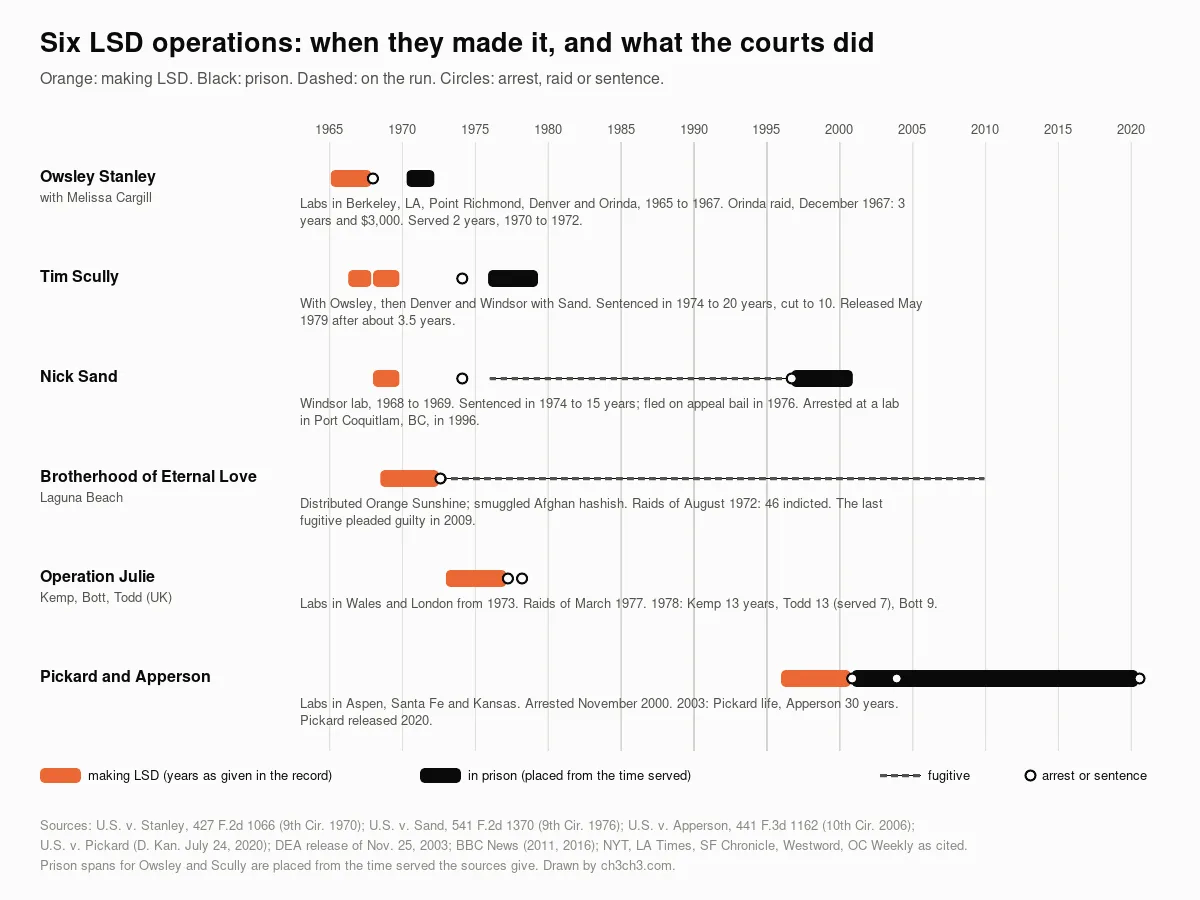
Figure 1. Six operations on one axis. Owsley and Scully's prison spans are placed from the time served the sources give; every other date is in a court record or a contemporary report cited below. [2]
Sandoz and Delysid
Hofmann was a chemist at Sandoz working through derivatives of lysergic acid. "In 1938, I produced the twenty-fifth substance in this series of lysergic acid derivatives", he wrote in his memoir.[1] He found out what it did five years later, by "accidentally ingesting a trace of the compound one Friday afternoon in April 1943", as the New York Times put it in his obituary.[3]
The accident happened on 16 April 1943, "during the purification and crystallization of lysergic acid diethylamide in the form of a tartrate".[1] On 19 April he took a measured dose on purpose. His lab journal entry begins: "0.25 mg tartrate. Taken diluted with about 10 cc water. Tasteless."[1] That is 250 micrograms.
Sandoz brought it out as a research drug, "giving it the trade name Delysid".[1] Hofmann wrote: "It was therefore decided to make LSD available free of charge to qualified experimental and clinical investigators all over the world".[1]
The company stopped in 1965. Hofmann reprints a letter "dated 23 August 1965, by Dr. A. Cerletti", head of the pharmaceutical department, saying Sandoz "has decided to stop immediately all further production and distribution of LSD".[1] Part of the reason was that the drug could no longer be kept in one company's hands: "Since the last patent on LSD expired in 1963", anyone could make it.[1] Supply to researchers went on through national agencies, and "In the United States the National Institute of Mental Health (NIMH) undertook the distribution of these agents to licensed research institutes".[1]
A 2022 review in Psychological Medicine dates the end of easy access the same way: "Clinical research became more difficult after 1965 when Sandoz ceased providing psychedelic drugs for research and their nonmedical use was prohibited in 1970".[4] Hofmann himself "stayed with Sandoz as head of the research department for natural medicines until his retirement in 1971".[3]
Owsley Stanley and Melissa Cargill, 1965 to 1967
Owsley Stanley "got his first taste of LSD in April 1964", according to the Los Angeles Times.[5] "He found the recipe for making LSD in the Journal of Organic Chemistry at the UC Berkeley library", the San Francisco Chronicle reported.[6] The chemistry was not his alone: "with a chemistry major named Melissa Cargill, he started a lab and began manufacturing a very pure form of the drug".[5]
The first raid did not stick. Rolling Stone dates it precisely: "On February 21st, 1965, police raided the house and confiscated various chemicals", including "a substance they wrongfully identified as speed".[7] The Chronicle puts the same raid a year later: "The Berkeley police raided his first lab in 1966 and confiscated a substance that they claimed was methedrine".[6] Both agree on the outcome. He "successfully sued the cops for the return of his lab equipment".[6]
The labs moved. Erowid's summary: "He produced a few grams of LSD in Los Angeles in 1965, more than that in Point Richmond in 1966, and the rest in Denver in 1967".[8] The Sydney Morning Herald's obituary adds that the Denver crystal was finished elsewhere: "He produced the raw product there and tableted it in Orinda, California".[9] In Los Angeles in 1966, "Owsley rented a pink stucco house in Watts" for the Grateful Dead.[7]
Distribution ran through a single link at a time. He "would only ever deal with one person at a time to distribute his product", Rolling Stone wrote.[7] "His was the acid behind the Acid Tests conducted by the novelist Ken Kesey", the New York Times wrote, and named the brands people knew, "like White Lightning, Monterey Purple and Blue Cheer, the varieties of his LSD that were among the most popular".[10] For the Human Be-In in San Francisco in January 1967, Rolling Stone writes that he provided 300,000 doses of White Lightning.[7] He made "a special batch called Monterey Purple for the 1967 Monterey Pop Festival".[6]
How much he made depends on who is counting. The Chronicle: he "made more than 1.25 million doses of LSD between 1965 and 1967".[6] The Times: "career output was more than a million doses, in some estimates more than five million".[10] Erowid gives a weight: "total production has been estimated to be around 460 grams of LSD".[8] At 100 micrograms a dose, 460 grams is 4.6 million doses, which sits inside the Times's range.
Orinda
Federal agents "entered the premises at 69 La Espiral Street, Orinda, California" and found what the Ninth Circuit called "a small factory for the manufacture of LSD".[11] Rolling Stone describes it as the night "thirteen agents broke into a house in the East Bay that Owsley had rented for the express purpose of making tabs".[7] The court's charges say the "offenses took place December 21, 1967".[11]
The seizure is where the accounts drift. The court's own figures are "a brown bottle containing 472 grams of white powder, which contained 5.3% LSD" and "a plastic bottle containing 42 grams of 95% Pure LSD".[12] Its arithmetic: "The total of LSD in Exhibits 11 and 18 was approximately 63.9 grams of LSD".[12] The Herald's obituary counts it in doses instead: "He was found in possession of 350,000 doses of LSD and 1500 doses of another drug, STP".[9]
The court also recorded his stated aim. He "had expressed his desire to produce only the purest and cleanest LSD to be distributed to his family and friends".[12]
The case was tried under food and drug law, because the Controlled Substances Act did not yet exist. "Appellants were convicted after a court trial on three counts of violating the Federal Food, Drug and Cosmetic Act". "Each appellant was sentenced to 3 years in prison and fined $3,000".[11] After the Supreme Court sent the possession count back, the Ninth Circuit wrote that it would "accordingly reaffirm the conviction of Stanley, Thomas and Massey as to count 5".[12]
He went in only after a later arrest. In 1970, "after a pot bust in Oakland", in the Chronicle's words, a judge revoked his bail.[6] The Times: after the judge revoked his "bail from a 1967 drug arrest, he served two years in federal prison".[10] "Owsley was sent to Terminal Island Federal Prison, a medium-security lockup in San Pedro".[7] "After his release from prison in 1972, he returned to the Dead".[5] He later moved to Australia, where in March 2011 "His car swerved off a highway and down an embankment before hitting trees near Mareeba".[10]
No court record or press account read for this article shows Melissa Cargill charged with anything.
Tim Scully and Nick Sand: Denver, Windsor, Orange Sunshine
Tim Scully worked with Owsley before he worked with Sand. Westword's history of the Denver labs gives the run at Point Richmond as "100 grams of pure LSD, or nearly 360,000 individual doses", and the first Denver lab as "300 grams, or about a million doses of LSD".[13] At Orinda, "and 67 grams of LSD that had come from the Denver lab were confiscated".[13] Those dose counts imply roughly 280 to 300 micrograms a dose, our division.
A second Denver lab, on South Elmira Street, was entered by police in June 1968. Scully "was arrested, on May 26, 1969, at an airfield in California".[13] It did not hold. The Colorado Supreme Court, "in October 1971 determined that the Denver police had conducted an illegal search of the property at 1050 South Elmira".[13]
By then he and Nick Sand had moved on. "Together they set up a lab in Windsor, California".[13] The New York Times's 1974 trial report describes it as a place "where their lab was secreted in the basement of a small wooden farmhouse".[14] Its product was named for its colour: "known as Orange Sunshine for the color of the tablets it came in".[15] Erowid describes the tablets as "tiny orange barrels containing 300 micrograms of LSD".[16]
The output was large. "the two partners turned out four million doses of Orange Sunshine", the Times wrote in Sand's obituary.[15] It went out "at Grateful Dead concerts, in California communes, in Indian ashrams, in the hashish havens of Afghanistan", and Sand made sure it was "available to American soldiers fighting in Vietnam".[15] A 1996 Chronicle account says Sand "headed an acid network that stretched from California to the Netherlands", with labs "located in Sonoma County, Colorado, Missouri and Belgium".[17]
The dates do not quite agree. The Los Angeles Times obituary says Orange Sunshine "hit the streets of San Francisco in 1967".[18] The indictment the Ninth Circuit reviewed charged "the manufacture and sale during 1968, 1969, and 1970 of a psychotropic organic compound".[2]
The trial
The New York Times dated the federal trial in San Francisco to the autumn of 1973, "the trial, which began Nov. 5".[14] The government's key witness was the oil millionaire William Mellon Hitchcock, who "received immunity from prosecution in return for his testimony".[14] The government named the "Brotherhood of Eternal Love as their distributors".[14] The defence said the tablets were not LSD at all but "a similar hallucinogenic ALD 52 that is not illegal".[14]
Both chemists later said otherwise. "The Orange Sunshine we delivered was LSD 25", Scully told Erowid, and "ALD 52 was an ill-advised desperate defense strategy that failed miserably".[19]
The appeals court summed up the case: "The drug case involved laboratories in California, Missouri, and possibly in Europe".[2] Scully and Sand were "tried before a jury together with Lester Friedman, who was acquitted".[2] "The trial court pronounced five consecutive sentences against Scully totalling 20 years imprisonment and a $10,000 fine". "Sand received consecutive sentences totalling 15 years imprisonment and a $5,000 fine".[2] In October 1976 the Ninth Circuit wrote: "We affirm."[2]
Scully served his time. Sand shared a cell with him for a while, "In his cell at McNeil Island Penitentiary in Washington State, which he shared with Mr. Scully".[15] Scully's "sentence was dropped from twenty to ten years", and "Scully was released from prison on May 29, 1979".[13]
Sand ran. He "went underground in 1976 to avoid serving a 15-year federal prison term", the Chronicle reported.[17] "he hid in Canada for two decades under an assumed name", the Times wrote.[15] "In late September, Sand was arrested in Port Coquitlam, a suburb of Vancouver", where the police "found 43 grams of crystalline LSD", and the Mounties called the lab "the largest production capacity of any laboratory ever seized in Canada".[17]
In Canada he "was sentenced to nine years in prison, to run concurrently with his United States sentence".[15] Back in San Francisco, for the years on the run, "The judge added five years, the maximum".[15] "Mr. Sand was released to a halfway house in 2001". "He completed his parole in 2005".[15] The Los Angeles Times counts it differently: "He was imprisoned for three years and sentenced to a halfway house for four more".[18] His own lifetime estimate, as the Times reported it, was "about 30 pounds of LSD over the course of his career, enough for nearly 140 million doses".[15]
The Brotherhood of Eternal Love
In the government's case the Brotherhood was the distribution network.[14] The New York Times called it "a drug cult based in Laguna Beach, Calif."[15] In time it spread inland: "the Brotherhood purchased property below Mount San Jacinto near Idyllwild in the summer of 1968".[20] Its money came from hashish. The BBC describes Orange Sunshine handed out "with funds raised from the smuggling of Afghan hashish", some of it carried "inside hollowed-out surfboards".[21] According to the Los Angeles Times, "the Brotherhood smuggled hashish from Afghanistan, which members would process and then can and label as peaches or tomatoes".[20]
The orange tablets travelled far from California. In a federal appeals case from West Virginia, the defendant "traveled from West Virginia to Ohio in the Spring of 1972" to buy LSD, and a witness described it "in the form of little orange pills known as" orange sunshine or orange barrels.[22]
On 5 August 1972 a joint federal and state force raided the group. In the New York Times's report the next day, 57 people "were arrested or indicted and large quantities of LSD" and hashish were seized.[23] The raids reached past California: "Three were seized on the island of Maui in Hawaii and three at Grants Pass in Oregon".[23] The indictment named Timothy Leary, though "Leary himself has been a fugitive in Switzerland since 1970".[23] Officials said the group smuggled "nearly 1,000 pounds of hashish into the United States each month".[23]
The outcome was mixed. In 1972, "local and federal authorities received grand jury indictments against 46 members of the Brotherhood"; "Police estimated that about 200 people were involved with the group at its peak".[20] The prosecutor, as the Los Angeles Times reported in 1989, recalled "eventual convictions on conspiracy and drug charges for 50% to 60% of those indicted".[20]
The courts kept meeting the name. A 1979 Ninth Circuit opinion calls the Sand case "a criminal trial in which three principal members of the Brotherhood were convicted on drug-related charges", though the trial record shows Friedman acquitted.[24][2] In 1980 a federal wiretap affidavit said "a group known as the Brotherhood of Eternal Love was going to smuggle approximately 8,000 kilos of hashish into the United States".[25]
The case closed in 2009. Brenice Lee Smith, "the last remaining fugitive from the once-infamous 1972 Brotherhood of Eternal Love case", "pleaded guilty this morning to transporting hashish from Afghanistan to Orange County between 1966 and 1972".[26]
Operation Julie: Wales and London, 1973 to 1978
The British ring had two wings. "In 1973, fearful of police attention, one wing of the co-operative led by Kemp and Solomon moved to west Wales while another branch remained in London".[27] Henry Todd ran the London side, where "he worked with a chemist, Richard Kemp, to produce a very pure form of LSD" until the two fell out.[28] Todd then "started a new LSD business in his house in Hampton Wick, near London". "The lab was in the attic, and the tablets were made a floor below".[28] "Kemp established his own factory in Wales".[28]
The Welsh lab was at Plas Llysyn. Police "noted his regular 50 mile commutes to Plas Llysyn, an old mansion in Carno near Llanidloes", and later found "water samples taken from the cellar chemically matched LSD samples the police had previously seized".[29]
The reach claimed for it is large and loosely sourced. The BBC described the ring as "exporting to 100 countries and, according to some reports, supplying 90%" of Britain's LSD.[27] The Times obituary of Todd says the operation was "making an estimated 90 percent of the LSD in Britain and supplying much of the world".[28] Neither names who made the estimate.
"On 26 March 1977, detectives finally swooped".[27] "Operation Julie involved more than 800 officers from 10 forces", and there were "Raids on 87 addresses in Wales, London, Cambridge and France between March and December 1977".[29] "One million LSD tablets were seized, along with enough crystal to make 6.5 million more".[30] Todd's house alone held "enough LSD to make 2.5 million microdots, or little tablets".[28] The street price of a tab "reportedly leapt from £1 to £5 overnight".[27]
A minister confirmed the shortage in Parliament. In January 1979 a minister told the Lords of LSD's "relative scarcity following the success of" Operation Julie, and of the risk of PCP "its entering the illicit market on a large scale mislabelled as LSD".[31]
The sentences
"After a trial at Bristol Crown Court, 15 defendants were given jail terms adding up to more than 120 years".[30] The BBC's 2016 count is the same: "A total of 120 arrests were made, resulting in 15 convictions and prison sentences totalling 120 years".[29] A 2010 BBC piece gives different totals: "A year later 17 defendants were jailed for a total of 130 years".[32]
"Kemp was sentenced to 13 years in prison and his partner Christine Bott, a qualified doctor, to nine years".[27] Todd "was sentenced to 13 years in prison, as was Kemp". "Mr. Todd served seven years".[28] Leaf Fielding, who "began as the tabletter, turning the raw chemicals into individual doses, and later took over the distribution network", was "sentenced to eight years in prison".[27]
The money became a law. Lord Denning told the Lords in 1986: "In 1978 there was an operation called Operation Julie and three men were convicted at Bristol Crown Court before Mr. Justice Park". Their proceeds were held "in unnumbered accounts in Switzerland and France".[33] The courts found they had no power to take it. Opening the Commons debate in 1986, the Home Secretary, Douglas Hurd, said "The Operation Julie case was the most notorious example of the courts being unable to deprive convicted traffickers" of their profits. Robin Corbett, the MP for Birmingham Erdington, gave the sums: "Assets estimated at £750,000 were identified and converted at that stage into French chateaux, Krugerrands and gold bars in a Swiss vault".[34] The tax office did better: the case "led, as I understand it, to the Inland Revenue recovering almost £500,000", a minister said in 1985.[35] "As a result of the Operation Julie saga, the Hodgson Committee was established", Denning said, and its work led to the confiscation powers in the bill then before Parliament.[33]
William Leonard Pickard and Clyde Apperson, 1996 to 2000
The lab moved three times. The Tenth Circuit's account, from the informant's testimony: Pickard "established an LSD laboratory in an Aspen, Colorado residence in late 1996", then "moved the LSD laboratory from Aspen to a house in Santa Fe, New Mexico", then "moved it to an abandoned missile base near Salina, Kansas".[36] The equipment ended up at the informant's own property, "at a decommissioned missile base near Wamego, Kansas that he owned".[36]
The DEA tied the pair to earlier seizures. Of the complete LSD labs the agency had ever seized, three were theirs: "a lab in Mountainview, California in 1998, a lab in Oregon in 1996, and this lab in Wamego, Kansas".[37]
On 6 November 2000 the Kansas Highway Patrol stopped the convoy moving the lab. "Pickard fled from the scene on foot after letting the rental car roll to a stop in a ditch" and was caught the next day.[36] The searches turned up a seizure "including 41.3 kilograms of LSD".[36]
The government's claims about the operation are large. The DEA said "every five weeks the lab produced about 2.2 pounds of LSD, approximately 10 million doses", and "the LSD was shipped to California and later to Europe for distribution".[37] The DEA called the pair "responsible for the illicit manufacture of the majority of the LSD sold in this nation".[37] The National Drug Intelligence Center says the Kansas lab, "located in a former missile silo", "produced an estimated 94 million dosage units", and calls it the DEA's largest LSD laboratory seizure.[38] At the sentencing, though, "Prosecutors said no LSD was made at the Wamego silo, about 15 miles east of Manhattan, and the LSD found there came from elsewhere".[39] The defence attacked the quantities. "But the judge said the DEA estimates were accurate, adding" that "if anything they were conservative".[39]
What happened to the supply
The DEA's special agent in charge cited the "fact that LSD availability in the United States was reduced by 95 % in" "the two years following their arrest".[37] That is an official's claim, given without a method.
The Justice Department's intelligence centre published the measured series a year later. DEA arrests for LSD "decreased from 162 in 2000, to 94 in 2001, to 26 in 2002, to 19 in 2003".[38] Lab-tested seizures "decreased from 24,460,969 dosage units in 2000, to 93,973 dosage units in 2001", and then "to 1,624 dosage units in 2002".[38] The bulletin sets these numbers beside falling use and availability and does not connect them to any one lab. It also says "Most LSD available in the United States is produced in northern California and the Pacific Northwest".[38]
The sentences
"after eleven weeks of trial, the jury found Pickard and Apperson guilty".[36] "Pickard was sentenced to life imprisonment without parole". "Apperson was sentenced to 30 years imprisonment without parole".[37] The appeals court recorded the same terms: "Pickard was sentenced to life imprisonment" and "Apperson was sentenced to 360 months".[36]
In July 2020 the district court in Kansas granted Pickard compassionate release. The order notes "Pickard is 74 years of age and has served 20 years in prison" and orders that "his term of imprisonment is reduced to time served", "to be followed by a five-year term of supervised release".[40]
What the colour means
Pure LSD has no colour. A 1979 clinical review says "LSD in pure form is colorless, odorless, and tasteless".[41] The DEA's resource guide says the same: "LSD is an odorless and colorless substance with" "a slightly bitter taste".[42] Shulgin described the salt as white, and wrote that "A totally pure salt, when dry and when shaken in the" dark "will emit small flashes of white light".[43]
So the colour people remember is in the tablet. The 1979 review mentions "the vibrant oranges and purples of the microdot tablet (some a mere 2 to 3 mm in diameter)".[41] Forensic chemists expect dyes. The SWGDRUG monograph gives a procedure "For LSD dosage forms that contain dyes".[44]
What the colour meant in 1967 was a brand. The Washington Post's series on the Haight, reprinted in the Congressional Record, said Owsley's tablets had "been manufactured in three colors: white, purple and most recently orange, if the street consensus is correct".[45] The paper saw a business at work: "an attempt has been made to get around the problem by establishing brand-name identity". An Owsley "double-domed purple, a hard-to-counterfeit pill, is a guarantee of purity if not price".[45] A doctor from the Haight free clinic, David Smith, told the paper: "The acid manufacturers do the same thing that the legal drug houses do. They vary the product ever so slightly so they can claim they're putting something new on the market".[45] Orange Sunshine, two years later, was named for its colour.[15]
A colour can also mean age. Erowid opened "An unopened, brown-glass vial of 1951 Sandoz LSD-25 (Delysid)", genuine Hofmann-era stock. "When opened, the powder was a very light brown-sugar to salmon color."[46] Light matters too: "Be aware that LSD will degrade with prolonged exposure to UV light."[44]
Beyond the brand names, none of the sources read treats a colour as a guide to dose or purity.
How many doses in a gram
A gram is a million micrograms, so the number of doses in a gram is a million divided by the dose. At 100 micrograms that is 10,000. The DEA uses a smaller unit: "the DEA standard dosage unit for LSD is 50" micrograms, and a gram "if pure, it can be converted to 20,000" units.[47]
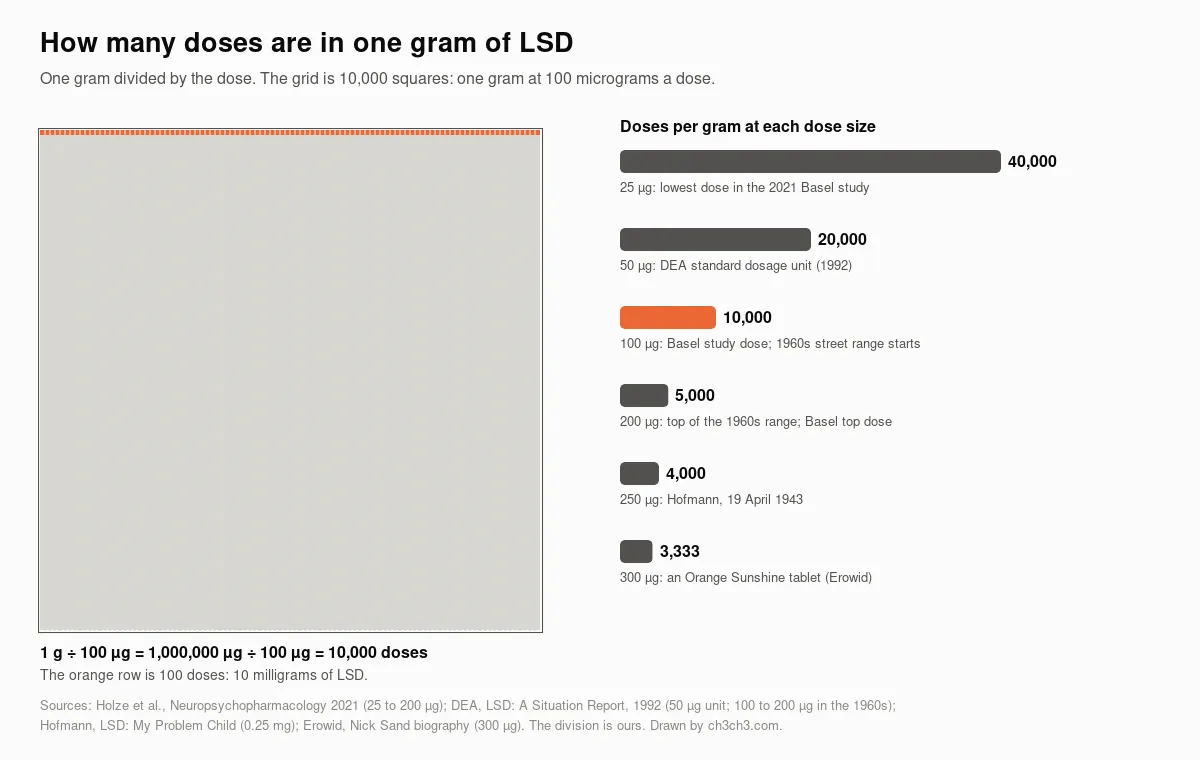
Figure 2. One gram is a million micrograms, so the number of doses is a million divided by the dose. The DEA's 1992 figure of 20,000 units a gram is the 50 microgram row. [47]
What counts as a dose has changed. The DEA wrote in 1992: "Current LSD potency or strength, which ranges from 20 to 80 micrograms per dosage unit, is" "considerably below levels reported during the 1960s and early 1970s when potency ranged from 100 to 200" micrograms.[47] Orange Sunshine's 300 micrograms sat above that 1960s range.[16] Shulgin gave "DOSAGE : 60 to 200 micrograms, orally".[43]
The best modern measure comes from Basel. In a 2021 trial, healthy volunteers "received placebo, LSD (25, 50, 100, and 200 µg)" in turn.[48] "A ceiling effect was observed for good drug effects at 100 µg." "The average duration of subjective effects increased from 6.7 to 11 h with increasing doses of 25–200 µg."[48]
The drug is far lighter than what carries it. The Sentencing Commission found "LSD is typically placed on blotter paper which generally weighs from 5 to 10 milligrams per dose", while "the weight of the LSD itself per dose is generally from 0.02 to 0.08 milligram".[49] For scale, the DEA says "Just two milligrams of fentanyl, which is equal to 10-15 grains of table salt, is considered a lethal dose."[50] That makes one grain of salt about 130 to 200 micrograms, our division, so a 100 microgram dose of LSD weighs less than one grain.
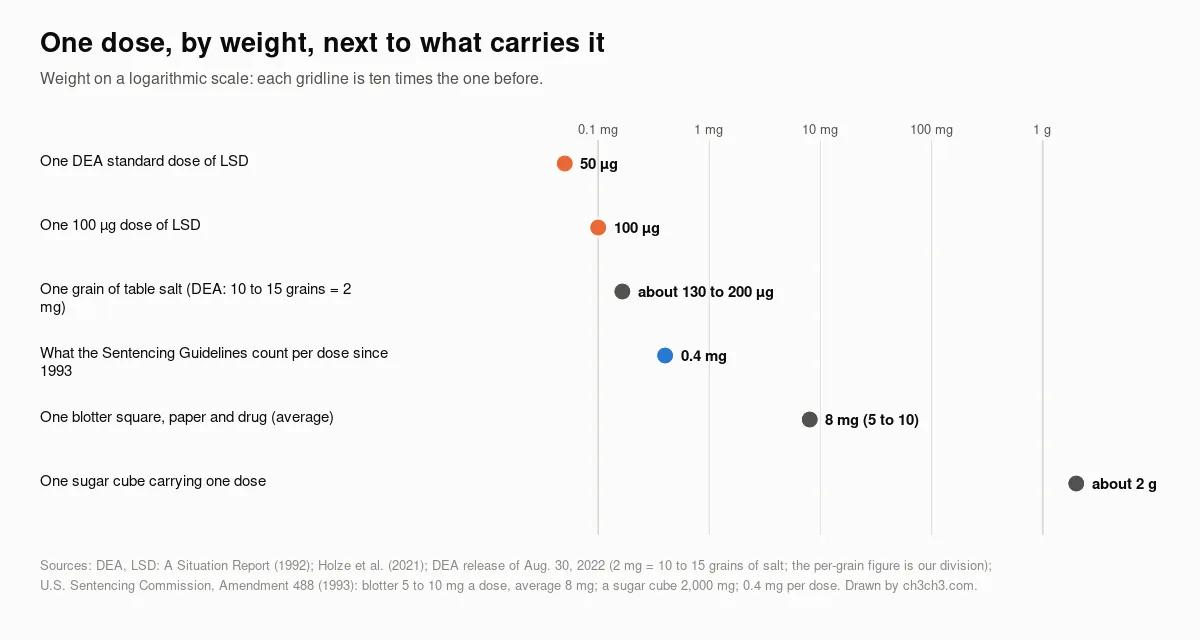
Figure 3. A dose of LSD weighs less than a grain of salt. The paper it rides on weighs about a hundred times more, and a sugar cube about forty thousand times more. The salt figure is our division of the DEA's 2 mg for 10 to 15 grains. [49]
The law, and the reasons given
The first federal control did not name LSD. The Drug Abuse Control Amendments of 1965 let the government designate drugs with a potential for abuse "of its depressant or stimulant effect on the central nervous system or its hallucinogenic effect".[51] Congress's stated reason was traffic that "otherwise has become a threat to the public health and safety".[51] The legislative history, as a federal appeals court later quoted it, put LSD first: "The most prominent of the hallucinogenic drugs being abused today is d-lysergic acid diethylamide, more commonly referred to as LSD-25." "It is capable of producing prolonged psychiatric reactions in persons possessing a previous underlying personality problem".[52]
California moved first on its own. Rolling Stone gives the date LSD became illegal in the state as October 6, 1966, and the Times notes "LSD was not outlawed in California until 1966".[7][10]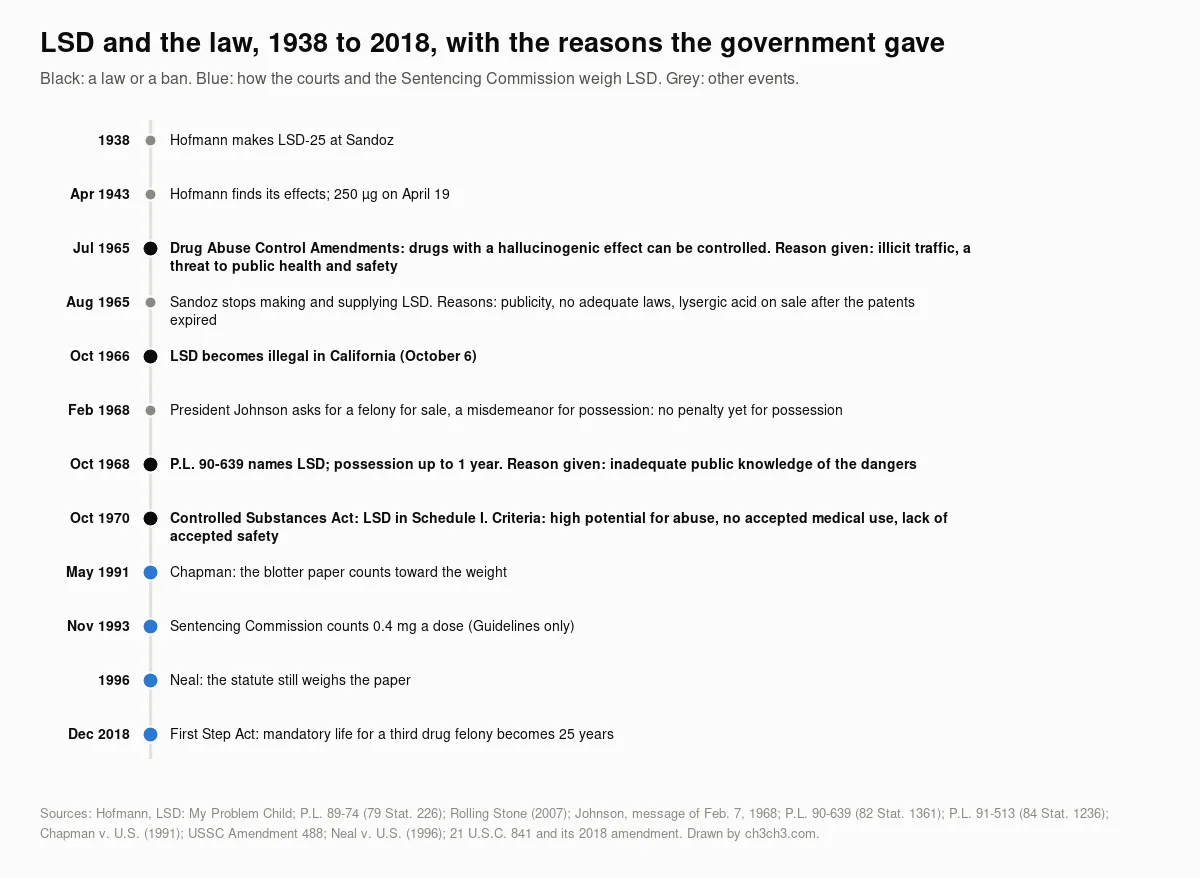
Figure 4. Twelve dates, with the reason each law gave for itself where it gave one. Black: laws and bans. Blue: how courts and the Sentencing Commission weigh LSD. [53]
In February 1968 President Johnson asked for more. "The illegal sale of LSD, a powerful hallucinogen, is only a misdemeanor punishable by a maximum prison term of one year for the first offense." "There is no penalty at present for possession of LSD for personal use."[54] He asked Congress to "Enact legislation to make the illegal manufacture, sale or distribution of LSD and other dangerous drugs a felony and the illegal possession of these drugs a misdemeanor."[54]
Congress did, in Public Law 90-639. It wrote LSD into the statute by name, as "lysergic acid diethylamide and any other drug".[55] Possession carried up to a year: a violator "shall be imprisoned for not more than one year or fined not more than" $1,000, and manufacture or sale "imprisoned for not more than five years or fined not more than" $10,000.[55] Its Section 5 gave a reason for an education programme, "because of the inadequate" public knowledge of what misused drugs do, and put priority on informing people, "particularly young persons, regarding the dangers of drug" abuse.[55] It was "Approved October 24, 1968."[55]
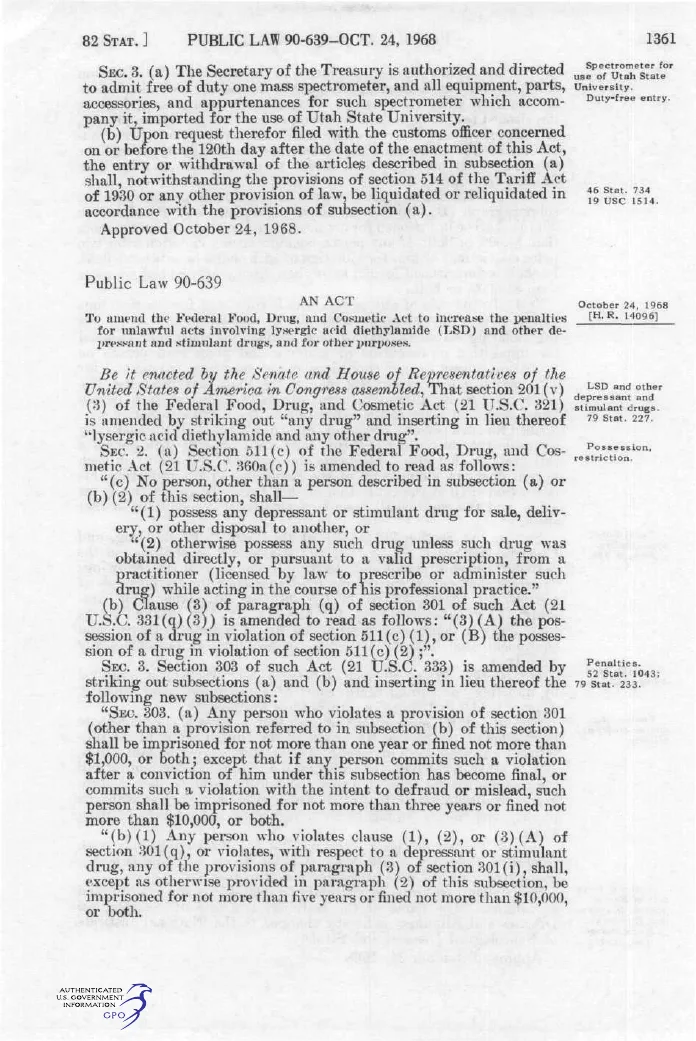
Figure 5. Public Law 90-639 as printed, under the tail of a tariff law about a spectrometer. Section 1 writes lysergic acid diethylamide into the statute by name. Section 2 makes possession an offence for the first time. [55]
The Controlled Substances Act of 1970 replaced all of it. Congress found that drug traffic had "a substantial and" "detrimental effect on the health and general welfare of the American" people, and listed LSD in Schedule I itself, as "(9) Lysergic acid diethylamide."[53] Schedule I has three tests. "The drug or other substance has a high potential for abuse." "The drug or other substance has no currently accepted medical use in treatment in the United States". "There is a lack of accepted safety for use of the drug or other substance under medical supervision."[56]
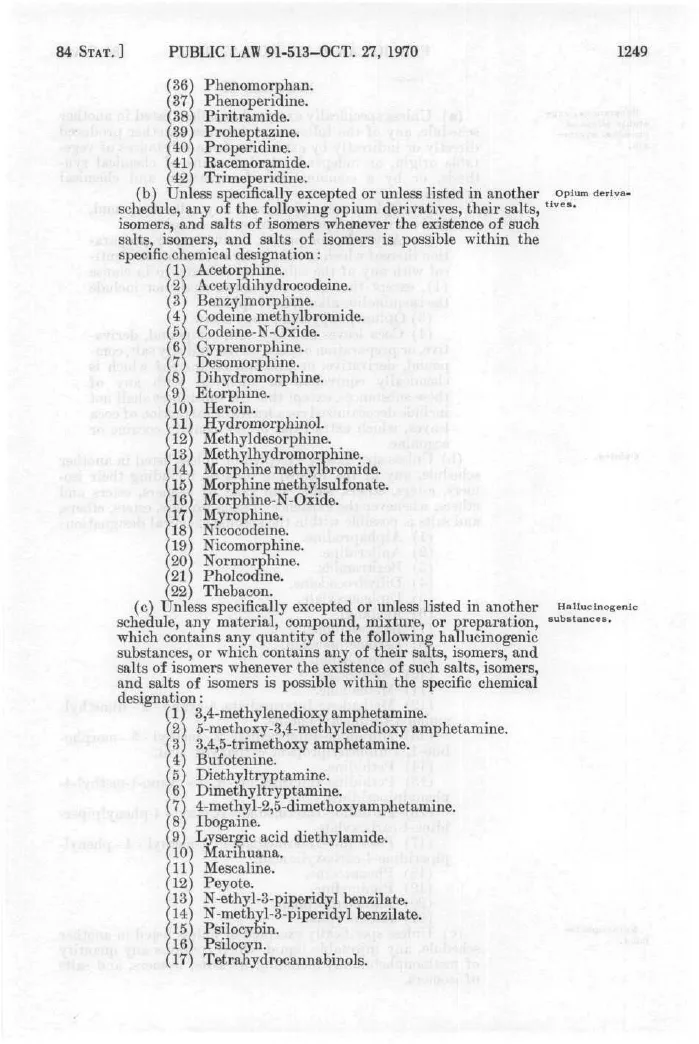
Figure 6. Schedule I as Congress wrote it in October 1970. LSD is number nine of seventeen hallucinogens, placed by the statute itself rather than by an agency. [53]
Sentencing by weight
Federal minimum sentences for LSD turn on the weight of a "mixture or substance". Five years starts at "1 gram or more of a mixture or substance containing a detectable amount of lysergic acid diethylamide (LSD)", and ten years at "10 grams or more of a mixture or substance containing a detectable amount of lysergic acid diethylamide (LSD)".[57]
The question was whether the paper counts. In Chapman, "Petitioners were convicted in the District Court of selling 10 sheets (1,000 doses) of blotter paper containing LSD". The "pure LSD weighed only 50 milligrams, the court included the total weight of the paper and LSD, 5.7 grams".[58] That crossed the one-gram line. The Supreme Court agreed in 1991: "We hold that the statute requires the weight of the carrier medium to be included when determining the appropriate sentence for trafficking in LSD".[58] The dissent pointed at the other carrier: "The sugar cube on which the dose may be dropped for purposes of ingestion and transportation, however, weighs approximately 2 grams".[58]
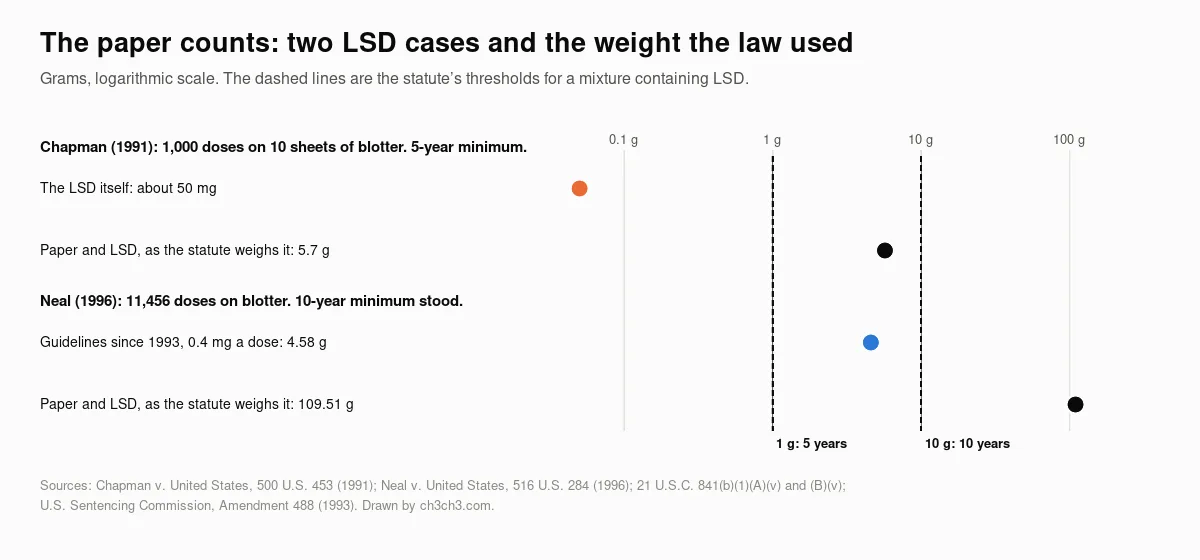
Figure 7. Two Supreme Court cases. In each, the drug alone sits below the line and the paper carries the case over it. [58]
The Sentencing Commission tried to fix it in 1993. It noted the old rule treated "125 doses of LSD on blotter paper (which has an average weight of 8 milligrams per dose) or 1 dose of LSD on a sugar cube (2000 milligrams per dose)" the same.[49] It chose a flat 0.4 mg a dose, and kept it below the figure for PCP, "a controlled substance that comparative assessments indicate is more likely to induce violent acts and ancillary crime than is LSD".[49] Where the paper is unmarked, "each 1/4 inch by 1/4 inch section of the blotter paper is equal to one dose".[49] Senators had already tried the direct route. "Both Sen. Joseph Biden (D-Del.) and Sen. Edward Kennedy (D-Mass.) have proposed amendments to exclude carrier weight from consideration in LSD cases."[59]
The fix reached only the Guidelines. "In 1988, petitioner Meirl Neal was arrested for selling 11,456 doses of LSD on blotter paper." "The combined weight of the LSD and the paper was 109.51 grams."[60] The new rule said to "Instead, treat each dose of LSD on the carrier medium as equal to 0.4 mg of LSD for the purposes of the Drug Quantity Table."[60] That made 4.58 grams, below ten. In 1996 the Supreme Court held that the statute still weighs the paper, so Neal's ten-year minimum stood. The statute, the Court wrote, "directs a sentencing court to take into account the actual weight of the blotter paper with its absorbed LSD, even though the Sentencing Guidelines require a different method".[60]
Three myths, and three more
Three myths grew around this history; each has its own page with sources. Three older LSD legends follow them.
References
- LSD: My Problem Child (English translation, first published 1979) — Albert Hofmann, MAPS edition (PDF)
- United States v. Sand; United States v. Scully, 541 F.2d 1370 (9th Cir. 1976) — US Court of Appeals for the Ninth Circuit, 8 October 1976, via law.resource.org
- Albert Hofmann, the Father of LSD, Dies at 102 — The New York Times (Craig S. Smith), 30 April 2008, Wayback capture
- Why was early therapeutic research on psychedelic drugs abandoned? — Wayne Hall, Psychological Medicine 52(1), Cambridge University Press
- Owsley Stanley dies at 76; Acid King of the 60s psychedelic era — Los Angeles Times (Elaine Woo), 15 March 2011, Wayback capture
- For the unrepentant patriarch of LSD, long, strange trip — San Francisco Chronicle (Joel Selvin), 2007, Wayback capture
- Owsley Stanley: The King of LSD — Rolling Stone (Robert Greenfield), 2007, Wayback capture
- Owsley Stanley (character vault) — Erowid
- Stanley, Augustus Owsley (1935-2011) — Malcolm Brown, Sydney Morning Herald, 19 March 2011, in Obituaries Australia (ANU National Centre of Biography)
- Owsley Stanley, Artisan of Acid, Is Dead at 76 — The New York Times (Margalit Fox), 15 March 2011, Wayback capture
- United States v. Stanley, 427 F.2d 1066 (9th Cir. 1970) — US Court of Appeals for the Ninth Circuit, 13 July 1970, via law.resource.org
- United States v. Stanley, 446 F.2d 374 (9th Cir. 1971) — US Court of Appeals for the Ninth Circuit, 5 August 1971, via law.resource.org
- Acid Trip: Denver's Secret LSD Labs Fueled the Psychedelic Revolution — Westword (Chris Walker), 31 October 2017, Wayback capture
- Oil Millionaire Key in Drug Case — The New York Times (Lacey Fosburgh), 28 January 1974, p. 16, Wayback capture
- Nicholas Sand, Chemist Who Sought to Bring LSD to the World, Dies at 75 — The New York Times, 12 May 2017, Wayback capture
- Nick Sand biography (character vault) — Erowid
- LSD Fugitive From 70s Busted for Lab in Canada — San Francisco Chronicle (Bill Wallace), 19 December 1996, Wayback capture
- Nicholas Sand, creator of famous Orange Sunshine LSD, dies at 75 — Los Angeles Times, 16 May 2017, Wayback capture
- Was Orange Sunshine actually ALD-52? (Ask Erowid, question 3189) — Erowid
- The Brotherhood of Eternal Love: Psychedelic Evangelists or Street-Smart Drug Dealers? — Los Angeles Times, 21 May 1989, Wayback capture
- The LSD cult that terrified America — BBC Culture (Benjamin Ramm), 12 January 2017, Wayback capture
- United States v. Dolan, 544 F.2d 1219 (4th Cir. 1976) — US Court of Appeals for the Fourth Circuit, 11 November 1976, via law.resource.org
- Joint Force Raids Coast Drug Cult — The New York Times (Dana Adams Schmidt), 6 August 1972, p. 1, Wayback capture
- Warth v. Department of Justice, 595 F.2d 521 (9th Cir. 1979) — US Court of Appeals for the Ninth Circuit, 24 April 1979, via law.resource.org
- United States v. Minis, 666 F.2d 134 (5th Cir. 1982) — US Court of Appeals for the Fifth Circuit, 20 January 1982, via law.resource.org
- Fugitive Buddhist Monk Pleads Guilty, Goes Free Tonight, Brotherhood Case Finally Closed! — OC Weekly (Navel Gazing blog), 2009, Wayback capture
- Operation Julie: How an LSD raid began the war on drugs — BBC News Magazine, 12 July 2011, Wayback capture
- Henry Todd, LSD kingpin turned Everest guide, dies at 80 — The New York Times, republished by The Boston Globe, 20 November 2025, Wayback capture
- Operation Julie: Forty years since mid Wales LSD bust — BBC News Wales, 10 April 2016, Wayback capture
- Operation Julie: How I infiltrated a drugs gang — BBC News, 2 October 2016, Wayback capture
- Misuse of Drugs Act 1971 (Modification) Order 1978, HL Deb 30 January 1979 — Hansard, House of Lords
- Matthew Rhys options Operation Julie book — BBC News Mid Wales, 3 December 2010, Wayback capture
- Drug Trafficking Offences Bill, HL Deb 4 March 1986 vol 472 — Hansard, House of Lords
- Drug Trafficking Offences Bill, HC Deb 21 January 1986 — Hansard, House of Commons
- Controlled Drugs (Penalties) Bill, HC Deb 19 April 1985 — Hansard, House of Commons
- United States v. Apperson, 441 F.3d 1162 (10th Cir. 2006) — US Court of Appeals for the Tenth Circuit, 28 March 2006, via Washburn University School of Law
- Pickard And Apperson Sentenced On LSD Charges: Largest LSD Lab Seizure In DEA History — Drug Enforcement Administration, news release, 25 November 2003, Wayback capture
- Intelligence Bulletin: LSD Trafficking and Abuse (Document ID 2004-L0424-026) — National Drug Intelligence Center, US Department of Justice, September 2004
- Judge gives defendants life sentence, 30 years in LSD case — Lawrence Journal-World, 26 November 2003
- United States v. Pickard, No. 00-40104-01-JTM (D. Kan.), Memorandum and Order, 24 July 2020 — US District Court for the District of Kansas, via govinfo
- LSD (Mace S, Clinical Toxicology 15(2):219-224, 1979), abstract — Erowid References
- Drugs of Abuse: A DEA Resource Guide, 2020 edition — Drug Enforcement Administration, Wayback capture
- TiHKAL, entry 26: LSD-25 — Alexander and Ann Shulgin (1997), Erowid online edition
- Lysergic Acid Diethylamide (monograph, revised 15 February 1999) — Scientific Working Group for the Analysis of Seized Drugs (SWGDRUG)
- The Acid Affair (Nicholas von Hoffman, Washington Post, October 1967), reprinted in the Congressional Record, Senate, 6 November 1967 — Congressional Record, bound volume 113 part 23, via govinfo
- LSD Purity (Erowid Extracts 10, June 2006) — Erowid
- LSD in the United States (LSD: A Situation Report), February 1992, NCJ 141198 — Drug Enforcement Administration, Office of Intelligence, via NCJRS
- Acute dose-dependent effects of lysergic acid diethylamide in a double-blind placebo-controlled study in healthy subjects — Holze F et al., Neuropsychopharmacology 46(3):537-544 (2021), via PMC
- Amendment 488 (effective 1 November 1993) — US Sentencing Commission
- DEA Warns of Brightly-Colored Fentanyl Used to Target Young Americans — Drug Enforcement Administration, press release, 30 August 2022, Wayback capture
- Public Law 89-74, Drug Abuse Control Amendments of 1965, 79 Stat. 226 — US Statutes at Large, via govinfo
- Iske v. United States, 396 F.2d 28 (10th Cir. 1968) — US Court of Appeals for the Tenth Circuit, 6 June 1968, via OpenJurist
- Public Law 91-513, Comprehensive Drug Abuse Prevention and Control Act of 1970, 84 Stat. 1236 — US Statutes at Large, via govinfo
- Special Message to the Congress on Crime and Law Enforcement: To Insure the Public Safety, 7 February 1968 — Lyndon B. Johnson, The American Presidency Project (UC Santa Barbara)
- Public Law 90-639 (H.R. 14096), 82 Stat. 1361 — US Statutes at Large, via govinfo
- 21 U.S.C. 812, Schedules of controlled substances — Legal Information Institute, Cornell Law School
- 21 U.S.C. 841, Prohibited acts A — Legal Information Institute, Cornell Law School
- Chapman v. United States, 500 U.S. 453 (1991) — US Supreme Court, via Legal Information Institute, Cornell Law School
- Drugs: Weighty Matters — Reason (Jacob Sullum), October 1993, Wayback capture
- Neal v. United States, 516 U.S. 284 (1996) — US Supreme Court, via Legal Information Institute, Cornell Law School
Comments
Sign in to join the conversation.
No comments yet.