
Cities and counties move on 7-OH: what Philadelphia, Hillsborough County and Irvine actually wrote
Federal action on 7-OH has come in notices and temporary orders, and a temporary order expires. Cities and counties have started writing their own rules underneath it. This piece reads three of them, all from autumn 2026: Philadelphia, Hillsborough County in Florida, and Irvine in California. Each was read from the government's own records system, and each draws the line between plain kratom and the concentrated products in a different place.
The federal floor they are building on
In July 2026 the DEA proposed temporary Schedule I control of 7-OH above a threshold (/p/11). Its notice made an observation the cities later borrowed: "In its natural botanical form, 7-hydroxymitragynine makes up less than two percent of the total alkaloid content or occurs in trace amount in M. speciosa."[1]
MGM-15, MGM-16 and mitragynine pseudoindoxyl went into Schedule I by temporary order (/p/113): "This temporary order is effective August 26, 2026, until August 26, 2028."[2]
For 7-OH itself the threshold changed. On October 14 the DEA gave notice of a new threshold, recommended by HHS (/p/200): 7-OH or pseudoindoxyl "greater than 1 mg per gram (for solid powders, encapsulated material, or other solid forms) or greater than 1 mg per milliliter (for liquid preparations)", or a low ratio of mitragynine to those two[3]. HHS explained the ratio this way: "The ratio-based approach reflects the alkaloid composition of natural kratom products and provides a way to identify products intentionally enhanced or concentrated with 7-OH or MGPI."[4] The notice said "The temporary scheduling order will be published in the Federal Register on or after November 13, 2026."[3] On November 18 a search of the Register for 7-hydroxymitragynine found nothing published after November 1[5].
So the federal line is a notice, not yet an order. The local lines below are law.
Philadelphia: a sales code for kratom and hemp together
Philadelphia's Bill No. 260163 was "Passed by the City Council on June 4, 2026. The Bill was Signed by the Mayor on September 15, 2026."[6] It says "This Ordinance shall be effective November 12, 2026"[6], and it puts kratom and intoxicating hemp into one new chapter of the city's business code (/p/311).
The 2 percent figure from the DEA's July notice is the core of it. Philadelphia bans the sale of a kratom product that "Contains a level of 7-hydroxymitragynine in the alkaloid fraction that is greater than 2 percent of the overall alkaloid composition of the kratom product"[6]. It also bans any product that "Contains a synthetic alkaloid, including a synthetic mitragynine, a synthetic 7-hydroxymitragynine or any other synthetically derived compounds of the kratom plant"[6]. The definition of a kratom product reaches alkaloids the plant could make but did not: anything "capable of being naturally produced by a Mitragyna speciosa plant and was synthesized or manufactured outside the plant"[6].
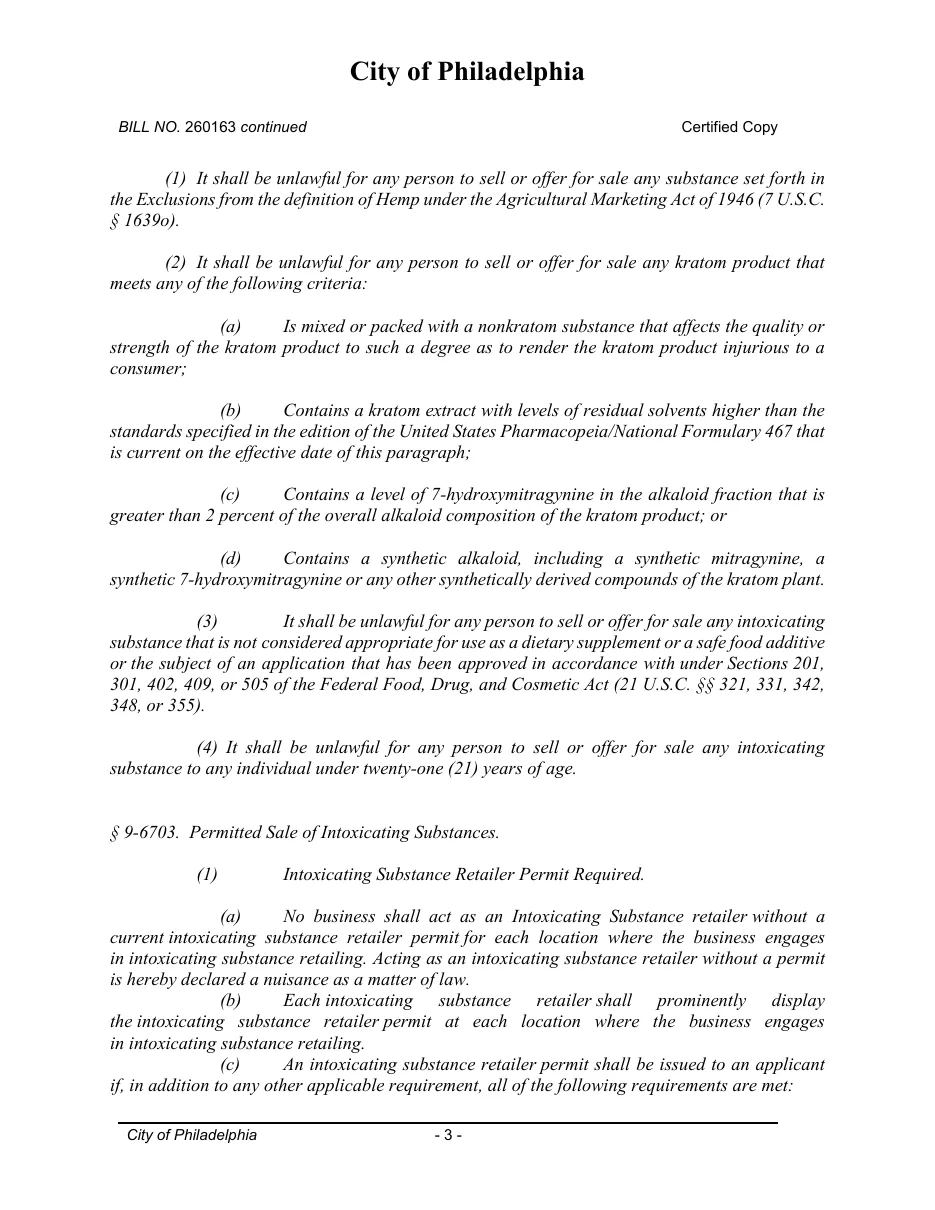
Figure 1. Philadelphia Bill No. 260163, certified copy, page 3: the four kratom criteria of section 9-6702(2), the broader clause (3) and the under-21 ban (4).[6]
MGM-15 and MGM-16 are not named. A semi-synthetic derivative made from plant mitragynine would have to be caught by the synthetic-alkaloid clause, and the bill does not say whether it is.
One clause is much wider than the rest. It bans the sale of any intoxicating substance, kratom included, that is "not considered appropriate for use as a dietary supplement or a safe food additive" or approved as a drug[6]. The bill does not say who decides what is considered appropriate.
A permit system follows, but it "shall take effect upon the issuance of regulations by the Department"[6]. The bans are in force now. A violation is a Class III offense, and "Each day a violation continues shall constitute a separate offense."[6]
Hillsborough County: the federal threshold, copied into a synthetic-drug law
Hillsborough County did not write a new chapter. It amended its 2013 Synthetic Drug Ordinance, the law aimed at spice and bath salts, so that a kratom product can be a synthetic drug (/p/310). On November 10 "The Board conducted a public hearing (thirty-eight individuals spoke) and amended" the ordinance, and the vote was 7-0[7].
The test is a lab result, and it is the HHS test. A kratom product is prima facie a synthetic drug above 1 mg of 7-OH per gram for solids or 1 mg per mL for liquids, "or shown not to contain at least 100 parts mitragynine for every one part of 7-" hydroxymitragynine[8]. Where the October federal notice sets a ratio, Hillsborough wrote one down as 100 to 1.
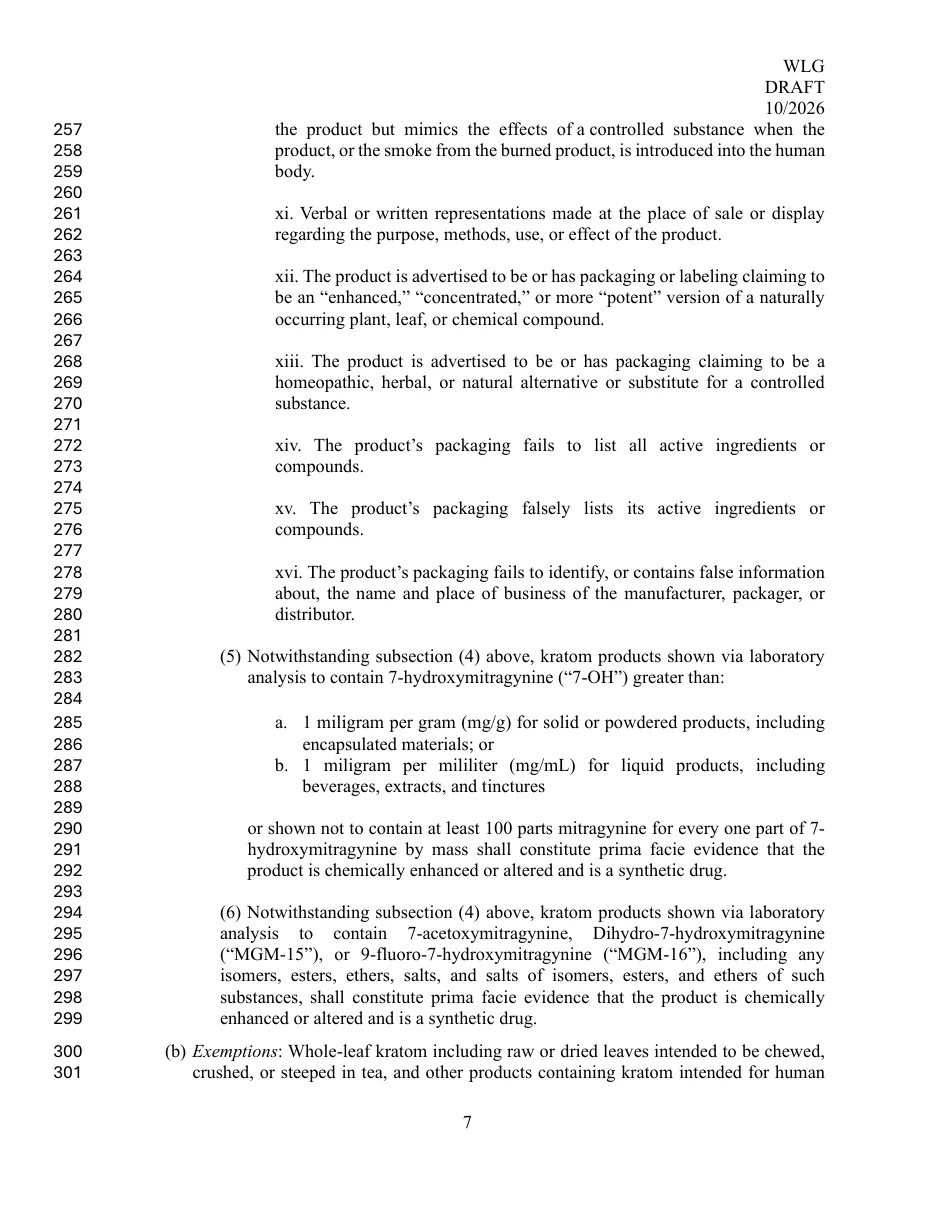
Figure 2. Ordinance page 7: the lab thresholds that make a kratom product prima facie a synthetic drug.[8]
It goes further than the federal notice on derivatives. The definition names 7-acetoxymitragynine, MGM-15 and MGM-16 by chemical name, and any of the three makes a product a synthetic drug with no threshold at all[8].
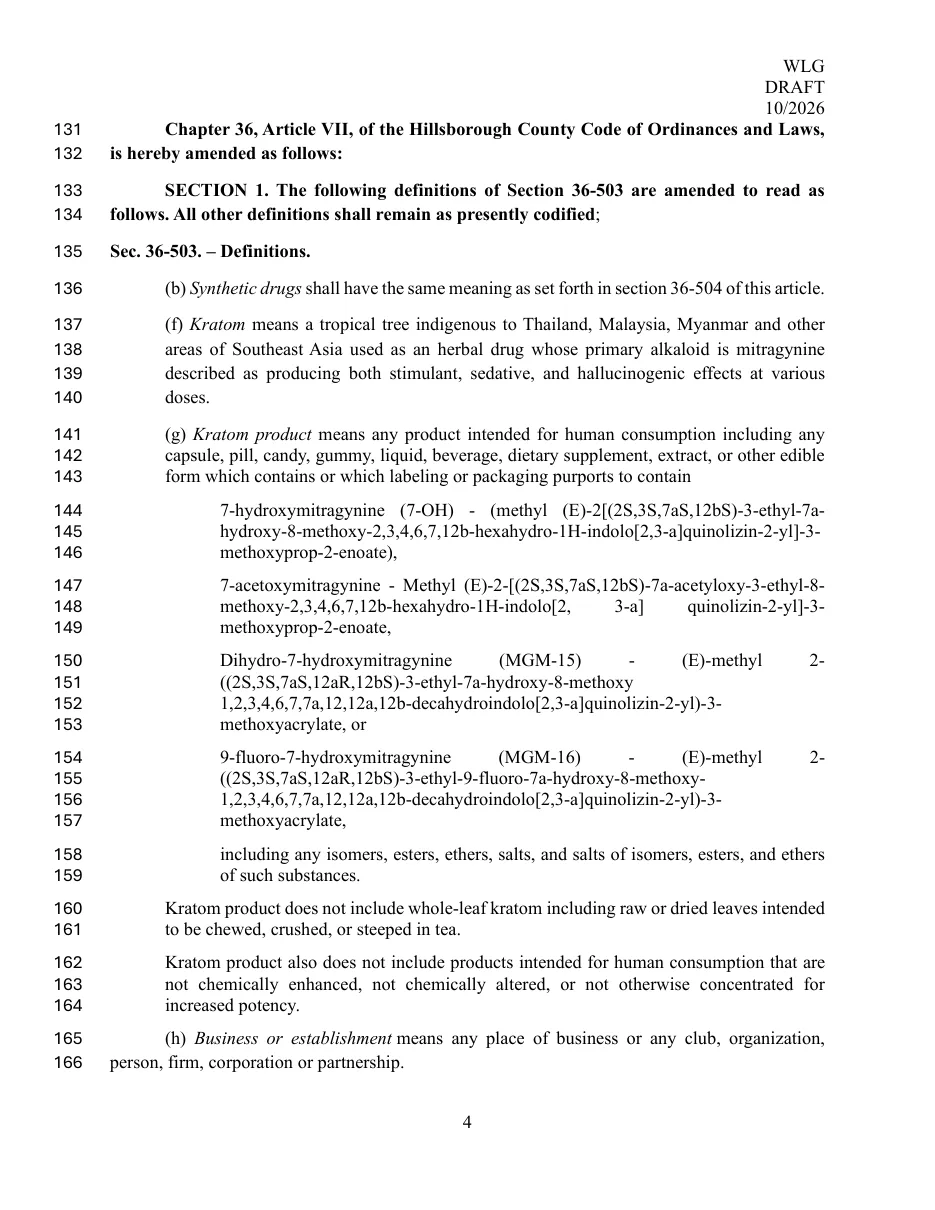
Figure 3. Hillsborough County, agenda item D-2 for November 10, 2026, ordinance page 4: the new definition of kratom product, four compounds by name, and the two exclusions.[8]
It also exempts the leaf: "Kratom product does not include whole-leaf kratom including raw or dried leaves intended" to be chewed, crushed or steeped[8]. The County Attorney's cover sheet says the aim was to stop concentrated products "while not regulating traditional botanical kratom"[8]. It also told the Board "there is no legal impediment to the BOCC adopting a more comprehensive ban on kratom by eliminating the exemptions in the proposed draft"[8]. The Board kept the exemptions.
The cover sheet gives the county's reason in one sentence: "The Medical Examiner Department reports that Mitragynine intoxication has contributed to 34 deaths in Hillsborough County."[8] It does not say over what period, or how many of those deaths involved concentrated products.
Selling or advertising a synthetic drug is a misdemeanor, up to $500 or 60 days in the county jail[8]. Every shop selling kratom in any form, leaf included, must post a sign that sales to under-21s are prohibited and that kratom may cause serious adverse health effects[8]. "This Ordinance shall become effective upon filing with the Florida Department of State."[8] The Clerk files it as Ordinance No. 26-43, and the certified copy ends with the Department of State's letter acknowledging that it was filed on November 10, 2026, the day of the vote[9]. It has been in force since that day[8][9]. Apart from the number and the signatures, the signed text is the draft the Board had in front of it[9][8].
Irvine: the 2 percent rule, and a question about MGM-15
Irvine's Ordinance No. 26-18 adds a kratom division to the city's business code (/p/312). Its 7-OH limit is Philadelphia's, measured a little more precisely: no product "with a level of 7-hydroxymitragynine that is greater than two percent (2%) of the total kratom alkaloids in the product"[10], where the total is the sum of five named alkaloids.
Its definition of a kratom product starts with the leaf itself, "means a product consisting of any part of a leaf of the plant Mitragyna speciosa in fresh, dehydrated, or dried form"[10], so the under-21 rule covers plain leaf as well as extracts. Synthesized alkaloids are banned, and synthesized is defined against cooking: chemical or biosynthetic production "rather than traditional food preparation techniques such as heating or extracting"[10].
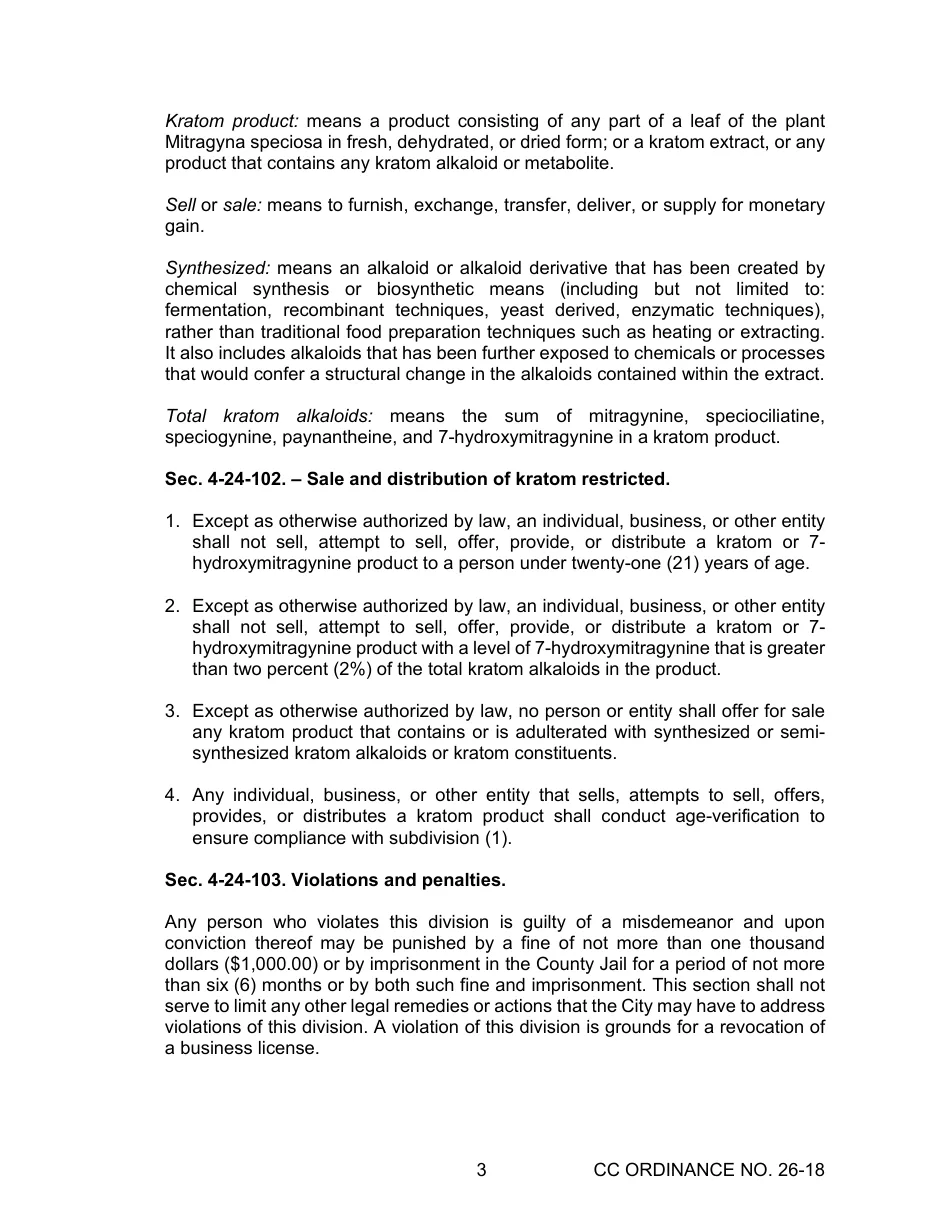
Figure 4. Irvine Ordinance No. 26-18, page 3: the definitions, the four restrictions of section 4-24-102 and the penalties of section 4-24-103.[10]
The council adopted it on October 27. Councilmember Liu pulled it from the consent calendar to ask whether it covered synthetics, and the minutes record discussion of derivative substances "including synthetics such as MGM-15" before a unanimous vote[11]. They do not record the answer. MGM-15 is not named in the ordinance. A violation is a misdemeanor, up to $1,000 or six months, and grounds to revoke a business license[10]. The ordinance "shall take effect thirty (30) days from the date of its" adoption[10]. By that count it applies from November 26.
Where the three lines fall
Philadelphia and Irvine use a share of total alkaloids, 2 percent, the figure the DEA gave in July for 7-OH in the natural plant. Hillsborough uses an absolute concentration plus a ratio, the figures HHS recommended in October. A product at 1.5 percent 7-OH passes in Philadelphia and Irvine, and fails in Hillsborough unless it carries at least 100 times as much mitragynine.
Only Hillsborough names MGM-15, MGM-16 and 7-acetoxymitragynine. MGM-15 and MGM-16 are already Schedule I federally until August 2028[2], so for those two the local text adds a county misdemeanor to federal Schedule I control. It also leaves the county law in place if the federal order lapses.
Only Irvine reaches plain leaf, and only for age. Hillsborough exempts it outright. Philadelphia's leaf rules depend on how its broad dietary-supplement clause is read, and nothing in the bill settles that.
Tupelo, Mississippi: no line at all
The three ordinances above all draw a line somewhere. Tupelo's does not. On February 3, 2026 its City Council added kratom to section 19-131 of the city code (/p/320), the list that already banned salvia, synthetic cannabinoids such as JWH-018, a piperazine and two cathinones, and on that list no one may use, possess, purchase, distribute, sell or publicly display for sale the substance within city limits[12]. The vote of the members present was unanimous, the mayor approved it the next day, and it took effect thirty days after passage[12].
The new entry covers products sold as kratom, any part of the plant in any form, and any product containing mitragynine or 7-OH[12]. It then lists alkaloids by name: ajmalicine, mitraphylline, rhynchophylline and mitragynine pseudoindoxyl, and as "similar" products, corynantheidine, 7-acetoxymitragynine, corynoxine A and B and some twenty more, ending with "any similar structural analogs"[12]. Anything on the list found in someone's possession "shall be confiscated and destroyed" by law enforcement[12].
There is no threshold, no leaf exemption and no age line, because adults are covered too. The council's findings say Mississippi's 2025 House Bill 1077 set the state's age limit at 21 and let cities add their own prohibitions, and that kratom's availability even to people over 21 harms public health[12]. Because possession is covered, the ordinance reaches the buyer as well as the shop.
The state law reads the same way. House Bill 1077, in force since July 1, 2025 (/p/321), bars selling kratom to anyone under 21, keeps it behind the counter and caps 7-OH at one percent of the alkaloids[13]. Its fourth section lets any city or county ban enacted before that date stand, and adds that "this act shall not preempt, override, or prohibit any future" local ban or restriction[13]. The state set a floor, and Tupelo built a ban on it.
The state health department has since warned buyers in general terms. Its release of September 23, 2026 puts counterfeit pills and concentrated 7-OH products under one warning: packaging, a label or the store a product came from may not tell a buyer what is in it (/p/327)[14].
Across the state line: Alabama
Alabama needs no ordinance. The Attorney General's office calls mitragynine and hydroxymitragynine "Schedule I controlled substances in Alabama", and in March 2026 it sent a statewide cease-and-desist letter (/p/323): "This letter is a demand for you to CEASE AND DESIST from possessing or selling these products."[15] Businesses must remove or destroy them on receipt or face forfeiture and felony prosecution[15]. Mississippi set a floor and left the rest to towns like Tupelo. Alabama's line is drawn statewide, and it reaches any product containing mitragynine, the leaf's main alkaloid, not only the extracts.
Before the autumn: from Newport Beach to Riverside
Other places wrote their rules before the autumn. Fifteen of them, read from their own records:
Newport Beach, California, March 12, 2024. The earliest here, and a total ban. Ordinance No. 2024-5 adds Chapter 10.75 to the city code, which makes it unlawful to sell, advertise, offer or distribute any kratom product in the city, directly or indirectly[16]. A kratom product is the leaf itself or any food, dietary supplement or beverage containing any part of the leaf, any extract, or any synthetic alkaloid or synthetically derived compound of the plant, so there is no percentage and no age line[16]. It was adopted on second reading on the consent calendar; "With Councilmember Avery voting" no, "the motion carried 6-1."[17] The vote covered the whole consent calendar, and public speakers that night had asked the council not to ban kratom[17]. The ordinance took effect thirty days after adoption[16].
Huntington Beach, California, September 16, 2025. Ordinance No. 4339 adds Chapter 9.92, whose title promises to prohibit the sale, distribution and possession of kratom; its operative section bans sales, not possession[18]. No kratom product to anyone under 21, with age verification; no product with 7-OH above 2 percent of the total alkaloids; nothing attractive to children; and nothing adulterated with synthesized or semi-synthesized alkaloids[18]. It was "Approved for Introduction September 2, 2025, by a vote of 7-0", and adopted on September 16, again 7-0; before the vote its sponsor said it was "intended to prohibit the sale, distribution and possession of synthetic kratom and protect children from the synthetic and natural products."[19] A violation is a misdemeanor, up to $1,000 or six months, and grounds to revoke a business licence; the ordinance took effect 30 days after adoption[18].
Riverside County, California, October 28, 2025. The Board of Supervisors adopted Ordinance No. 1004 unanimously, for the unincorporated county[20]. It bans selling kratom or 7-OH products to anyone under 21, and any product whose 7-OH is more than 2 percent of total kratom alkaloids, the same five-alkaloid sum Irvine later used. It also bans products that appeal to children and any kratom product containing synthesized or semi-synthesized alkaloids. A violation is a misdemeanor, up to $1,000 or six months, and the ordinance took effect 30 days after adoption[20].
Tustin, California, November 4, 2025. A week after the county, Tustin went the whole way. The council introduced Ordinance No. 1571 on October 21[21] and adopted it on November 4, 5-0, adding Chapter 10, Prohibition on the Sale and Distribution of Kratom Products, to Article 6 of the city code[22]. The minutes describe it as banning the sale, distribution and advertisement for sale of any product containing any part of the kratom leaf[22].
Stanton, California, December 9, 2025. Ordinance No. 1166 adds Chapter 9.51 in Newport Beach's words: it is unlawful "to sell, advertise for sale, offer for sale, or distribute, directly or indirectly, any kratom product in the City", and a kratom product starts with the leaf[23]. It was introduced on November 25, 4-0 with one member absent[24], and on December 9 "The City Council adopted Ordinance No. 1166." on a 5-0 roll call, after written comments that ran heavily against a complete ban[25]. It has no penalty clause, and took effect 30 days after adoption[23].
Anaheim, California, January 13, 2026 (/p/394). The council adopted Ordinance No. 6619, which adds Chapter 6.105 to the city code; the minutes record "AYES – 7" and "NOES – 0"[26]. Its 2 percent rule is the county's: a product may not have "a level of 7-hydroxymitragynine that is more than 2 percent of the total kratom alkaloids in the product", the same five-alkaloid sum[27]. It bans sales under 21, products attractive to children, and any kratom product "adulterated with synthesized or semi-synthesized kratom alkaloids or kratom constituents", and it requires child-resistant packaging[27]. A violation is a misdemeanor, up to $1,000 or six months, or an administrative citation, and the ordinance took effect thirty days after final passage[27].
Orange, California, January 27, 2026 (/p/396). Two weeks after Anaheim, its neighbour went the other way. The council voted 7-0 "to adopt Ordinance No. 01-26", after a speaker card pulled it from the consent calendar[28]. The new Chapter 9.45 makes it unlawful to sell, offer, distribute, display, give away or possess for commercial purposes "Any kratom or kratom product containing any detectable amount of kratom alkaloids."[29] A kratom product includes the leaf and any extract or alkaloid, natural, synthetic or semi-synthetic, "regardless of concentration", so there is no percentage and no age line; packaging that suggests kratom is banned too[29]. The ordinance sets no fine of its own: violations go through administrative, civil or criminal remedies as authorized by law, they are public nuisances, products can be seized and destroyed, and "Each day a violation continues constitutes a separate violation."[29] It took effect thirty days after final passage[29].
Kansas City, Missouri, February 12, 2026 (/p/391). The council passed a Committee Substitute for Ordinance No. 251028, which adds section 50-206 to the city code[30]. It uses the 2 percent rule, measured against the alkaloid composition, and bans adulterated products, a term that covers synthesized and semi-synthesized alkaloids. It goes past the other 2 percent cities on form and licensing: no candy-like or child-appealing products, nothing "combustible or intended for vaporization", and no sale "Without obtaining a valid Kratom Retail License issued by the City."[30] Sales under 21 are banned. A conviction carries up to $1,000 or six months, each day a separate offense. Section 2 reads: "That this ordinance shall take effect sixty (60) days after its passage."[30] By that count, it applied from April 13. The licence followed on April 16 (/p/393): Ordinance No. 260335 sets a $500 Kratom Retail License that expires each December 31, requires kratom to be sold in the manufacturer's original packaging with its alkaloid content, semi-synthesized alkaloids included, labelled in milligrams, and repeats the 2 percent, adulterated, candy and vape bans as licence conditions. A violation carries up to 180 days or a fine of $100 to $1,000[31].
Dana Point, California, March 17, 2026 (/p/395). Newport Beach's model, two years on. Ordinance No. 26-04 adds Chapter 5.41, and the City Clerk certifies that it was adopted on March 17 with all five council members voting for it[32]. "It is unlawful to sell, advertise for sale, offer for sale, or distribute, directly or indirectly, any kratom product in the City", and a kratom product starts with the leaf[32]. The staff report says the city copied Newport Beach and other Orange County cities, and lists Tustin, Stanton and the City of Orange as having banned retail sales already[33]. The ordinance has no penalty clause of its own; the report says enforcement may include administrative citations or misdemeanor penalties[33]. It took effect 30 days after adoption[32].
Mission Viejo, California, April 14, 2026 (/p/397). Another Newport Beach copy. The council introduced Ordinance 26-361 on March 24, 5-0[34], and "Adopted Ordinance 26-361" on April 14 on the consent calendar, also 5-0[35]. The new Chapter 11.26 bans selling, advertising, offering or distributing any kratom product, leaf included, and, like Orange, it reaches packaging: no product "the packaging for which indicates, implies, or otherwise suggests that the product contains" kratom leaf, mitragynine or 7-OH[36]. It has no penalty clause, and took effect 30 days after final passage[36].
Los Alamitos, California, April 20, 2026 (/p/409). The one city here that drafted a total ban and stepped back. At the first hearing on February 9, council members raised a "Concern regarding total ban as whole leaf products can be beneficial", and that testing would make enforcement cost-prohibitive; they sent the draft back to allow whole leaf for adults and prohibit derivatives[37]. The revised Ordinance No. 2026-02 was introduced on March 23[38], and on April 20 "The City Council adopted Ordinance No. 2026-02" on a unanimous consent calendar[39]. The new Chapter 9.28 bans sales to anyone under 21, with age verification, products attractive to children, and kratom products adulterated with synthesized or semi-synthesized alkaloids. Its 2 percent clause, on the same five-alkaloid sum, covers any product, not only kratom products. Violations fall under the city's general penalties, which the staff report says means misdemeanor or infraction citations, civil action or administrative citations, and the ordinance took effect on the 31st day after adoption[40].
Riverside, California, April 21, 2026 (/p/392). The city inside that county went further than the county. Ordinance No. 7765 "was presented and adopted" on the consent calendar[41]. Its new section 9.04.235 bans the sale or distribution of any kratom product or 7-OH product to any person, with no age line and no percentage, and its definition of a kratom product starts with the leaf[42]. Its recitals give the reason: the police department did not believe a 2 percent limit could be enforced, because vendors misstate concentrations and lab tests are slow and expensive[42]. A violation is a misdemeanor, up to $1,000 or six months, each day a separate offense, and grounds to revoke a tobacco retail permit. The ordinance took effect on the 30th day after adoption, May 21[42].
Fullerton, California, May 5, 2026 (/p/410). Back to Riverside County's model. Ordinance No. 3357 adds Chapter 7.22[43]. It was introduced on April 21, 5-0[44], and adopted on May 5 as a consent item, 5-0[45]. It bans sales to anyone under 21, with age verification, any kratom or 7-OH product over 2 percent 7-OH on the five-alkaloid sum, and products attractive to children, and it requires child-resistant packaging. A violation of the sales rules is a misdemeanor, up to $1,000 or six months, and the ordinance took effect 30 days after adoption[43].
Idaho Falls, Idaho, June 4, 2026 (/p/411). The plainest of them. Section 5-4-13 makes it unlawful to sell or offer to sell any kratom or kratom product to anyone in the city, and defines kratom as any part of the plant, any extract or derivative, five alkaloids by name, and their synthetic and semi-synthetic forms[46]. The council adopted it 5-0 under a suspension of the three-readings rule, effective July 1, 2026; council members called a sales ban one of the few local tools they could enforce, and the minutes record that "The ordinance targets sales only within City boundaries, not personal possession."[47] The text presented for adoption has no penalty clause[46].
Canyon Lake, California, August 5, 2026 (/p/417). A city inside Riverside County, writing the county's rule into its own code: Ordinance No. 279 adds Chapter 11.92 by "adopting local regulations consistent with the regional-approach provided for under Riverside County Ordinance No. 1004"[48]. The council introduced it on June 10, alongside ordinances on nitrous oxide and drug paraphernalia, 5-0[49], and adopted it on August 5 on the consent calendar, 5-0[50]. It bans sales to anyone under 21, with age verification, any kratom or 7-OH product over 2 percent 7-OH on the five-alkaloid sum, products attractive to children, and products containing synthesized or semi-synthesized kratom alkaloids, constituents or derivatives. A violation can be charged as a misdemeanor, up to $1,000 or six months, or as an infraction; each day is a separate offense, products can be seized, a violator can lose city licences and permits, and the ordinance took effect 30 days after adoption[48]. Not everyone wanted the line there: a speaker that night "requested consideration of a complete kratom ban in place of the proposed ordinance."[50]
So the 2 percent rule was in local law a year before Philadelphia, and Riverside shows the argument against it: a percentage limit only works if someone can afford to test for it.
References
- Schedules of Controlled Substance: Temporary Placement of 7-Hydroxymitragynine Above a Specified Threshold in Schedule I (notice of intent, 91 FR 40917, Docket DEA-1570) — Drug Enforcement Administration, Federal Register, 2026-07-06
- Schedules of Controlled Substances: Temporary Placement of Mitragynine Pseudoindoxyl, MGM-15, and MGM-16 in Schedule I (temporary scheduling order, 91 FR 54948) — Drug Enforcement Administration, Federal Register, 2026-08-26
- Schedules of Controlled Substances: Temporary Placement of 7-Hydroxymitragynine and Mitragynine Pseudoindoxyl Above a Specified Threshold in Schedule I (notice of intent, 91 FR 65370, Docket DEA-1570) — Drug Enforcement Administration, Federal Register, 2026-10-14
- HHS Recommends Science-Based Thresholds to Target Dangerous Enhanced Kratom Products — US Department of Health and Human Services, 2026-10-09 (Wayback Machine copy)
- Federal Register search: documents containing the term 7-hydroxymitragynine — Office of the Federal Register
- Bill No. 260163 (certified copy), amending Title 9 of The Philadelphia Code to add Chapter 9-6700, Intoxicating Substances — Council of the City of Philadelphia
- Recap of the November 10, 2026 BOCC regular meeting — Hillsborough County Board of County Commissioners
- Agenda item D-2, November 10, 2026: amendment of Synthetic Drug Ordinance 13-3 (Chapter 36, Article VII), cover sheet and ordinance — Hillsborough County Board of County Commissioners
- Hillsborough County Ordinance No. 26-43 (agenda item D-2, November 10, 2026), certified copy with the Florida Department of State acknowledgment of filing, in the Clerk's Board Records Documents — Clerk of the Circuit Court and Comptroller, Hillsborough County (Board Records)
- Item 2.8, October 27, 2026: second reading and adoption of Ordinance No. 26-18 (Irvine Municipal Code Title 4, Division 24), staff report and ordinance — City of Irvine, City Council
- City Council adjourned regular meeting minutes, October 27, 2026 (approved November 10, 2026) — City of Irvine, City Clerk
- Tupelo City Council minutes, February 3, 2026, with Appendix B: Ordinance to amend Section 19-131 of the Code of Ordinances to ban kratom and kratom products — City of Tupelo, Mississippi (City Council)
- Mississippi House Bill No. 1077, 2025 Regular Session (As Sent to Governor): Kratom products; prohibit sale to persons under 21 (Laws 2025, Chapter 488) — Mississippi Legislature
- Beware of Counterfeit and Unregulated Drugs — Mississippi State Department of Health, 2026-09-23
- Alabama Office of the Attorney General: cease and desist letter on products containing mitragynine and/or hydroxymitragynine, March 24, 2026 — Alabama Office of the Attorney General
- Newport Beach, California: Ordinance No. 2024-5, adding Chapter 10.75 (Prohibition of the Sale and Distribution of Kratom) to the Municipal Code, as presented for adoption on March 12, 2024 (Attachment A to file 24-0295) — City of Newport Beach, California, City Council
- Newport Beach, California: City Council meeting minutes, March 12, 2024 (approved March 26, 2024) — City of Newport Beach, California, City Clerk
- Huntington Beach, California: Ordinance No. 4339, adding Chapter 9.92 (Sale, Distribution, and Possession of Kratom Prohibited) to the Municipal Code, as attached to Legistar file 25-725 for adoption on September 16, 2025 — City of Huntington Beach, California, City Council
- Huntington Beach, California: City Council/Public Financing Authority regular meeting minutes, September 16, 2025 (approved October 7, 2025) — City of Huntington Beach, California, City Clerk
- Riverside County: Board of Supervisors item 3.2, October 28, 2025, adoption of Ordinance No. 1004 regulating the sale and distribution of kratom products, with the Board's minute entry and the signed ordinance — Riverside County Clerk of the Board of Supervisors
- Tustin, California: City Council minutes, October 21, 2025 (introduction of Ordinance No. 1571) — City of Tustin, California, City Clerk (Granicus)
- Tustin, California: City Council minutes, November 4, 2025 (second reading and adoption of Ordinance No. 1571) — City of Tustin, California, City Clerk (Granicus)
- Stanton, California: Ordinance No. 1166, adding Chapter 9.51 (Prohibition of the Sale and Distribution of Kratom and Kratom Products) to the Municipal Code, in the City Council agenda packet of December 9, 2025 — City of Stanton, California, City Council
- Stanton, California: City Council minutes, November 25, 2025 (introduction of Ordinance No. 1166) — City of Stanton, California, City Clerk
- Stanton, California: City Council minutes, December 9, 2025 (approval of Ordinance No. 1166) — City of Stanton, California, City Clerk
- Anaheim, California: City Council regular meeting minutes, January 13, 2026 — City of Anaheim, California, City Clerk
- Anaheim, California: ordinance adding Chapter 6.105 (Kratom) to Title 6 of the Municipal Code, as presented for adoption on January 13, 2026 (adopted as Ordinance No. 6619) — City of Anaheim, California, City Council
- Orange, California: City Council minutes, January 27, 2026 (final) — City of Orange, California, City Clerk (Legistar)
- Orange, California: Ordinance No. 01-26, adding Chapter 9.45 (Kratom Products) to the Orange Municipal Code, as attached for adoption on January 27, 2026 — City of Orange, California, City Council (Legistar)
- Kansas City, Missouri: Committee Substitute for Ordinance No. 251028, enacting Code sections 50-206 (kratom products) and 50-207, authenticated as passed February 12, 2026 — City of Kansas City, Missouri, City Council (City Clerk)
- Kansas City, Missouri: Ordinance No. 260335, enacting Chapter 20, Article II (Kratom Retail License), authenticated as passed April 16, 2026 — City of Kansas City, Missouri, City Council (City Clerk)
- Dana Point, California: Ordinance No. 26-04, adding Chapter 5.41 (Prohibition of the Sale and Distribution of Kratom) to Title 5 of the Municipal Code, adopted March 17, 2026 (clerk-certified copy) — City of Dana Point, California, City Council (City Clerk; eCode360)
- Dana Point, California: agenda report, March 17, 2026, item 11 (second reading and adoption of the kratom ban) — City of Dana Point, California (City Manager and Chief of Police)
- Mission Viejo, California: City Council minutes, March 24, 2026 — City of Mission Viejo, California, City Clerk (OnBase Agenda Online)
- Mission Viejo, California: City Council minutes, April 14, 2026 — City of Mission Viejo, California, City Clerk (OnBase Agenda Online)
- Mission Viejo, California: Ordinance 26-361, adding Chapter 11.26 (Prohibition of the Sale and Distribution of Kratom Products) to the City Code, as presented for adoption on April 14, 2026 — City of Mission Viejo, California, City Council (OnBase Agenda Online)
- Los Alamitos, California: City Council adjourned regular minutes, February 9, 2026 — City of Los Alamitos, California, City Clerk (CivicClerk)
- Los Alamitos, California: City Council special minutes, March 23, 2026 — City of Los Alamitos, California, City Clerk (CivicClerk)
- Los Alamitos, California: City Council regular minutes, April 20, 2026 — City of Los Alamitos, California, City Clerk (CivicClerk)
- Los Alamitos, California: City Council agenda packet, April 20, 2026, item 11C (staff report and Ordinance No. 2026-02, adding Chapter 9.28, Sale and Distribution of Kratom Products) — City of Los Alamitos, California, City Council (CivicClerk)
- Riverside, California: City Council minutes, April 21, 2026 — City of Riverside, California, City Clerk
- Riverside, California: ordinance adding Riverside Municipal Code section 9.04.235, prohibiting the sale and distribution of kratom products (the text adopted as Ordinance No. 7765) — City of Riverside, California, City Council
- Fullerton, California: Ordinance No. 3357, adding Chapter 7.22 (Restrictions on the Sale and Distribution of Kratom Products) to the Municipal Code, second-reading copy (.docx), adopted May 5, 2026 — City of Fullerton, California, City Council (Legistar)
- Fullerton, California: City Council minutes, April 21, 2026 (.docx) — City of Fullerton, California, City Clerk (Legistar)
- Fullerton, California: City Council minutes, May 5, 2026 (.docx) — City of Fullerton, California, City Clerk (Legistar)
- Idaho Falls, Idaho: City Council agenda packet, June 4, 2026, item E.1 (26-061, ordinance adding City Code 5-4-13, sale of kratom prohibited within city limits) — City of Idaho Falls, Idaho, City Council
- Idaho Falls, Idaho: City Council meeting minutes, June 4, 2026 — City of Idaho Falls, Idaho, City Clerk
- Canyon Lake, California: Ordinance No. 279, adding Chapter 11.92 (Regulation of Kratom Products) to the Municipal Code, as presented for adoption on August 5, 2026 — City of Canyon Lake, California, City Council
- Canyon Lake, California: City Council regular meeting minutes, June 10, 2026 (approved August 5, 2026) — City of Canyon Lake, California, City Clerk
- Canyon Lake, California: City Council agenda packet, September 9, 2026, item 2, the minutes of August 5, 2026 as presented for approval — City of Canyon Lake, California, City Clerk
Comments
Sign in to join the conversation.
No comments yet.