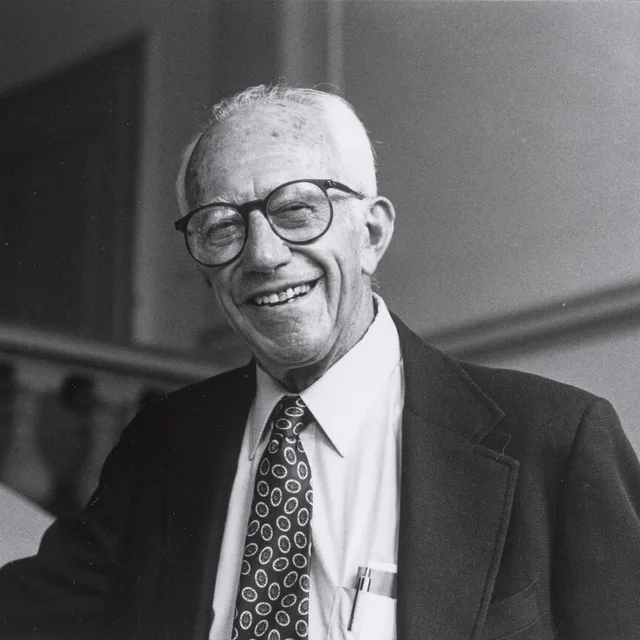
Leo Sternbach
Leo Sternbach (1908-2005) was a Polish-American chemist who earned his doctorate in organic chemistry at the Jagiellonian University in Krakow in 1931, joined Hoffmann-La Roche in Basel in 1940, and moved to its Nutley, New Jersey site in 1941. With Moses Wolf Goldberg he developed the first commercially applicable synthesis of the vitamin biotin, and he discovered the ganglionic blocker trimethaphan (Arfonad). Returning in 1955 to the quinazoline N-oxides of his student days, he synthesized chlordiazepoxide (Librium, marketed 1960) and then diazepam (Valium, 1963), founding the benzodiazepine class; his Roche group went on to produce nitrazepam, flunitrazepam, clonazepam, flurazepam and bromazepam. Later benzodiazepines from other firms - oxazepam, temazepam and lorazepam (Wyeth), alprazolam and triazolam (Upjohn) - and Roche's own midazolam (Walser and Fryer, 1975) were not his work.
Compounds
8 credited across 2 classes · 7 with a page here
- Benzodiazepines
- Chlordiazepoxide C16H14ClN3O first synthesis, 1956 source
The first benzodiazepine (Ro 5-0690), made from his 1930s quinazoline N-oxide work and shelved; colleague Earl Reeder resubmitted it and Lowell Randall's 1957 screening found the activity. Patented 1958, marketed as Librium 1960.
- Diazepam C16H13ClN2O first synthesis, 1959 source
Synthesized by Sternbach's Roche group as a simplified, more potent follow-up to chlordiazepoxide; patented 1959, marketed as Valium 1963; the most prescribed US drug 1969-1982.
- Clonazepam C15H10ClN3O3 first synthesis, 1960 source
Roche nitrobenzodiazepine from Sternbach's programme; obituaries credit him with Klonopin. Patented 1960 per Wikipedia, US approval 1975. Year given is the patent year.
- Bromazepam C14H10BrN3O first synthesis, 1961 source
Sternbach is a named inventor (with Fryer and Schmidt) on Roche's US Patent 3,100,770, filed August 1961, whose Example 6 is bromazepam. Approved for medical use 1974 (Lexotan).
- Nitrazepam C15H11N3O3 first synthesis, 1961 source
From Sternbach's Roche team in the late 1950s; patented 1961, marketed as Mogadon 1965. Obituaries name Mogadon among his own breakthroughs; year given is the patent year.
- Flunitrazepam C16H12FN3O3 first synthesis, 1962 source
Discovered at Roche within the benzodiazepine programme Sternbach led; patent application filed 1960, granted 1962, first marketed (Rohypnol) 1972-74. Year given is the patent year.
- Flurazepam C21H23ClFN3O first synthesis, 1968 source
Roche hypnotic benzodiazepine; obituaries name Dalmane among his own drugs. Patented and introduced 1968; synthesized by his group earlier in the 1960s.
- Ganglionic Blockers
- Trimethaphan first synthesis source
Pre-benzodiazepine Roche work: a ganglionic blocker (Arfonad) used for hypertensive crisis and to limit bleeding in neurosurgery. Wikipedia and obituaries credit Sternbach with its discovery, but no source gave an exact synthesis year (late 1940s-early 1950s; in clinical use by the mid-1950s). No inventory family fits an antihypertensive.
Books
- The Benzodiazepine Story 1980 · by them
Booklet published by Editiones Roche, Basel, expanding his 1979 J Med Chem review of the same title; the URL is the journal version.
- Good Chemistry: The Life and Legacy of Valium Inventor Leo Sternbach 2004 · about them
By Alex Baenninger and co-authors, McGraw-Hill; some listings give 2003.
Reading
- Valium Inventor Dies At 97 (AP obituary), CBS News · obituary
- National Inventors Hall of Fame: Leo H. Sternbach · article
- Sternbach LH, 'The benzodiazepine story', J Med Chem 1979;22(1):1-7 · paper
- Librium and Valium: anxious times, RSC Education in Chemistry · article
- US Patent 3,100,770 (5-pyridyl-1,4-benzodiazepines, incl. bromazepam; Fryer, Schmidt, Sternbach) · archive